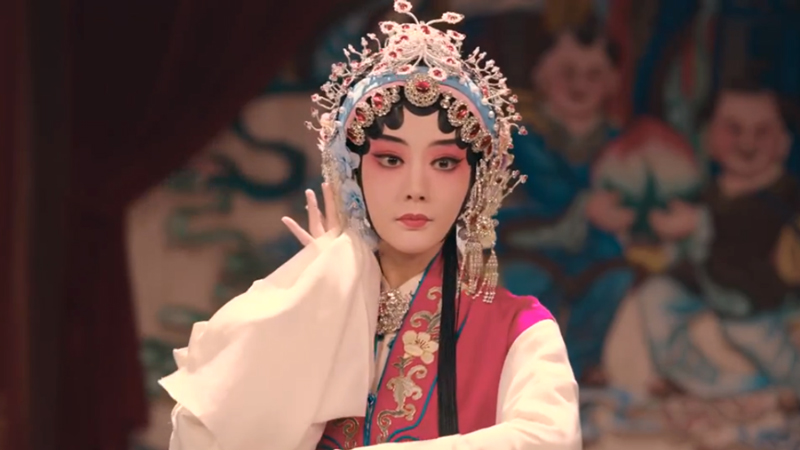
Li Yitong (李一桐) appears in A Prophet (我不是大师) with a red embroidered stage costume, silver headpieces, and precise, brisk eye makeup. Above her brows sit several curved black strips, laid in a tidy arc. For regular opera-goers, the look is familiar: it is the forehead styling of a Dan (旦), the female role type in Xiqu (戏曲). Professionals call the pieces Tie Pian Zi (贴片子); many viewers now nickname them Tong Qian Tou (铜钱头). They are made from real hair or specially prepared false hair, dampened with Pao Hua Shui (刨花水), then pressed one by one along the hairline and temples. Seven small curves are common, though five or three also appear. Two longer strips often fall beside the cheeks.
Old Roots
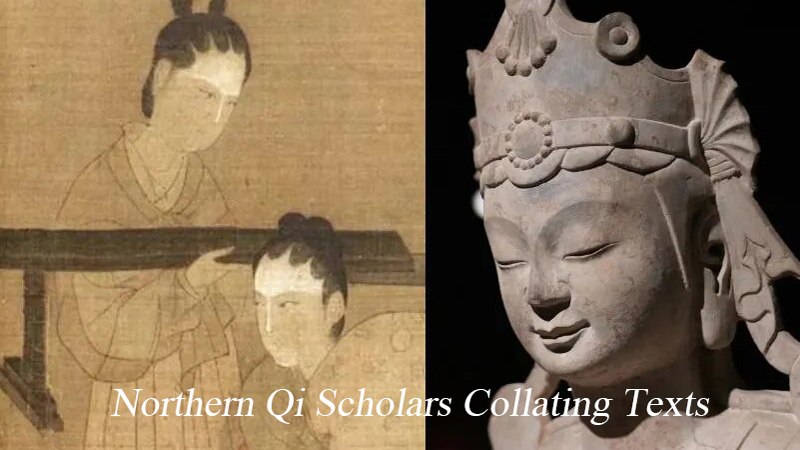
The shape did not begin on an opera stage. Its ancestor reaches back to the Northern Dynasties, when women in the north trimmed forehead hair into small cloud forms. The style made the forehead look fuller and rounder. A painted scene in Northern Qi Scholars Collating Texts (北齐校书图) shows this hairline treatment. I suspect Buddhist sculpture helped it spread: many statues from that period carry a similar curved line above the brow. The hair did not simply decorate a face; it echoed a visual language people already trusted.
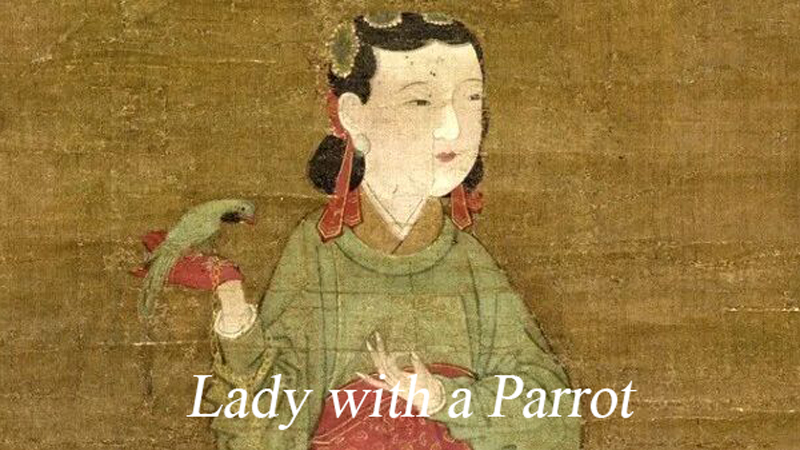
Tang dynasty court paintings keep a related look, but the Song dynasty gave it a formal name. In Feng Chuang Xiao Du (枫窗小牍), writers described Yun Jian Qiao E (云尖巧额), a clever cloud-pointed forehead. Palace women and ordinary wives both adopted it. You can spot it in Listening to the Ruan (听阮图) and in the White Yarn Song tomb mural. By the Ming dynasty, examples still appear in Lady with a Parrot (鹦鹉仕女图). During the Qing dynasty, the fashion almost disappeared from daily life.
The stage version has a clearer inventor. During the Qianlong (乾隆) reign, Qinqiang (秦腔) performer Wei Changsheng (魏长生) developed the forehead strips. When Peking Opera took shape, it absorbed staging and makeup ideas from Kunqu (昆曲), Hui Diao (徽调), and Han Diao (汉调). The strips spread through the Qing court and theaters. At first, the number and curve of the small forehead pieces were not strictly fixed. In the Republican era, Peking Opera reached a peak, and artists such as Mei Lanfang (梅兰芳) helped settle a standard: seven small curves with two large willow strips. Role types still adjust the pattern.
The stage did not copy daily fashion in a literal way. It selected a silhouette people already knew, then sharpened it for performance. The cloud-pointed forehead and the later strips share a rounded, symmetrical outline. One came from mirrors and murals; the other belongs to oil paint and footlights. That transfer says something about opera: it often takes a popular ornament, tests it in front of an audience, and keeps what reads clearly from the back row. What survived was not a random decoration but a shape that could survive distance.
Backstage Reasons
Why has this practice lasted across opera genres? First, it fixes the face for a large room. Old teahouse theaters had no close-up screens. Every viewer watched with bare eyes. Faces differ: some are wide, some long, some narrow. The strips pull those differences toward a shared rounded outline. Attention then moves to the story and the voice, not to a performer’s uneven hairline. The audience reads character faster, and the actor becomes less self-conscious. On stage, small adjustments often decide whether a scene feels intimate or distant. These black curves work like a frame around the eyes and mouth.
Second, the strips protect makeup and mark role types. False hair and real hair are pressed tightly against the scalp, covering stray wisps at the temples and hairline. When a performer sweats under hot lights, loose hair would stick to oil paint and smear a carefully built face. The strips keep that risk down. Regular opera fans also learn to read them. A slight change in angle, length, or number can hint at a Gui Men Dan (闺门旦), a flirtatious Hua Dan (花旦), or a fierce Wu Dan (武旦). Costume, gesture, and voice matter, yet the forehead already tells part of the role.
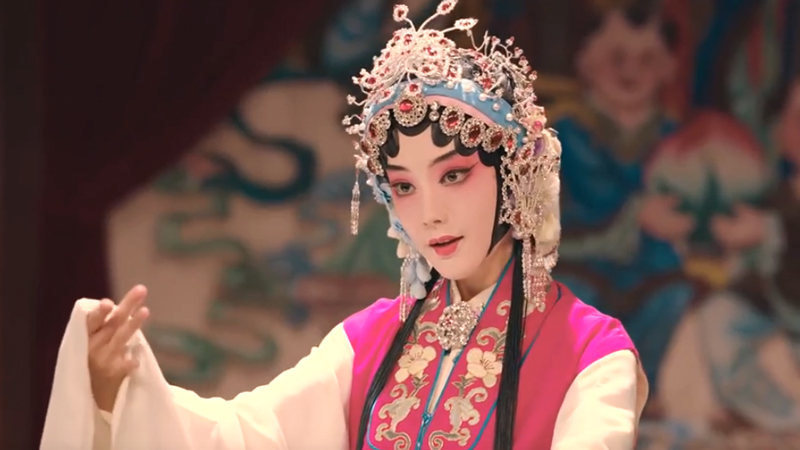
Different opera traditions may disagree on melody, dialect, and gesture, yet many share this forehead grammar. A traveling troupe can move between stages, and the audience still understands the female lead before she sings. That shared shorthand matters in a live form where a raised eyebrow can be missed. Modern film and television often loosen the wrap and soften the paint, as Li Yitong’s production does, but they rarely erase the strips completely. The pieces connect a camera close-up to a much older stage contract: the face is not left raw. It is built, layer by layer, for a public gaze.
Third, taste has memory. For more than two hundred years, audiences have accepted these strips as what a Dan should look like. Remove them, and the face may seem bare, almost wrong, even when the singing is perfect. Li Yitong’s look in A Prophet borrows from traditional Peking Opera Gui Men Dan, but the production softens it for camera. The head wrap is looser, the makeup materials are finer, and the lighting is gentler. Still, the strip shapes and silver ornaments carry a clear theatrical rhythm. Would you recognize her as Li Yitong under that opera face?