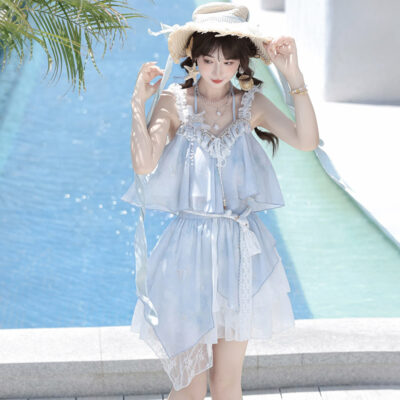
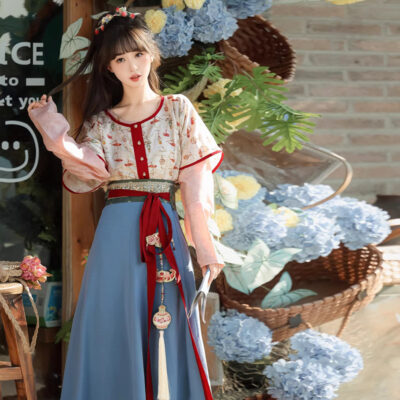
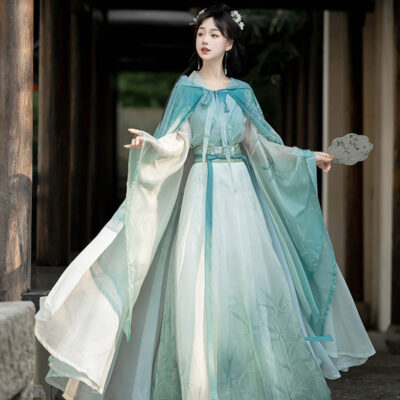
Costumed role-players were the busiest draw at many Chinese scenic spots this National Day holiday. Parks staged historical reenactments, Song-dynasty street parades, joke-trading “wild men” and theme-park variety turns, and the casting notices behind them kept trending online. Well-known sites put out public recruitment calls for the holiday peak, and the wave has become the clearest sign yet of how tourism operators expect to earn money from a visit.
A village in Shanxi offers the sharpest example. Situ Town, in Beishidian township, Jincheng, has set aside 30 million yuan to recruit 100 NPCs, or non-player characters, with a top annual salary of 10 million yuan and more than 7,000 applicants. The town is not hiring ordinary holiday staff. It wants performers and social-media personalities who bring their own followings and can improvise with visitors, and it has folded the recruits into a single storyline built to lift the immersive offer before the holiday rush.
Situ is a rural tourism destination known for its iron-flower show, in which molten metal at over 1,600 degrees Celsius is struck against the night sky in a performance called “A Thousand Years of Iron Souls.” The site holds a national AAAA rating. On ordinary days about 50 staff NPCs in costume walk its lanes, running brain-teasers, idiom-chain word games and charades with visitors, while a stage host pulls guests up to dance or play along.
Where the Recruits Come From
Historical and folk sites have run similar campaigns. Xiang Yu’s Hometown in Suqian, Jiangsu, posted a casting call for a Xiang Yu role in April, and the pay rule drew comment: the daily rate equals the applicant’s height in centimetres multiplied by ten, and candidates must stand at least 185 cm tall, carry a sturdy build and handle lines for stage interaction.
Zhangjiajie’s Wulingyuan district posted roles drawn from Journey to the West and the Yang family generals, offering board, lodging and full costume and makeup, with strong performers able to convert to permanent staff. In Chongqing, the Dazu Rock Carvings site recruited Huafu Week NPCs tied to local culture, built around the area’s carved symbols, traditional rites and folk blessings.
Parks selling pure fun form a second group. Erlongshan in Guangzhou and Zhenhai’s Shanhai Jiulongyuan in Ningbo both advertised “wild man” posts before the holiday, with low barriers and performers encouraged to interact freely; online commenters called it “legal madness,” and the advertised rate was 200 yuan a day. Jiulongyuan took just 18 posts and drew more than 600 applicants, some travelling in from Sichuan and Yunnan. In Hubei, the Diebu Qingjiang Dixin Valley site hired in two rounds, for summer and the holiday, filling roles that include a blessing high priest, a mountain-song “upright man,” a valley matchmaker and an old-bridge pedlar, all drawn from Ba culture and all including meals and lodging. Happy Valley parks in Shanghai and elsewhere issued audition calls for “drama-queen” NPCs to drive the mood during their Halloween-style play festivals.
Shifting Tourist Spending
Behind the casting calls is a change in how sites earn. Traditional destinations built on old streets and natural scenery have struggled with sameness: visitors arrive for a photo stop, finish in half a day to a day, spend little beyond the ticket and rarely come back. Even sites with fixed large-scale shows have found that stage performance alone does not lift revenue, because it asks the visitor to watch rather than to take part.
Lu Li, an associate professor at Sichuan University’s tourism school, and other analysts read the NPC wave as a response to demand for hands-on interaction, emotional release and a sense of stepping into a scene. Low-cost, high-interaction NPC programmes cover the weak spots of traditional sites, whose offer can feel thin and short on atmosphere, and they have become a mainstream way for parks to reach new audiences.
The Numbers Behind Millennium City Park
Kaifeng’s Millennium City Park, and the nearby Wansuishan site, are the cases the industry keeps returning to. Millennium City Park built a standing NPC system drawn from the figures in the painting “Along the River During the Qingming Festival.” Bao Zheng patrols the streets, Wu Dalang sells steamed buns and street performers work the corners. Each role carries a full character biography, and the brief is improvisation rather than fixed lines. Visitors who trade poems or finish tasks earn jiaozi, the paper money of the Song period, and spend it on snacks and souvenirs, so they stop watching a Song street and start taking part in one. The park stages several hundred street interactions a day and keeps recruiting Song-culture NPCs.
The commercial effect shows in the visitor numbers. When the park’s parent, Kaifeng Millennium City Park Co., filed for a Hong Kong listing on June 15, its prospectus reported about 9.6 million visitors in 2025, fourth among single-theme parks nationally and first among Henan’s 5A-grade sites, with revenue of 746 million yuan and net profit of 212 million yuan. Park managers credit longer stays and a rising share of food and souvenir income, while clips of visitors with NPCs spread on their own across short-video platforms, handing the park low-cost reach.
Holiday Rollout in Henan and Sichuan
Shangqiu in Henan put the model to work across its sites from October 1 to 7. At the Mangdang Mountain Han Liang King tomb complex, a “Meet Mangdang: Han Splendour Over River and Mountain” festival ran with more than 50 NPCs, parades themed on the Four Symbols and the Classic of Mountains and Seas, a Guochao band, local opera and a live-action drama about the Hongmen Banquet. Discounts carried the pitch further: visitors from Shandong paid half price for a combined ticket, self-driving visitors got 12 percent off, anyone in Hanfu entered free, and reciting a Han-era fu poem could win an annual pass. At the Huoshentai site nearby, visitors joined NPC check-in games and a fire-god rite, with pitch-pot, rubbing and fire-drilling challenges. The old city ran a seven-day “Confucian Gathering” with six check-in points, 18 opera shows and several contests.
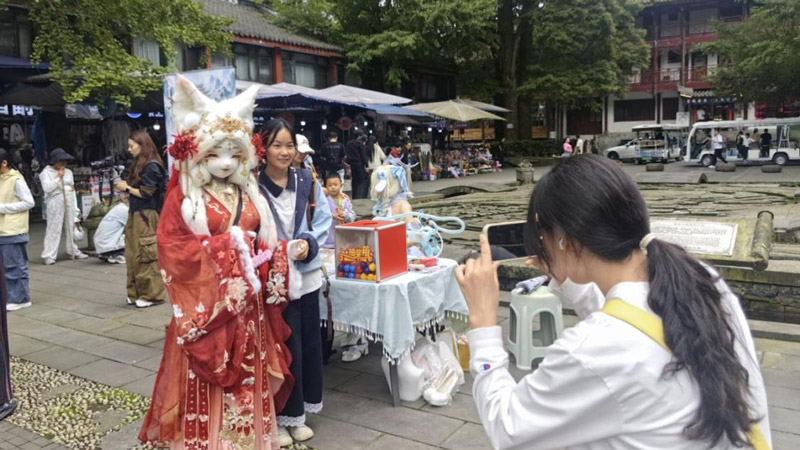
Sichuan took a different route on October 1, when the 2026 Qingchengshan Guochao culture event opened at Tai’an Old Town below Qingcheng Mountain’s rear slopes under the title “Qingcheng Sect: Xianxia Ling.” Built on the mountain’s xianxia storytelling and staged with costume beast-suits and game-style challenges, it recasts a sightseeing stop as a loop of quests, stamps, prize draws and money spent on site. By 10:30 a.m. the lanes were full, with beast-suited guests and Hanfu cosplayers forming the NPC line and inviting visitors to join a “sect recruitment.” A nine-tailed fox costume drew the first crowd. The event runs on a four-stage mechanism: a Xianxia Ling pass, five trial games, stamp collection and a “spiritual root” test. Visitors collect a pass at the gate, take on literary and martial trials that include the Qingcheng flying-flower game, music theory, horse-stance drills and pitch-pot questioning, earn a stamp for each cleared stage, then enter the prize draw once the set is complete. Lingran, founder of the organising Lingran Studio, explained that the event uses the mountain’s xianxia culture as its narrative spine and folds in Qingcheng martial arts and classical poetry.
When Replication Backfires
Sector observers also flag the failure mode. The NPC identities that work are rooted in local culture: Millennium City Park and Wansuishan lean on Song street life and wuxia, and Xi’an’s NPCs stand on the Tang imperial mood. Smaller sites that copy the format wholesale, importing generic scripts and interactions without regard for their own heritage, end up with the same costumes and the same games everywhere, which breeds fatigue, leaves no memory worth returning for and fades into a short-lived gimmick.
Advice from the sector is consistent. Drop the copy-first instinct, dig into the local tradition, build a system for refreshing the content, train a professional NPC team and close the loop around the immersive operation, so that a burst of online attention turns into something a site can keep.