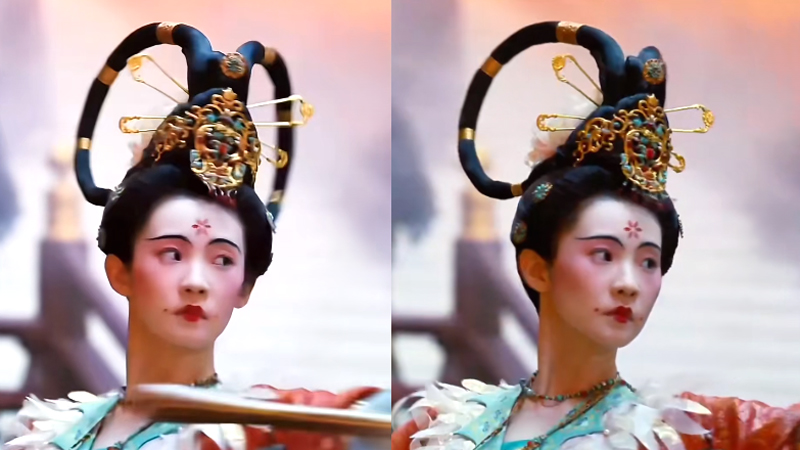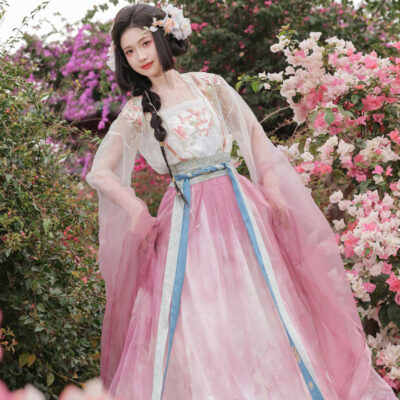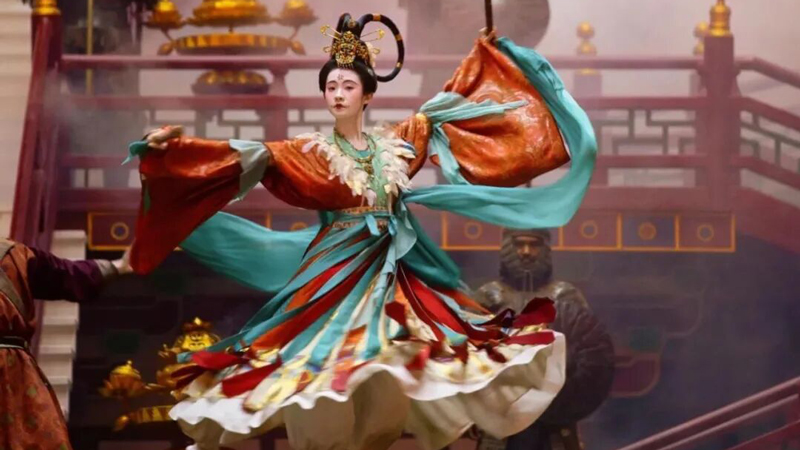
When Zhang Yifan (张艺凡) appeared as Zhang Shi’erniang (张十二娘) in the film Heroes of Dunhuang (敦煌英雄), viewers noticed something unusual above her head. Two large hollow rings, perched symmetrically on either side of her crown, rose upward like portals to another era. The actress, previously known for her role in Better Days (少年的你), wore a red-and-green Tang-style outfit with feather accents on her shoulders, but it was the hairstyle that sparked the most curiosity. What is this strange creation? Did women in ancient China really walk around with two giant loops on their heads? The answer, as it turns out, is a resounding yes.
From Small Rings to Sky-High Loops
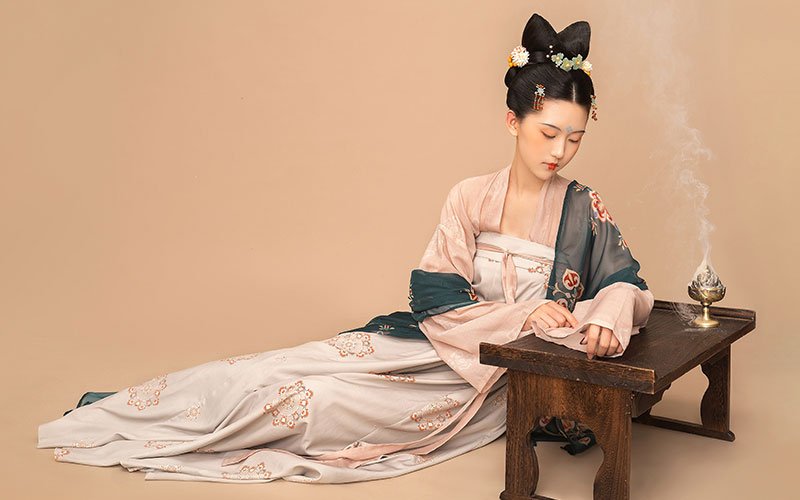
The style is called the double-ring fairy chignon. In Chinese, it is known as Shuang Huan Wang Xian Ji (双环望仙髻), a name that translates roughly to “two rings gazing at immortals.” The technique involves dividing the hair into two sections and coiling each into a large, hollow ring on opposite sides of the head. These rings stretch outward and tilt upward, creating an airy, almost architectural silhouette. Women who wore this style often decorated the rings with intricate gold ornaments or Huadian (花钿), floral marks applied to the forehead, to fill the empty space and add layers of splendor.
Its roots reach back to the Wei, Jin, and Northern-Southern Dynasties, when a simpler version called the double-ring bun first appeared. That earlier style featured smaller rings positioned lower on the head, giving a modest and delicate impression. A famous depiction survives in the Nymph of the Luo River (洛神赋), a painting attributed to Gu Kaizhi (顾恺之), where the goddess wears exactly this kind of bun. Over centuries, the small, demure rings grew bolder, and by the Tang Dynasty, they had evolved into the dramatic double-ring fairy chignon.
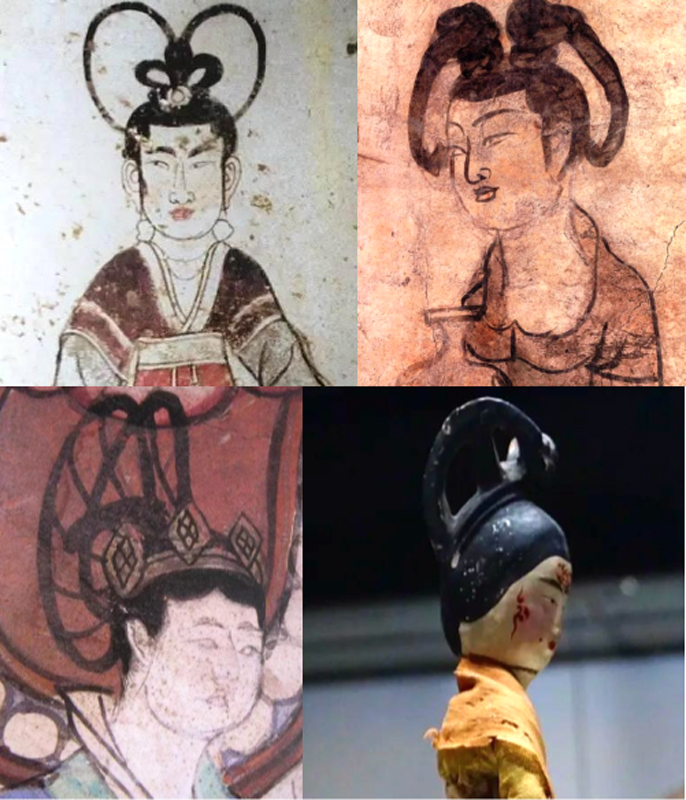
During the Tang era, this hairstyle became a fixture in Dunhuang murals. Flying apsaras, musicians, and donors in sutra illustrations all sport the double-ring fairy chignon, their painted silhouettes soaring across cave walls. Excavated Tang figurines and tomb murals show palace maids and dancers wearing the same style. Written records such as Notes on the Dressing Table (妆台记) and Categories of Coiffures (髻环品) confirm its popularity, especially during the reign of Emperor Xuanzong, when the palace brimmed with women who styled their hair in this manner.
Why Tang Women Wanted Rings in the Sky
The Tang Dynasty embraced an aesthetic of grandeur. Openness and confidence defined the era, and beauty meant abundance, scale, and presence. Clothing grew wider, sleeves longer, and hairstyles taller. The higher and larger the bun, the more it signaled status and refinement. The double-ring fairy chignon, with its expansive loops, fit this spirit perfectly. It was not merely a hairstyle; it was a statement of belonging to a world that valued boldness over restraint.
Such towering structures could not be built from natural hair alone. Tang women relied on Yiji (义髻), or artificial hairpieces, crafted from wood, paper, or fabric bases wrapped with real strands. These pre-shaped pieces could be secured onto the head like helmets, holding their form without collapsing. The craft was sophisticated enough that even Yang Guifei, the emperor’s famous consort, wore such pieces. With Yiji, a woman’s natural hair volume no longer limited her ambitions. She could wear rings that reached toward the heavens regardless of what grew from her own scalp.
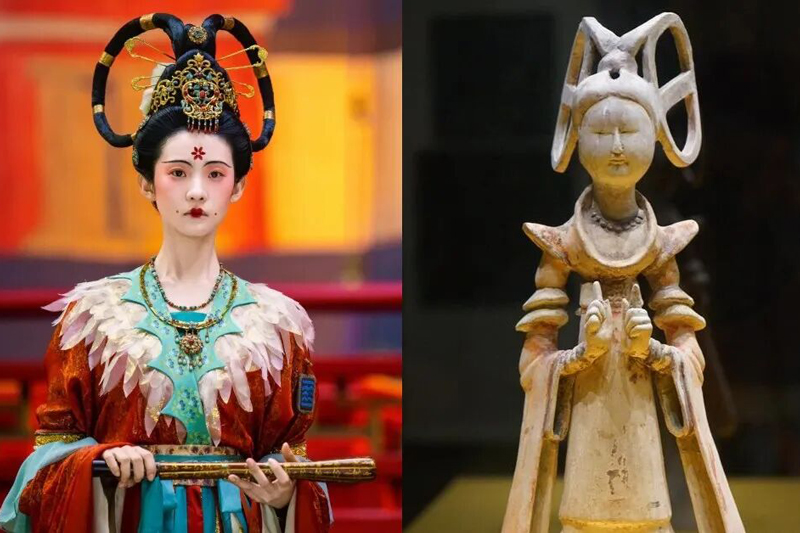
Palace dance performances also drove the style’s spread. Court dancers wore elaborate buns with flowing robes, creating a visual spectacle that nobles quickly copied. From the palace, the trend trickled down to wealthy households and eventually to commoners, much like how stage costumes today inspire everyday fashion. The double-ring fairy chignon became a shared language of celebration and display, a way for women across social ranks to participate in the same visual culture.
Other Odd Shapes and a Modern Question
The Tang Dynasty produced many unusual coiffures beyond the double-ring fairy chignon. There was the single-blade half-flip bun, which resembled a tilted knife, and the snail bun, whose coiled shape mirrored a seashell. A related style called the double-hanging ring bun placed its rings lower, dangling beside the face rather than soaring above the crown, and was mostly worn by young girls. These variations show that Tang women treated hair as a canvas for experimentation, constantly pushing shapes into new territories.
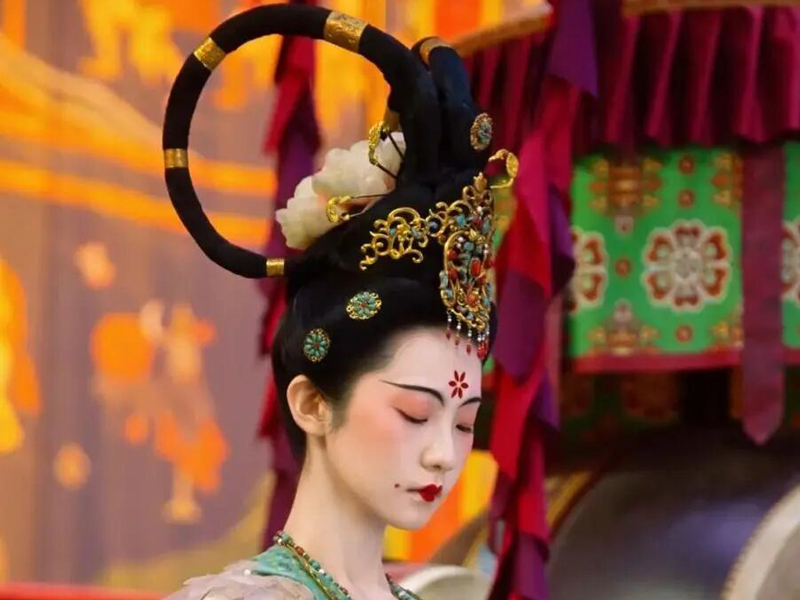
In Heroes of Dunhuang, the production team dressed Zhang Yifan in a style rooted in Tang-era Dunhuang. The double-ring fairy chignon she wears is not a fantasy invention but a faithful nod to historical aesthetics. Audiences found it strange only because previous films and dramas rarely showcased this particular look. The film’s choice to restore it brings a forgotten chapter of fashion history back into view, reminding us that what seems bizarre today was once the height of elegance. So, does Zhang Yifan’s double-ring fairy chignon look beautiful? Perhaps the better question is whether we are ready to see the past as it truly was. The rings, after all, were never meant to be subtle. They were meant to make you look up.