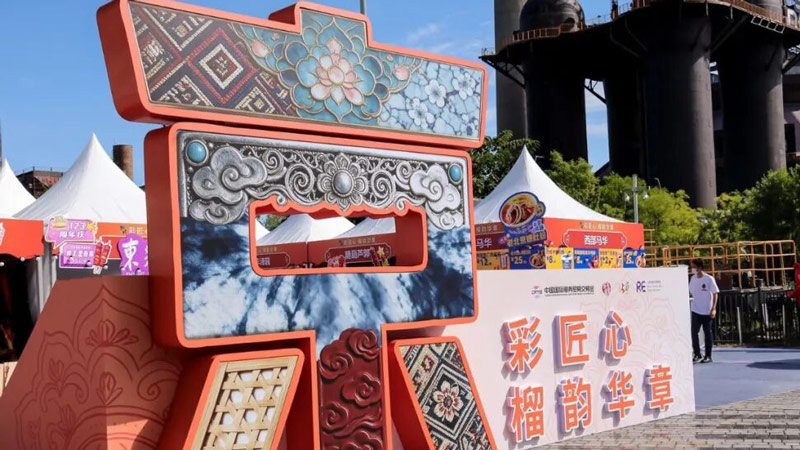
A carnival dedicated to ethnic handicrafts made its debut at the 2026 China International Fair for Trade in Services (CIFTIS). On the afternoon of September 9, the first “Jingcai Jiangxin, Liuyun Huazhang” carnival for integrated innovation in ethnic handicraft industries opened in step with CIFTIS at Beijing’s Shougang Park, running through September 13 around the park’s No. 3 blast furnace and adjoining spaces. The Beijing Ethnic and Religious Affairs Commission organized the event together with the Beijing Commerce Bureau and ethnic-affairs departments of participating provinces and regions.
Positioned as a key CIFTIS companion program, the carnival pushes three tracks for the ethnic handicraft sector: developing fusion products, cultivating fusion brands, and building fusion spaces. The launch ceremony showcased entries from a Beijing youth creative-design contest themed on forging a shared Chinese national consciousness, with young designers weaving motifs of interethnic exchange into their work, and more than ten company representatives pitched brands on stage to push traditional craft toward creative transformation.
The program layout stacked several exhibition formats in one venue. A fusion-space exhibition used holographic projection and panoramic imaging to stage the immersive theater piece “Wenmai, Wensheng, Wenchuang” (纹脉·纹生·纹创, Patterns Born, Patterns Created), tracing the artistry of ethnic patterns; an XR digital workshop applied VR, AR and AI tools to interactive demonstrations of heritage crafts from key regions; and the fair also hosted award displays from the Beijing creative-design contest and a fine-works exhibition of heritage handcraft skills.
Dress took the spotlight on September 9, when the “Brocade of Shared Beauty” cultural performance show took the stage at Shougang Park. A runway team from Guizhou presented heritage costumes from villages that model participants had embroidered themselves, with the twelve zodiac animals as recurring patterns — one performer wore silver ornaments valued at roughly 300,000 yuan. A joint team from Eve Group and the Beijing Institute of Fashion Technology contributed new designs, and the Ulan Muqir (乌兰牧骑) troupe of Zhenglan Banner in Inner Mongolia performed khoomei throat singing, pairing costume display with vocal tradition.
The fusion market organized exhibiting stalls into four zones — international, key domestic regions, ethnic handicraft specialties, and a food-heritage tasting zone — open daily from 10:00 to 20:00. Each stall ran as a small theater of its own, hosting micro-performances, tourism promotion, hands-on heritage experiences and craft tastings, while a “Craftsman Theater” micro-stage scheduled flash performances of traditional music, dance, food craft and dress throughout the day. The “One Place, One Product” program added dedicated pitching sessions for regional public brands and well-known companies, with professional exhibition space, a private stage, business-negotiation rooms and press-interview areas.
More than 80 exhibiting entities joined, among them fusion brands, time-honored firms and heritage inheritors from across the country, supported by over ten institutions including the Beijing Institute of Fashion Technology, the Beijing Cuisine Association, Eve Group, Beijing Golden Lacquer Inlay and the Xibu Mahua catering group, plus ethnic-affairs departments from more than 20 provinces and regions. Organizers framed the carnival as a full chain linking cultural display, artistic exchange, trade matching and industrial cooperation, tying the handicraft sector to the digital economy and tourism consumption.