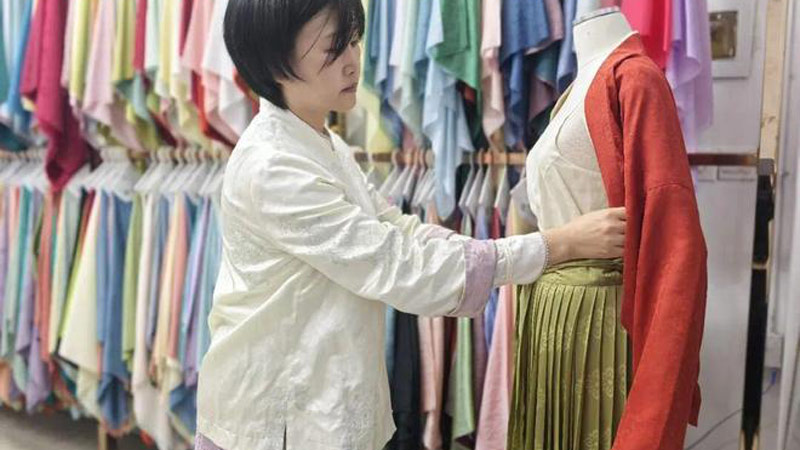
A single skilled weaver on a traditional leno loom could once produce only a few centimetres of cloth in a day. That figure is the reason Hualuo silk, an open-weave fabric prized for its airy hand, stayed a boutique material for most of its modern life. Shaoxing Zhongge Textile has spent years on the arithmetic. According to a September 26 report in Keqiao Daily, the company has pushed heritage leno-weave Hualuo (花罗) from small-batch handwork into stable volume production and built a product matrix around Hanfu, Qipao and Xinzhongshi garments, moving its business beyond raw fabric sales toward brand value.
“We have turned leno-weave Hualuo into something we can produce at a stable volume,” general manager Wan Lili said. The fabric is woven with twisted warps and parallel wefts, so its openings vary in density and the cloth stays light and flowing. Small-batch custom work had kept it from scale. In the second half of 2024 the company released a Hualuo fabric that meets the national standard and lifted production efficiency to ten times its earlier level, opening a path from hand craft to modern manufacturing and giving Hanfu brands a supplier they can rely on across seasons.
Making Leno Weave Repeatable
Volume alone was not the goal. The company then worked outward into fabric applications and market demand. Chemical-fibre Hualuo takes pleating well and suits pleated skirts; a Tencel blend is comfortable and easy to care for and fits daily wear; a Tencel-acetate blend goes further on texture and drape. Its developers ran repeated trials on the ratio of mulberry silk to Tencel, on twist and on finishing, to fix the shrinking and creasing that trouble traditional silk fabrics. The result keeps both a firm body and a soft, breathable hand, and its air permeability and drape coefficient can be measured and checked.
Where the Motifs Come From
Pattern is the other half of the business. Zhongge Textile draws its motifs from Chinese tradition so that each bolt of cloth carries a traceable cultural record. Its team compared motifs, densities and weave structures against excavated objects from the Mashan Chu tomb and from the Dingling Ming tomb, one by one, to recover the fabric language that a Hanfu form calls for. Founder Huang Jianhua had already spent more than a decade on Hanfu fabric in the China Light Textile City. “Luo is the king of silk,” he told the reporter. “The leno technique twists the yarns against each other to form stable openings, breathable but not see-through; the ancients called it cicada wing.”
Traditional leno fabric carried one fatal weakness: efficiency. One skilled weaver could manage only a few centimetres a day. Huang’s team spent years on a single task, turning the craft into a production process. They digitised the traditional leno loom and worked with mechanical engineers to develop a dedicated rapier loom that keeps the core leno structure while raising output dozens of times over. Zhongge Textile’s Hanfu fabric now runs at scale, and its cost has fallen to one tenth that of traditional craft fabric. Huang and his wife Wan Lili dug into dynastic dress records and excavation reports together, from Tiangong Kaiwu to the Dingling dress archives, setting yarn structure, warp and weft density and leno angle for each motif from the yarn up. He describes the work as understanding, from the yarn end, what the ancients wanted to say in a given motif rather than copying a look from a finished cloth. That approach won recognition from first-tier Hanfu brands.
Brand building is how a fabric mill avoids competing on price. At the 2026 Keqiao Fashion Week spring edition, the “Elegant Song and Ming” Zhongge × Jiyuan new collection show ran on the water stage at Keqiao ancient town, with more than 60 models walking in Song-style and Ming-style Hanfu. Rhombus and wan-character fret motifs surfaced faintly in the night light. The collection took the clarity of Song dress and the formality of Ming dress as its starting point and folded traditional forms, bird-and-flower motifs and light, elegant tones into everyday expression. Wan Lili said the runway taught the company what Hanfu culture actually involves, from fabric to form, and that the months of preparation were as much a culture course as a show.
Inspection, Stock and the Next Step
Winning customers comes down to stable quality and fast delivery. On quality, the mill runs a double inspection on grey cloth and finished cloth. On delivery, it keeps stock on hand to shorten response times so buyers can restock without missing a market window.
The next phase keeps the focus on Hanfu and Guofeng fabric. Zhongge Textile plans to hold its Hualuo volume advantage, explore combinations with other heritage crafts, push standardised plant dyeing and keep upgrading traditional weaving and finishing. Bringing plant dyeing into production means repeatable, measurable process standards so that colour can be traced and the method can move from the lab to the market. The company also intends to use brand work and runway events to move from fabric supplier to a promoter of Hanfu culture, toward a long-term goal of bringing traditional culture into modern daily life. In Keqiao, a global fabric hub, that shift starts inside the twist of a leno weave.