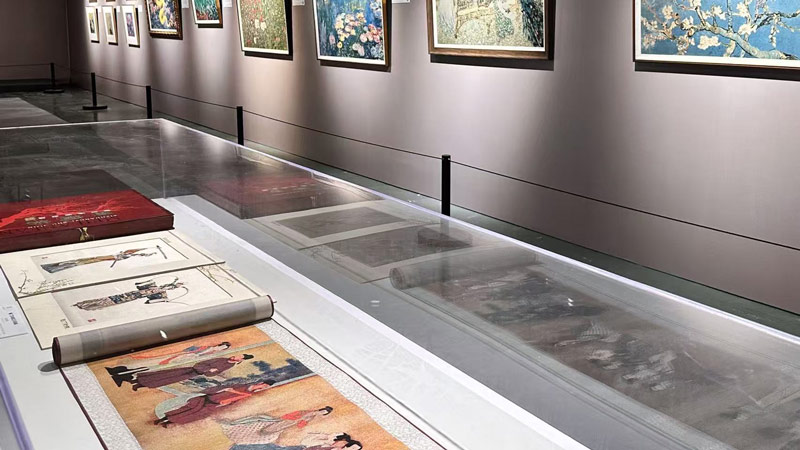
On the morning of September 23, five-colour silk thread caught the gallery lights on the fourth floor of the Shanghai Museum of Textile and Costume. The museum sits on the Yan’an Road campus of Donghua University, and several works on its walls had already travelled a diplomatic route. That morning the Shanghai leg of “Innovation and Inheritance of Chinese Brocade Weaving in the New Century,” a touring exhibition funded by the China National Arts Fund, opened in the hall. Sun Yize, an academician of the Chinese Academy of Engineering and a Donghua professor, attended, together with Donghua vice president Zhang Qinghua, Zhejiang Sci-Tech University party deputy secretary Yao Jun, curator Li Jialin and museum director Bian Xiangyang. Zhang presented Li with a museum collection certificate and declared the exhibition open. The Shanghai run lasts one month.
A Tour That Keeps Moving
The show had crossed three cities before it reached Shanghai. It started at the China National Silk Museum in Hangzhou on April 30 and ran there until May 30 in the museum’s Yinhang Hall, co-organised with the School of Art and Design at Zhejiang Sci-Tech University. The Beijing leg began on August 19 on the 39th floor of the National Financial Information Building, inside the Xinhua News Agency Art Museum, and closed on September 17. Chengdu and Nanning are next. Zhejiang Sci-Tech University and the China National Arts and Crafts Society jointly host the tour, the Beijing stop added the Xinhua News Agency Art Museum as a co-host, and Li Jialin curates throughout.
Reading the Four Great Brocades
Roughly 130 works fill the Shanghai rooms, grouped into three sections covering brocade and its times, tradition in dialogue with innovation, and technology as a weaving tool. The strongest teaching material sits in the middle section, where the four great Chinese brocades hang side by side and their structural differences read at a glance.
Yunjin brocade comes from Nanjing and relies on Zhuanghua weaving (妆花), a method that lays extra coloured wefts into the ground cloth and lets gold and silver thread build dense, layered colour. Shu brocade, from Chengdu, works through warp and weft figuring under a strict colour scheme and stands as the representative silk of the southwest. Song brocade, from Suzhou, favours formal, orderly motifs and has long served both mounting and clothing. Zhuang brocade, from Guangxi, draws its patterns from daily life and nature and runs to brighter, quicker colour. Beside them hangs Kesi silk tapestry, whose makers use the Tongjing Duanwei (通经断纬) technique, cutting the weft at each colour change so that the surface reads like a carved picture.
Also on view are pieces that have appeared at APEC and G20 events. “The Golden Imperial Consort” is billed as the world’s largest single-panel brocade picture, and the technique behind it won a National Technology Invention Award in 2003. A brocade scroll reunites the two halves of “Dwelling in the Fuchun Mountains,” a Yuan painting whose sections are kept in separate museums on the mainland and in Taiwan, China; that work was shown at the Shanghai World Expo and is held by the Palace Museum in Beijing and the National Museum of China. A blue-and-white porcelain chair in the collection of the Paris Olympics committee carries porcelain motifs into modern furniture design.
Silk Thread as a Palette
The gallery’s most talked-about effect is Li Jialin’s thread-based colour mixing. Working with five colours of silk, he weaves several thousand distinct shades, and the results carry a Dunhuang mural, “Preaching Under the Tree,” onto woven cloth and move the Mona Lisa’s smile from canvas to silk. Li, who founded the modern Chinese brocade field, has argued for decades that innovation is the strongest form of inheritance. He produced a full-length silk brocade scroll of “Along the River During the Qingming Festival” in 1998 and has since taken brocade into the China House at the Paris Olympics and onto the Milan Design Week schedule.
For Shanghai he donated two pieces. “Prime of Youth” takes its name from a line about time and youth, a nod to the generations of work that keep a craft alive. “Shanghai Today” is a set of six panels that look across both banks of the Bund and gather nearly a century of the city’s change into thread. “Choosing Shanghai, choosing Donghua” is how the exhibition frames the pairing of an old craft with a contemporary fashion city. Li notes that Shanghai has a deep textile history and an open international outlook, while Donghua’s textile discipline sits in the world’s top tier; together, he says, they can dig into the aesthetic roots of brocade and put the craft into a living fashion language.
Brocade Leaves the Display Case
While the Beijing leg ran, the exhibition joined SS2027 Beijing Fashion Week to stage the WEEK UP Contemporary Brocade Art and Design Transformation Fashion Creative Exhibition, which pushed brocade off the shelf and toward the wardrobe. Its Chinese-brocade section brought together designers Wang Yutao, Zhang Yichao, Wang Hongying, Liang Yan and Sheng Yarong, who worked from national-level heritage fabrics including Shu, Yunjin, Song, Hang and Lu brocade and folded traditional garment techniques into modern cuts. A second section, presented by the ethnic art creative research centre of the National Ethnic Affairs Commission, drew on Li, Miao, Dong and Shui weaving traditions and showed Shu, Song and Lu brocade alongside Zhijin brocade and a large group of composite brocade fabrics made into art fashion.
On the opening day the ground floor of the National Financial Information Building hosted “Huaxia Silk Rhyme, New Splendor,” an immersive brocade show with more than 60 garments. The Xinhua News Agency Art Museum also launched a partner programme, signing a first group of seven institutions that includes the Li Jialin Brocade Art Centre and the Nanjing Yunjin Museum, with the stated aim of deepening an art, media and industry chain and giving craft inheritance a long-term platform.
Innovation First, Inheritance Second
Cai Daying, chairman of the China National Arts and Crafts Society, used his Beijing opening speech to make a small but pointed argument about word order. The tour, he noted, is the first to put “innovation and inheritance” (创新与传承) at the centre of its title rather than the familiar “inheritance and innovation” (传承创新). The words are the same, he said, but reversing them changes what drives the work: innovation becomes the starting point and the landing point of inheritance, and creativity becomes the force that carries a tradition toward the classic. His phrasing for the goal was that art should follow the times and craft should lead fashion.
Alongside that argument, Cai laid out the society’s three-part academic position from the past six years. The first is to supply art for daily life, meeting varied demand and creating new demand rather than only answering it. The second is to bring literati art into homes, into society and into public space, so that craft becomes a presence in living rooms, cars and offices instead of a decoration. The third is to give traditional technique a fashion expression, coordinating heritage and craft logic to build a master economy, an artisan industry and a new fashion consumer category. In Beijing, he added, brocade sits well with the Eight Crafts of Yanjing, the imperial crafts of the old capital.
The Question the Tour Keeps Asking
Across Hangzhou, Beijing and Shanghai, the tour returns to one question: can brocade reach the contemporary wardrobe and the modern home. Li Jialin says technology has given the craft a historic opening and that he hopes the exhibition lets more people feel the range of new brocade work. The Beijing stop drew residents, tourists and industry visitors; after Shanghai the tour moves on to Chengdu and Nanning, and the answer is being tested on the display tables and runways along the way.