In Against the Current (兰香如故), Tan Songyun (谭松韵) wears red cords in her hair, and the image may stop you. She plays Shen Jialan (沈嘉兰), once the eldest granddaughter in a Grand Secretary’s residence. After her family falls, she takes the maid identity of Xu Lanxiang (许兰香) and enters Lin (林) Manor. Her maid look is plain: a blue-green cross-collar short jacket, pale green long sleeves, and a simple cloth skirt. The brightest detail is not jewelry. It is the red cord hanging beside her face and wrapped near her bun. Does that small red line remind you of childhood? It did for me.
Childhood Revisited
Many children in Chinese families remember a grandmother or aunt tying their hair with red cord. If the hair was soft, thin, or full of loose strands, a single tie often slipped. So adults braided the hair and fixed the end with red cord, or they tied small sections down the braid. The style in the drama looks similar, though the wrapped sections are longer. During festivals, red cord carried extra meaning: joy, luck, and a wish for safety. It was cheap, bright, and easy to buy at a corner shop. That practical beauty made it common in ordinary homes.
Red has long been a favorite color in Chinese daily life. It appears at weddings, New Year markets, and doorways. On hair, it does more than hold strands together. It adds a spark against dark hair and simple cloth. Wealthy women could afford gold pins, jade hairpins, and silk ribbons. They used red cord as a small accent under larger ornaments. Poor women and servants had fewer choices. For them, red cord was both a tool and decoration. It kept a hairstyle neat while giving a plain outfit one warm note. That balance between use and beauty is why the detail feels so alive.
Seeing Tan’s character with red cord can pull a viewer back to a kitchen chair, a comb, and a patient pair of hands. The memory is not grand. It is small, warm, and specific. You may recall the pull on your scalp, the smell of soap, or the way the cord looked against black hair. That personal echo is why the styling works before the plot explains anything. A single object can open a door to the past. In Against the Current, the red cord is not just costume. It is a quiet signal that many viewers already know.
What makes this image linger is its double life. It belongs to a fictional maid, yet it also belongs to real families. It can be decorative, but it can also be ordinary. It can mark a festival, and it can simply keep a braid from coming apart. When a prop carries that much everyday weight, the audience does not need a speech to understand it. The eyes recognize the cord before the mind names the reason. That is the quiet power of small costume details. They can make a distant historical setting feel close enough to touch.
Ming Echoes
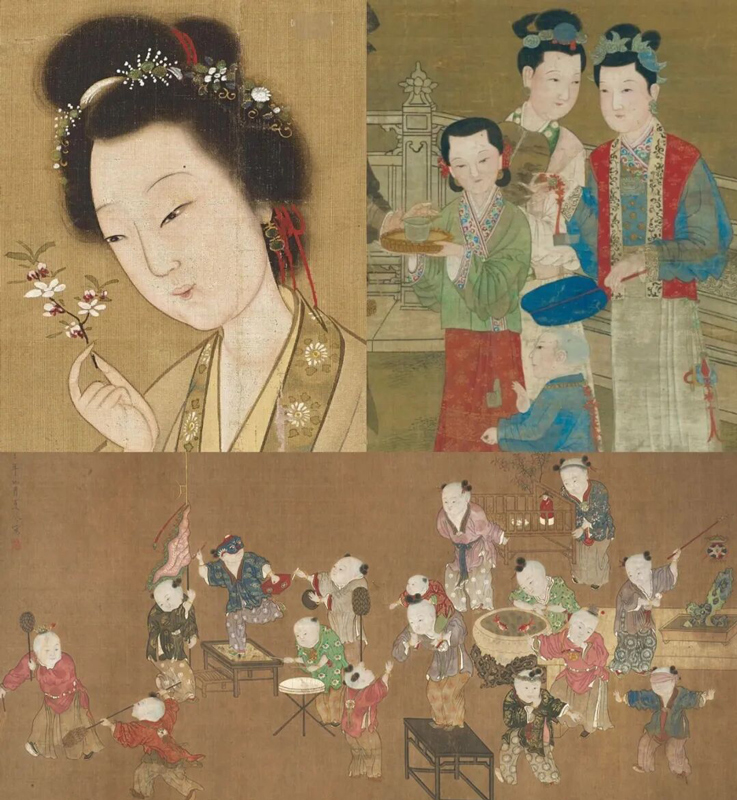
The show’s makeup and clothing draw from the Ming Dynasty. In surviving paintings, red cord appears often in women’s hair. Works such as Beauty and Peach Blossoms (人面桃花图), The Peddler (货郎图), and Children at Play (婴戏图卷) show everyday details that historians can study. Yet paintings are not photographs. They select, simplify, and sometimes idealize. Costume designers also need to serve a story, a camera, and an actor’s face. So the final look can be historical in mood while still being a creative choice. That is true for many period dramas, and it is true here.
Historical records suggest that adult women in the Ming often wore their hair in buns. Common shapes included two-loop buns, small buns, and one-thread buns. The Plum in the Golden Vase (金瓶梅) even mentions a one-thread bun tied with red cord. A maid might not wear the same ornaments as a mistress, but she still needed hair that stayed in place during work. Long loose sections on one side, with red cord woven through the braid, are more theatrical than typical. They frame the face and catch light. This does not make the design wrong. It means the design speaks in the language of television.
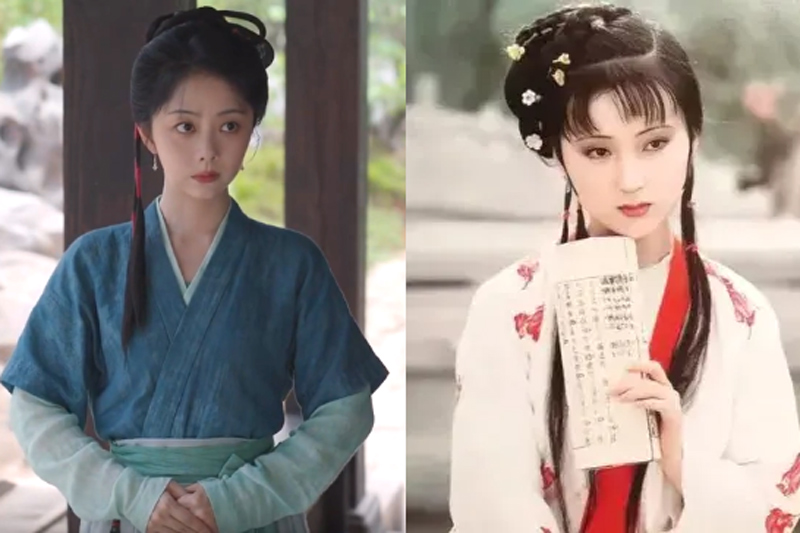
Viewers who know older adaptations may feel a tap of recognition. The 1987 Dream of the Red Chamber (红楼梦) gave Lin Daiyu (林黛玉) long side locks, and that image became part of popular memory. Later dramas borrowed the idea because it reads well on screen. It suggests youth, fragility, and an unfinished story. When Tan wears red cord in a similar way, the reference is not accidental. It connects her maid to a visual tradition that audiences already carry. The past and the present meet in a small piece of string.
Why did the team use red cord for Tan’s character? One reason is class. Different maid ranks wear different styles. Xu Lanxiang enters Lin Manor as a third-class maid. She cannot wear fine hairpins or rich fabrics. Red cord braided into her hair marks her low position. A second reason is character growth. Early red cord braids act like a starting mark. They show where Shen Jialan begins after losing her old life. As the story moves, her clothes and hair can change. A third reason is visual. The blue, green, and gray fabrics are quiet. Red cord becomes the one sharp line below the face. It guides the eye, supports close-ups, and keeps the frame from turning flat.
So, is Tan’s red-cord hairstyle beautiful? The answer depends on taste, but its purpose is clear. It recalls childhood, respects Ming hints, and solves screen problems. It also asks viewers to remember. Did you ever sit still while someone tied your hair with red cord? Did you feel the tug, hear the adults talking, and wait for the finished braid? Those memories give the image its power. Against the Current may be fiction, but the red cord is real. It ties a character to a household, a history, and a viewer’s own past.