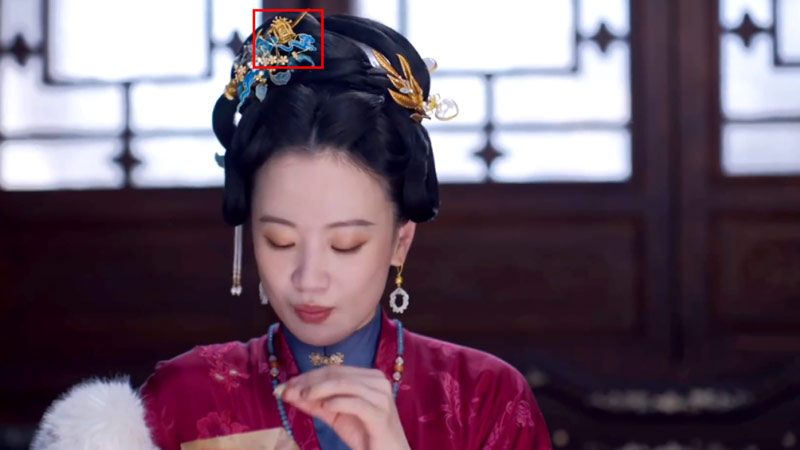
In the new costume drama Against the Current (兰香如故), Li Meng (李梦) plays Zhao Xingtang (赵星棠). One look has caused a stir. A golden hairpin rises from her hair like a miniature pavilion. Blue kingfisher-feather flowers and silver leaves cluster around it. It looks less like jewelry and more like a tiny garden placed on her head. Most hairpins use birds, flowers, dragons, or phoenixes. Pavilions are rare in costume dramas.
So is this a designer’s invention, or did ancient China really wear architecture in its hair? The answer sits in Ming dynasty fashion, where goldsmiths turned roofs, railings, and door panels into personal ornaments. The pin is strange only if we forget how boldly old jewelry could play with shape.
Ming Court Fashion
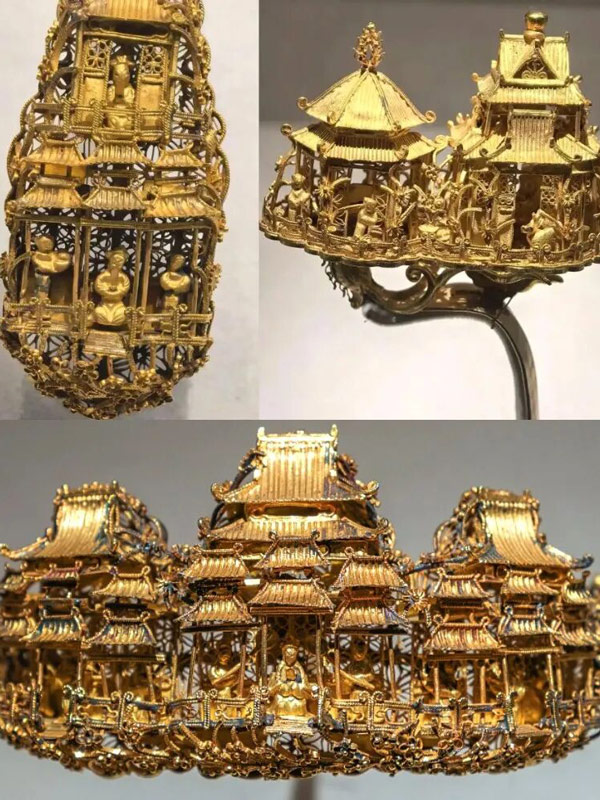
Such ornaments were not invented for television. In the Ming dynasty, noblewomen wore what later scholars call pavilion hairpins or tower hairpins. They belonged to a special group of floral hairpins. Women fixed them into formal headpieces as center ornaments, front ornaments, or side ornaments. The pin’s head was built as a three-dimensional building. Some showed a single pavilion. Some added trees, mythical beasts, and courtyards to suggest a small estate. Others combined several pavilions into one piece. These designs required a jeweler to think like an architect. They were clever, costly, and easy to recognize across a room. They also turned a private landscape into something a woman could carry above her forehead.
Surviving examples are not rare. Tombs of Ming princes and nobles have yielded several. A gold pavilion hairpin from the tomb of Prince Zhuang of Yi (明益庄王) in Nancheng (南城), Jiangxi (江西), is especially famous. It has double eaves, clear railings, and visible door panels. Flowers, plants, and tiny figures surround the building. Its filigree work is finer and more complex than the one worn by Li Meng. Similar pieces came from elite tombs in Jiangyin (江阴), Jiangsu (江苏), often made of pure gold filigree. These finds confirm that the screen version follows a real tradition, not fantasy. The past had already pushed jewelry into miniature architecture.
Why did this fashion appear? First, metalwork had matured. Ming artisans mastered filigree, chasing, and repoussé. A single ornament could combine several techniques. Other surviving hairpieces, such as gold-inlaid jade ornaments showing the Eight Immortals, or gem-studded double-phoenix centerpieces, show the same love of layered detail. Jewelers had the skill, and patrons had the money. A pavilion hairpin was a display of technical confidence as much as personal taste. It let a workshop prove it could build a world small enough for a hair bun but rich enough to reward close looking.
Second, landscapes and architecture filled visual culture. From the early to middle Ming period, palaces and common households admired painted mountains, towers, and gardens. Those themes appeared on lacquer, porcelain, decorative patterns, and paintings such as Jade Cave Fairy Land and Fanghu Isle. Wearing a tiny pavilion echoed that taste. Third, the pin signaled rank. Pure gold and a three-dimensional building on a formal hair bun were beyond most households. In rituals, it told viewers that the wearer came from a princely or high-official family. Beauty, status, and technical display met in one object. That is why the pin survived as more than a passing court fad.
Screen Styling
For Zhao Xingtang, the choice fits. She is the principal wife of the Lin family. A pavilion hairpin carries weight and refinement. When placed on her bun, it gives her the calm authority of a household matriarch. The ornament does not need to shout. Its scale, material, and detailed roof already say she holds power. In a drama, costume can explain a character before dialogue does. Here, the hairpin works as a quiet badge of status, tradition, and self-control. It also separates her from younger, softer roles that rely on flowers, ribbons, or pearls. Her crown is not cute. It is composed, formal, and quietly commanding.
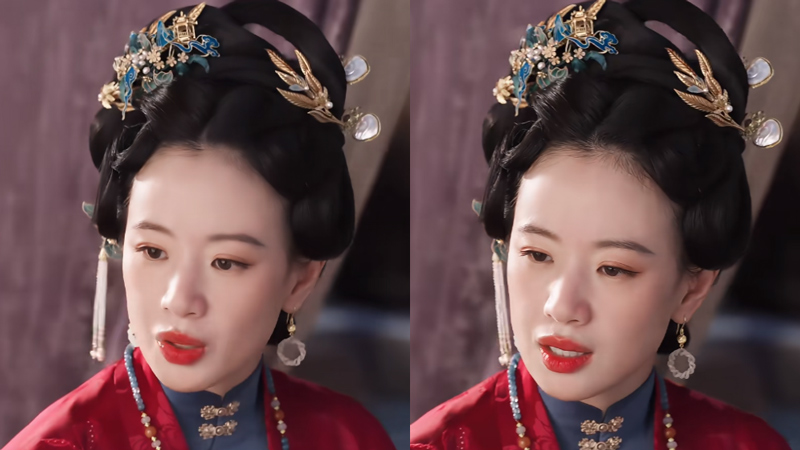
Visually, it also balances the outfit. Zhao wears a deep wine-red robe with subtle patterns. The color is dark and restrained. A golden pavilion with blue-green floral accents creates a bright point at the top of her head. It lifts the whole look without making it chaotic. The blue flowers echo the blue standing collar at her neck. That repeated color ties the robe, hair, and face together. The result feels formal, elegant, and carefully composed, rather than merely odd. Even the pin’s sharp silhouette helps her stand out in wide shots, where small jewelry often disappears into the hair.
There is another practical reason. Many costume dramas repeat similar hairpins. Viewers see the same phoenixes, pearls, and step-shake ornaments again and again. A pavilion hairpin stands out. It gives the show a memorable silhouette and helps the audience link the ornament to the role. Even someone who forgets the plot may remember the woman with a tiny building on her head. That is strong design. So, does Li Meng’s pavilion hairpin look beautiful to you, or does it still feel too strange? Either way, it opens a window into a real Ming fashion that turned gold, wire, and imagination into a private skyline.