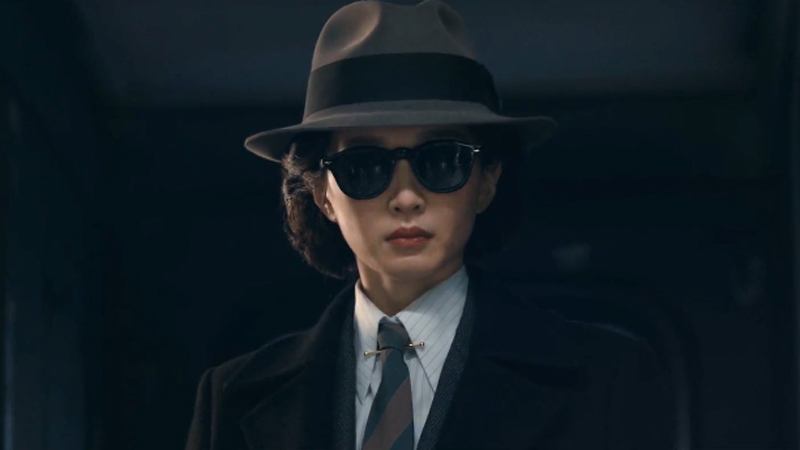
A thin metal rod rests beneath the tie knot worn by Jiang Shuying (江疏影) in The Awake (醒来). On screen, it cuts across her collar like a small needle. The first reaction is simple: why? She plays Su Men (苏门), a woman whose sharp suits and striped shirts already set her apart. The object is not random jewelry. It is a collar bar, a forgotten accessory from Western formal dress. Its return here says more about character, period detail, and costume design than most viewers expect. A tiny rod can raise a big question, and that question opens a door into history. That is why the rod deserves a closer look.
A Sharp Accessory
The collar bar appeared in European and American formal wear near the end of the 19th century. As Western tailoring reached China, it traveled with suits, ties, and stiff collars. Early users were often people in coastal treaty ports who dealt with foreign merchants, missionaries, and banks. By the 1920s and 1930s, it had become common in modern offices, especially foreign firms and banks. Men wore it, but some women did too. In a Republican-era city wardrobe, it signaled familiarity with modern dress rather than simple ornament.
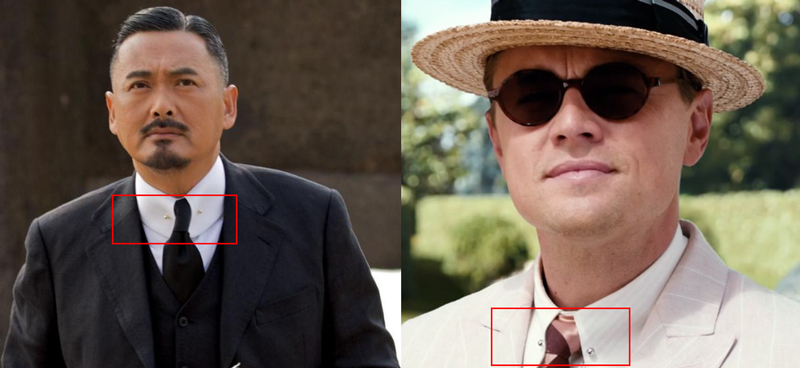
There are two main styles. A pierced collar bar works with a pinned-collar shirt. The two collar points have tiny holes. The bar passes through them, pulls the points together, and lifts the tie knot. The result is a clean collar that does not curl and a knot that looks fuller. Films such as Let the Bullets Fly (让子弹飞) and The Great Gatsby (了不起的盖茨比) show this style. It needs precise tailoring, so it feels formal and deliberate.
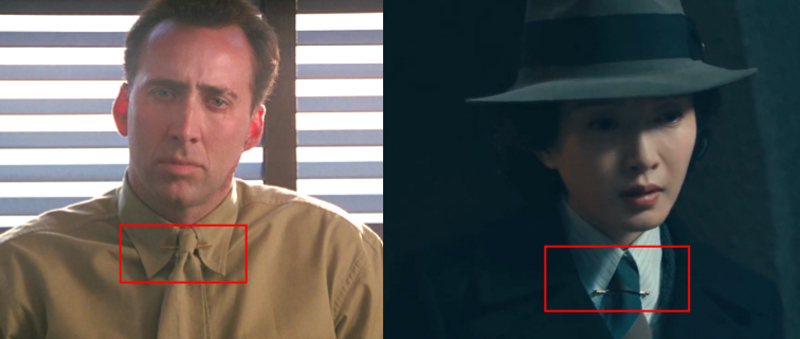
A clip-on collar bar is the simpler version. Two small clips grab the fabric directly. Costume teams like it because no custom shirt is required. Nicolas Cage wears one in Windtalkers (风语者), and the The Awake wardrobe uses the same type for Su Men. People often confuse a collar bar with a tie tack. A tie tack is a long pin with a metal head. It sits a few centimeters below the knot, passes through both tie blades, and anchors them to the shirt placket. Its job is to stop the tie from swinging. A collar bar frames the collar and supports the knot. The difference is small in size but huge in effect.
It is easy to mix up three accessories. A tie clip holds the tie to the shirt front. A tie tack pins the tie to the placket. A collar bar sits at the collar and controls the points. Each solves a different problem. The collar bar is the most formal and the least seen today. That rarity is exactly why it works on camera. When a viewer sees it, the brain pauses. The pause creates attention. Costume designers use such pauses to guide the eye to a face, a line, or a hidden emotion.
Character and Clues
Why did the crew give Su Men a collar bar? The first reason is accuracy. Many Republican-era dramas stop at a tie when dressing a woman in a suit. A collar bar is a quieter, harder detail. Adding it makes the period feel lived in, not rented. The second reason is character. Su Men is calm, restrained, and quick to act. Menswear strips away softness, while the metal bar adds a cold edge. It matches her inner toughness. A bow or silk scarf would soften her image and change how audiences read her. The choice is not decoration for decoration’s sake.
The third reason is identity. Su Men wears dark suits and light striped shirts. In group scenes, other suited figures can blur together. The metal line at her collar catches the eye and marks her apart. It also gives viewers a visual clue: she belongs to a modern professional world, yet she refuses its usual gender codes. The collar bar becomes a small signature. It does not shout, but it stays in memory. That is effective costume storytelling.
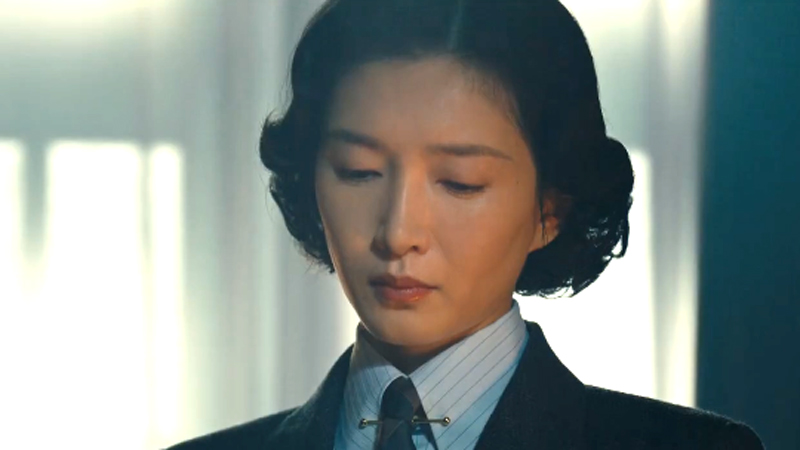
Jiang Shuying has played elegant and complex women before, including Serenade of Peaceful Joy (清平乐) and Nothing But Thirty (三十而已). Those roles built expectations. Su Men breaks them with a harder silhouette. The collar bar helps that break feel physical, not just written. It also reminds viewers that women in the Republican era did not only wear body-hugging dresses or soft blouses. Some moved through banks, newsrooms, and foreign firms in tailored suits. Their history is less familiar, and a small piece of metal can open the door to it.
Today, few people wear collar bars in daily life, so the accessory can look odd at first. Many period dramas also skip such fine points. The Awake restores the detail and lets the audience notice it. The choice invites questions, and those questions lead to history. A tiny metal rod under a tie knot is not just decoration. It shows how wardrobes can carry time, class, gender, and personality without a single line of dialogue. For that alone, the costume team deserves credit. It turns a small prop into a lasting question.