A Turkish merchant who has traded here for 31 years calls Three Lanes and Seven Alleys the heart of the city. A Korean historian has spent two years turning its street signs into Korean. An Italian painter learned to lacquer here, and a Harvard professor keeps scanning the county’s old contracts on villagers’ doorsteps. People’s Daily devoted page 17 of its October 12 edition to these arrivals, under a column on Chinese cities seen by foreigners, and the through-line is narrow: Fuzhou keeps its old fabric in use rather than under glass.
The city has 2,200 years on record, and its heritage runs north to south along a single axis, from the Xindian and West Han Yecheng sites through Three Lanes and Seven Alleys, Zhuzifang, Shangxiahang and Yantai Hill. That axis is where all four foreigners ended up working.

A Translator Who Rewrote the Lanes for Korean Visitors
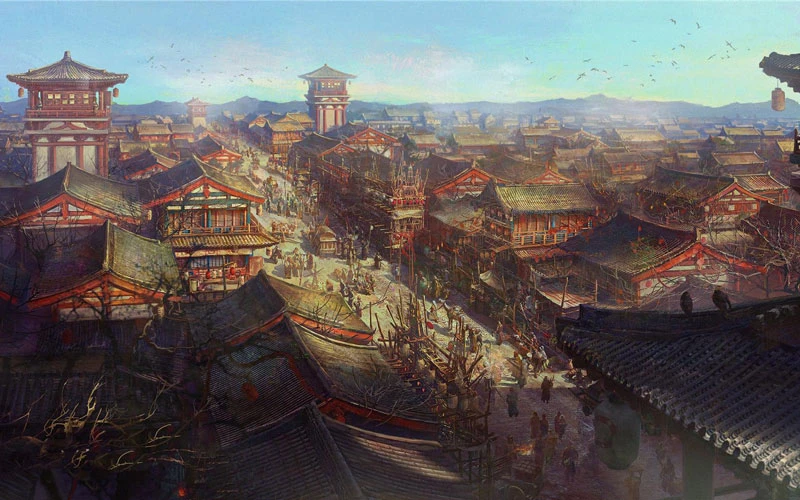
Aladdin Colak arrived from Turkey in the mid-1990s, when Fuzhou already looked like a modern city to him, and has watched the lanes stay fixed while everything around them changed. “Thirty years ago, when friends came to Fuzhou, the first place I took them was Three Lanes and Seven Alleys,” he said. “Today it is still the first place. I think this is the heart of Fuzhou.” The neighbourhood took shape under the Jin, matured in the Tang and peaked in the Ming and Qing, and produced Lin Zexu, Yan Fu, Shen Baozhen and Lin Juemin.
In the 1990s, when Lin Juemin’s former residence was scheduled for demolition, the city halted the plan and restored the house instead, then adopted a conservation method it still uses: inlay-style, incremental, micro-circulation, small-scale, uninterrupted. Exhibition rooms went in, and heritage workshops moved onto the lanes. Ryu Ho-in, a young Korean historian working as an invited foreign-language translator and reviewer for the city, has now rendered the introductions to Three Lanes and Seven Alleys, Shangxiahang and Wu Mountain into Korean. He reads each draft aloud to Korean friends before signing off. “Many of the names carry classical meaning,” he noted. “A literal translation leaves visitors with nothing.”
Korean travel agencies toured the city in early September and plan to bring groups between November and March, with the lanes as a fixed stop. Ryu said the neighbourhood changed how he thinks about preservation: people still live there, new businesses have moved in, and the past is not sealed off.
Lacquer, Glass and Cork Under an Italian Hand
In a workshop off the main street, an Italian artist who has lived in Fuzhou for 15 years is two months into learning lacquer. He goes by the Chinese name Linghe, and he is painting a cartoon self-portrait in raw lacquer, a medium that rewards patience and punishes haste. “The finished piece often surprises you,” he said, “and it grows warmer with the years.” Around that project he has added hand-painted glass, cork carving applied to men’s hats, and paper-cuts of his own design, using craft techniques to make contemporary work.
Two solo exhibitions came out of the same platform, and the messages that followed did more for him than the reviews. “Local visitors wrote to me on social media about what they felt looking at the paintings,” he recalled, and the response left him in tears. He also posts short videos of his explorations, arguing that the city’s craft heritage belongs to more than one country. Jan Martorell, from Spain, took a different route: he and his wife opened a cafe two years ago and run events there to put locals and foreigners in one room. His mother studied the Silk Road, which is how the family first came.
The Documents a Harvard Professor Scans Himself
Yongtai County, in the mountains west of the city, held more than 2,000 fortified manor houses at its height; 152 survive in reasonable condition, five of them national heritage sites and 18 provincial. As residents moved out, the houses emptied. A rescue campaign launched in September 2015 to repair the most important ones, and in the course of that work, bundles of paper came out of camphor chests: contracts, genealogies, account books, partition deeds, pleadings, receipts, tax bills and ritual texts, some from the Ming.
Michael Szonyi, a Harvard historian and former director of the Fairbank Center for Chinese Studies, joined the research team led by Zheng Zhenman of Xiamen University in 2017. His method is unfashionably direct: hear that a household has documents, go there, scan them on the spot. “These records tell ordinary people’s stories,” he said. “They let us understand that period from the bottom up.” The Eight Min Library project, begun in March 2019, plans 1,650 print volumes over ten years; its Fujian folk contract series has reached 36 volumes and 100 books, covering more than 80,000 Yongtai documents, all published for the first time and grouped by place, household and object.
Since 2022 Szonyi has taught a Harvard course on reading Chinese folk documents, taking students to Yongtai to stand in the houses the paper describes. In 2024 the county named him an honorary villager; on January 4 this year, Shengping Manor in Dayang township handed him a key cut with his name. He has said he intends to spend the rest of his career on the archive.