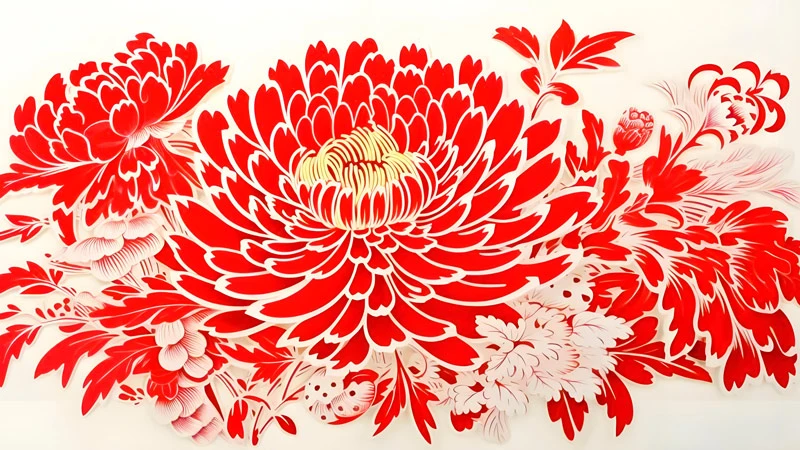
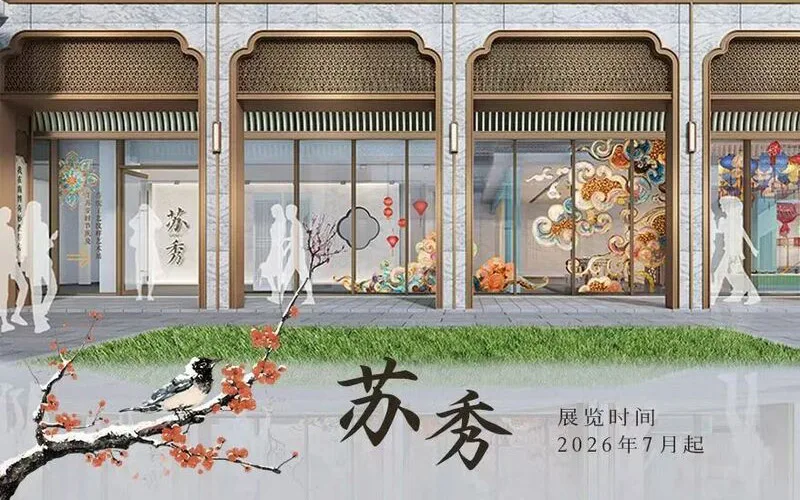
Grid & Grace: East Meets West is a fifteen-scarf exhibition at the Suzhou Silk Museum in Suzhou, Jiangsu, on view in the History Hall from 12 September to 29 November 2026. Admission is free. The show is a Sino-Italian dialogue between hand weaving and generative models, and it was built as a design problem rather than a technology demonstration: the slowness of a material craft and the weightlessness of computation are placed on the same table and left to argue.
Raffaele La Marca, an Italian designer who is also a doctoral researcher jointly trained by Soochow University’s School of Art and the University of Campania, made the works during a five-month stay in Suzhou. The curator is Fan Weiyan, a designer and teacher at the same school. The museum, the Soochow University School of Art and the University of Campania co-hosted the project, which sits inside a 2026 China National Arts Fund programme.
How a Loom Grid Became a Prompt
Before a motif ever reached a loom in imperial-era Suzhou, it had to be translated into the loom’s own language on squared paper. Those gridded draft sheets, still held in museum collections, record how a flower or a cloud was broken into cells that a drawloom could read. La Marca used the sheets themselves as a generative matrix. The squared cell became the pixel, and the model produced tiled digital grounds that inherit the rhythm of the drawloom rather than the look of a photograph.
Its holdings were then sorted into three symbolic families: flowers standing for the mortal realm, animals for the liminal zone, and clouds for the celestial realm. Each motif was dismantled, layered, blended and then generated, and a human hand chose which outputs survived. The survivors were printed and woven onto Suzhou silk as scarves, so the file had to pass through a material that would not accept every image put in front of it.
- Material first: the model only ever worked from patterns and weaving charts that exist in the collection, so every output can be traced back to an object.
- The medium decides: an image that silk could not carry was dropped, which makes the fabric a filter rather than a surface.
- Authorship stays human: the scarves are attributed to the designer, and the model is named as a collaborator.
That order is the part worth copying. Institutions building artificial intelligence projects around craft usually start with the tool and look for material afterwards, which is how a pile of generated decoration appears and no decision gets made. Starting from the archive, then letting the fabric veto, then fixing credit, produces fewer images and a defensible method.
Three AI Shows in One Building
The museum did not stage this exhibition alone or in isolation. Two other shows about artificial intelligence and traditional technique ran in the same building this autumn, on different premises and with different national partners. Read together, they look like a deliberate test of three routes into the same question.
| Exhibition | Dates | Route into the problem |
|---|---|---|
| Grid & Grace: East Meets West | 12 September to 29 November 2026 | Italian design practice, mediated by silk scarves |
| China-UK AI Art Tour, silk tie-dye | 29 September to 29 October 2026 | Hand tie-dye set against interactive digital work |
| Shujian Suyun, provincial tour, Suzhou stop | 29 September to 21 October 2026 | Museum digital infrastructure, shown at scale |
Each of the three does a different job. The Italian strand answers what a designer does with a model when the material is silk. The British strand, organised by a national folk arts centre, treats hand tie-dye as a contemporary art language and puts the algorithm in the same room as the resist-dyed cloth. The provincial strand, run by the Jiangsu culture and heritage authorities in the museum’s Future Hall, is the infrastructure layer: a 135-metre digital scroll of the Grand Canal and a reconstruction of a 78-metre porcelain pagoda that stood in Nanjing until the nineteenth century.
What the arrangement admits is that none of these routes settles the question on its own. A design school show proves a method can work at the scale of fifteen objects. An art tour proves the conversation can cross borders. A digital infrastructure exhibition proves the archive exists. Only the three together describe the actual state of the field, which is why the scheduling deserves more attention than the individual press openings did.
The Dataset Underneath the Silk
Behind the scarves sits an archive that most visitors never see. The city’s silk culture digital centre has completed faithful digital capture of patterns from 16,000 silk objects, and the pattern database now holds more than 50,000 motifs, sorted into thematic sets for rosette, dragon and cloud designs. A keyword search for peony pulls up more than sixty variants. An attached tool strips a pattern into vector, line and sketch outputs, and a colour extractor gives back both numeric values and the traditional names Chinese colour vocabulary assigns to them.
Qian Zhaoyue, the museum’s director, noted that a single peony can be woven, embroidered or dyed, and that one motif therefore carries the convergence of all three crafts. The database is already working with more than twenty companies and has produced over 200 cultural products, which makes the exhibition look less like an experiment and more like the visible end of a pipeline. In August 2026 a joint directive from six central government departments asked historical craft industries to build parameter datasets and industry-level data platforms, and the museum’s silk pattern and colour dataset has since been named a provincial pilot. For Chinese art institutions, the sequencing is the lesson: the dataset came first, the exhibition came second.
What the Show Leaves Open
Two limits are worth stating plainly. Fifteen scarves are research outputs, not products, and a five-month residency produces a sample of a method rather than capacity or orders. Carrying material first and letting the medium veto into a batch design process, and then into a copyright registration process, is the step the exhibition does not attempt. That work belongs to the mills and the provincial administrations, and it is slower than a show.
A harder gap is evaluative. Nobody has settled how authorship, originality or licensing should work when a model participates in a pattern, and the show displays the question without answering it. Whether the method travels to stitch-level crafts is equally open. Printing on silk tolerates a generated edge; Su embroidery does not, because every shift of tone is a decision made by a hand holding a needle. That is where a model has least purchase and where the next honest test of the method would sit.
For anyone going: the museum is at 2001 Renmin Road in the old town, near Beisi Pagoda. It closes on Mondays except public holidays, the last entry is 16:00, and the Future Hall stays open until 20:00. The same ticket covers the permanent galleries, where the drawloom and the gridded sheets behind this exhibition are on display as working objects rather than illustrations.