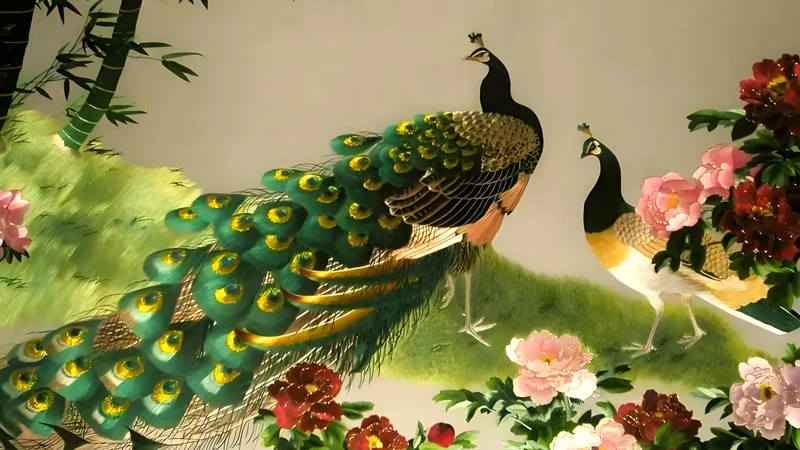
Nanjing Yunjin Museum unveiled a framed brocade panel titled Three Brocades in Harmony at the 9th China International Import Expo’s debut product launch on 6 November, the first time Yunjin, Song brocade and Shu brocade have been woven into a single scroll.

Three Cities Inside One Frame
The museum led the project and Qian Xiaoping, a designer long associated with Chinese brocade, set the composition. “This is the first time in the history of Chinese brocade that the three famous brocades have shared one scroll,” said Gu Ying, who heads the museum’s publicity centre. The team went back to a Song dynasty painting, Zhao Mengjian’s Three Friends of Winter, and borrowed its pine, bamboo and plum as the governing image.
Each city then took one flower. Nanjing’s plum holds the centre, with Suzhou’s osmanthus and Chengdu’s hibiscus arranged around it, one blossom to one city, so the three places of origin are legible in the composition before a visitor reads a caption. The title comes from a phrase about harmony without uniformity, and the panel is scheduled to go on sale as merchandise on 14 November, when the national brocade committee holds its annual meeting, through the museum’s online channels and its flagship store.
Not a Patchwork: Each Brocade Owns One Zone
What separates the panel from three cloths sewn together is the division of labour. Genuine silk and gold-wrapped thread were used throughout; the gold sits with a classic Song brocade motif, and craftsmen in Nanjing and Suzhou adjusted the balance between them over repeated trials. Above and below the picture heart, the entwining lotus band that marks Song brocade runs as a border, and the entire outer mounting is worked in Shu brocade with the pine, bamboo and plum of the original painting.
Three responsibility zones follow from that: Yunjin carries the dense central blossoms and the gold, Song brocade carries the fine border bands, Shu brocade carries the mounting. Each technique keeps its own character, and every seam has to align pattern density and colour gradation across two different weaves. Brocade has always been the most expensive layer of traditional chinese clothing, because the loom sets the limit well before the tailor does, and a joint panel exposes exactly where those limits fall.
What to Look For at the Seam
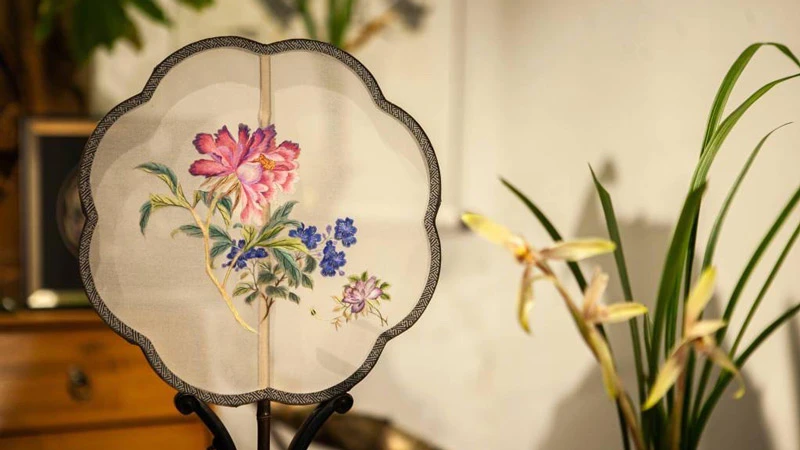
The collaboration has a precedent. At the previous expo, Yunjin and Shu brocade produced Auspicious Phoenix and Qilin, a phoenix on one face and a qilin on the other, and Zhou Shuangxi of the Nanjing Yunjin research institute and Qian Xiaoping made a pair of double-sided round fans together. A second pairing is on show this year: Nine Carps in a Golden Age, with Zhou Shuangxi’s team weaving the frames and scales of nine carp in Yunjin and Yao Jianping’s team laying in the peonies in Su embroidery, which the museum describes as the first genuine joining of brocade and embroidery in Chinese silk art.
Alongside the panel, the stand holds a ceremonial robe in a four-season floral ground with gold-thread python worked in Zhuanghua weaving, a Tuan Shan round fan with a red ground and a phoenix among peonies, and a bolt of cloud-patterned cloth kept out to demonstrate the trade’s old measure of value, an inch of brocade for an inch of gold. The python robe belongs to the Qing dynasty clothing order, in which the number of pythons marked rank, which is why the gold count on a single garment was a bureaucratic fact as much as a decorative one.
This year’s expo also set up an ICH workshop zone for the first time, and brocade was placed inside it, in a humanities exchange section that the organisers describe as the largest in the expo’s history. Gu Ying reads the change through buyers: younger customers now treat heritage products as everyday goods rather than display pieces, and overseas interest has moved from curiosity to orders. The museum’s own description of its role has shifted with it, from guardian of a technique to translator of one, and a panel that puts three weaving traditions on a single sheet is the clearest example of what that translation looks like.