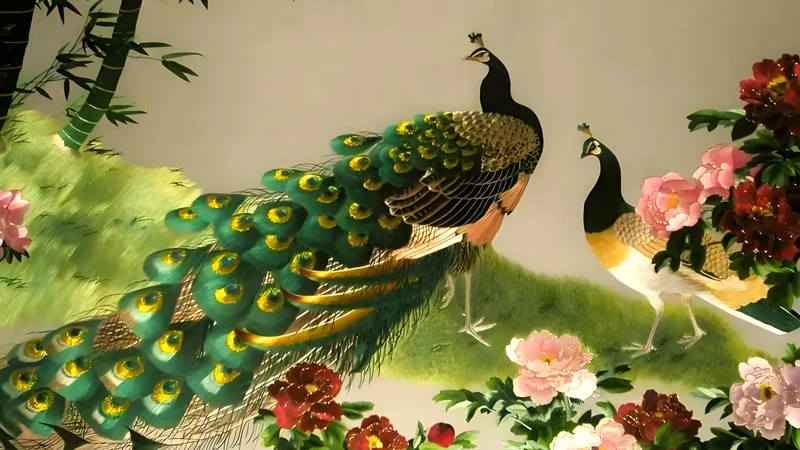
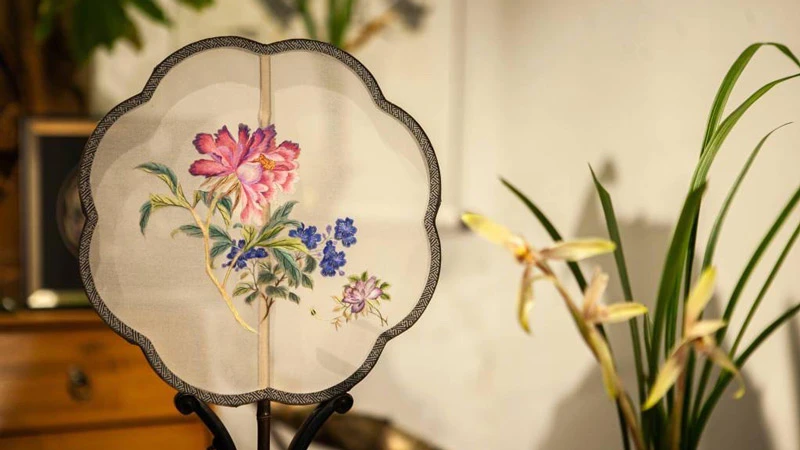
Five embroiderers from Chuxiong, in Yunnan, sat in a circle at the China International Import Expo on 6 November and worked in sequence: running stitch, insertion stitch, shuttle stitch, seed stitch, gold thread. A camellia took shape under the lights. What they were finishing was a limited edition made for the fair, a Calvin Klein tote and a Tommy Hilfiger passport holder, and the order behind it runs to about 1,500 pieces.
The Flower That Had to Be Stitched
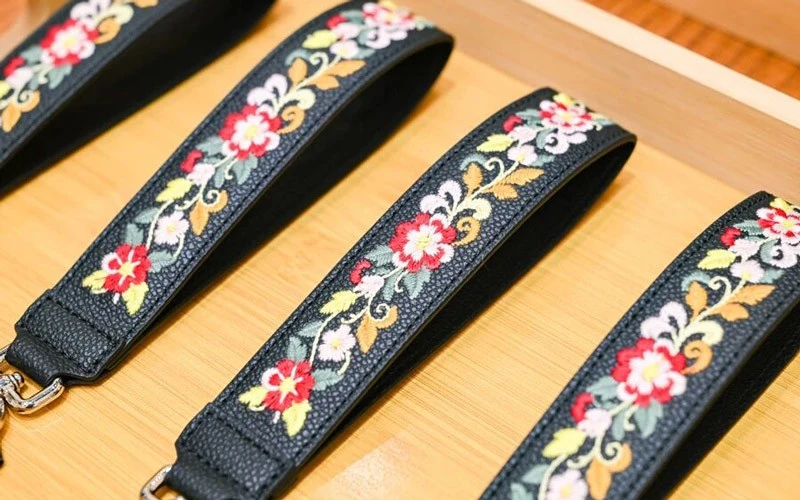
The commercial terms are modest by apparel standards and precise nonetheless: 900,000 yuan in total, a production cycle of more than 90 days, 128 Yi embroiderers (彝绣) on the handwork, and more than 300,000 yuan distributed to them in wages. The tote carries the Calvin Klein monogram beside a Yi camellia motif in the tradition’s red, green and yellow. The passport holder carries the white magnolia, Shanghai’s city flower.
Design ran through Zhang Jianxun (张建勋), an embroiderer known locally as a male stitcher in a trade dominated by women, working back and forth with the brand until the line work and the stitch execution were settled in Chuxiong. In September the PVH team flew back to Yunnan to sign off the samples. The pattern was never the hard part. The logo was.
A brand mark cannot be printed onto this product and still be the product, so it had to be embroidered, stitch by stitch, and embroidered accurately enough to satisfy a trademark owner. Yi work normally starts from a paper template, and the fine curves of a monogram cannot be cut cleanly at that scale. Zhang tested alternatives for a long stretch before landing on water-soluble cloth printed with the line drawing: stitch over it, then dissolve the backing away. The fix kept the handwork and gave the geometry a temporary guide that could be aligned exactly.
Four Tests Before a Box Ships
Having the capability to take an international order is not the same as being able to deliver one. A product heading for a global brand has to clear a sequence: whether dyed thread matches across batches, whether stitch pitch holds steady, whether colourfastness and abrasion resistance pass third-party testing, and whether the whole consignment reaches an overseas warehouse on the agreed date to one standard.
Zhang’s answer was to divide the order into stages that can each be checked. Orders come in at the front. The middle stage distributes work to home workshops and to the central Yi embroidery workshop, with training standardised across both. The back end handles inspection, warehousing, brand packaging and dispatch. Yi embroidery is worked by counting warp threads, and of its 72 traditional stitches many still cannot be reproduced by machine, so the division of labour is less a compromise than a way of cutting a craft that resists subdivision into segments a manager can supervise.
Splitting a Craft Into Manageable Pieces
It began with a letter. At the end of April one arrived from PVH’s China headquarters on the desk of Zhou Zeng, a Shanghai-appointed deputy director in the Yunnan Department of Commerce’s foreign investment office. He had spent years in Shanghai before the posting, knew textiles and knew the foreign firms based there, and had been in Chuxiong since July 2025 walking local industry. What he kept running into was the difficulty of converting heritage into product.
Yi embroidery entered the national intangible heritage list in 2014, but the craft had no process document a foreign buyer could read. Without one, a procurement team cannot assess risk, and without an assessment there is no order. That gap, rather than any shortage of skill, was what stood between the workshops and the buyer.
Before the PVH team flew down in early May, Zhou ran a shortlist. From 77 workshops and 513 embroidery studios across the prefecture he picked those with unified operating standards and a record of contract work, and that record was substantial: several had produced for BMW and Porsche and had shown at Shanghai Fashion Week. Immediately after the May Day holiday the team toured Yi embroidery branches across three counties and the city, reviewing samples and delivery histories. The order landed with Zhang.
His own route into it took a decade. He graduated in 2016 in economic management, came home in 2018 and started selling farm products alongside embroidery. As buyers grew more exacting he organised village stitchers into a system of centralised workshop production and home-based stitching, taught himself painting and digital pattern drawing, and learned stitches by asking the women who had done them for forty years. From a heritage workshop in Chuxiong to a booth at the import expo, he reckons, took ten years.
Who Vetted the Workshops
The money reached individual households in amounts that can be counted. Li Jingying, from the same village, has a heart condition that keeps her out of farm work, so embroidery is her only income. She completed 50 pieces for this order at just over 100 yuan each, roughly 6,000 yuan in total. She could not travel to Shanghai, and Hei Xiumei, a neighbour, promised to photograph the booth for her.
For Zhou, the purchase validated a model rather than a product: standardised delivery plus brand premium. He sets out two routes from here. One is high-end single pieces made with international brands and sold in limited editions. The other is mass-market fashion, using Shanghai’s design and brand services to raise the value of Yunnan’s heritage output. Further out, he wants Shanghai’s trade and finance infrastructure to open cross-border settlement and delivery, and the Silk Road e-commerce partner network to carry the products into South and Southeast Asia.
Nine hundred thousand yuan is not a large order in the apparel business, and the significance sits elsewhere. Yi embroidery has appeared at New York, Milan and Paris fashion weeks and in several brand collaborations, but most of those stopped once a motif had been licensed. This time the making, the testing, the packaging and the delivery all came from the workshops, with the brand supplying design and standards. What separates contract work from co-creation is an auditable process and a delivery record, and both now exist in writing.
At the expo, PVH and the China National Textile and Apparel Council also launched an empowerment programme for Chuxiong Yi embroidery covering design innovation, sustainable production, brand building and marketing. Whether that turns a single order into a standing channel is a question for the next two years, and no one at the booth claimed otherwise.