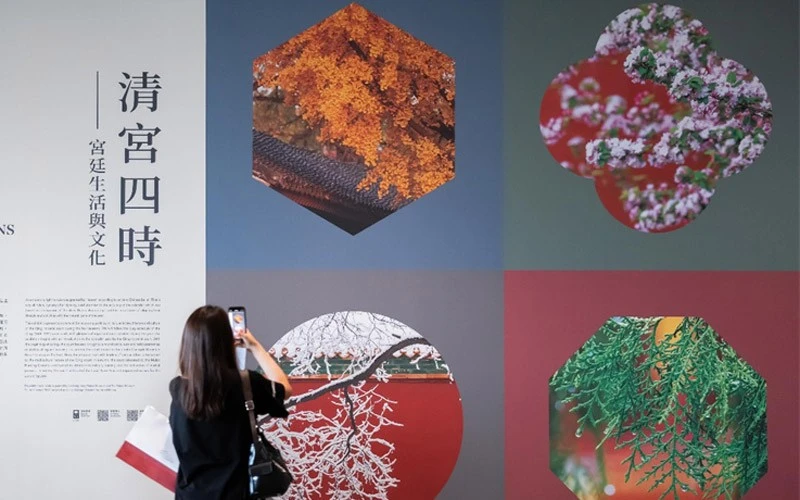
One hundred and eighty-seven objects from the Palace Museum in Beijing went on show at the Hong Kong Palace Museum on 4 November, arranged around a single idea: a year at the Qing court, told season by season. The exhibition, Qing Court in Four Seasons, fills Gallery 2, the largest room in the building, and stays open until 3 November 2028.
| Dates | 4 November 2026 to 3 November 2028; preview 3 November |
| Venue | Gallery 2, Hong Kong Palace Museum, West Kowloon |
| What it is | Palace life through the ritual year, in four seasonal units |
| Scale | 187 objects lent by the Palace Museum; 14 leaves of the farming-and-weaving album shown six at a time |
| Hours | 10:00 to 18:00 Monday, Wednesday, Thursday, Sunday; 10:00 to 20:00 Friday, Saturday and public holidays; closed Tuesday |
| Tickets | HK$70 standard, HK$35 concession, free under six |
Colours Borrowed From a Library Catalogue
The wall colours are the first curatorial decision and the one visitors will remember. Malachite green sets the spring room, vermilion the summer, moon white the autumn and a blackened grey the winter. The source is the binding system of the Siku Quanshu, the eighteenth-century imperial library, where the four divisions of classical literature were bound in four colours that correspond to the seasons.
What that borrows is a reading device rather than a palette. Each of the four colours is a shade with a job: the green carries a yellow cast, the vermilion runs warmer and more saturated than palace-wall red, and the moon white is not white at all but a very pale blue. Set beside one another they let a visitor know which season they have walked into before reading a single label. For an exhibition that runs two years and rotates objects within it, that stability is the point.
What Each Season Holds
Spring is about silk and grain. The core is the Yongzheng emperor’s farming-and-weaving album, in which the prince who would take the throne and his consort are painted as a farmer and a silkworm woman, each leaf carrying a poem in his hand. The album rotates six leaves at a time. A famille-rose vase painted with the twelve months of flowers sits beside it, evidence of the February flower festival, when the court prayed to the flower god and asked for a good harvest in the same gesture.
Summer moves to Chengde, where emperors from the Kangxi reign onward spent roughly the fifth to ninth lunar months handling memorials, receiving officials and meeting frontier leaders. Autumn is the Mulan hunt, and its objects are the most concrete: a chair built from the antlers of a deer Kangxi killed, a tiger spear about 2.5 metres long carried by the imperial tiger battalion, and a vase whose bats and hundred deer encode fortune and long life. Winter is New Year, anchored by a screen 3 metres high and 3.6 metres wide recording lantern dances, firecrackers and the burning of cypress branches to clear the old year. Gifts went out in the same season, Ruyi and pouches to juniors, officials, eunuchs and palace maids, which is where qing dynasty clothing stops being costume and becomes protocol.
A Day Stretched Into a Year
Wang Yiyou, deputy director of the museum, described the show as an extension of an earlier exhibition that compressed court life into a single day and found that visitors queued for the interactive parts, calligraphy and opera. The answer here was more of them, plus a longer axis: the same court, observed across twelve months rather than eighteen hours.
Two installations carry that stretch. An immersive piece by the media artist Jeffrey Shaw follows the route from the Old Summer Palace in Beijing to Chengde, with the projection moving through day and night as the journey advances. A winter station hands visitors brush and paper to copy the emperor’s own fu character and spring couplets, the calligraphy a Qing household pasted up in the final month. Textiles get their own quiet argument in the same rooms: a pouch worked in counted-stitch gauze embroidery and closed with a chinese knot is filed under winter, where it belongs as a New Year gift rather than as an accessory.