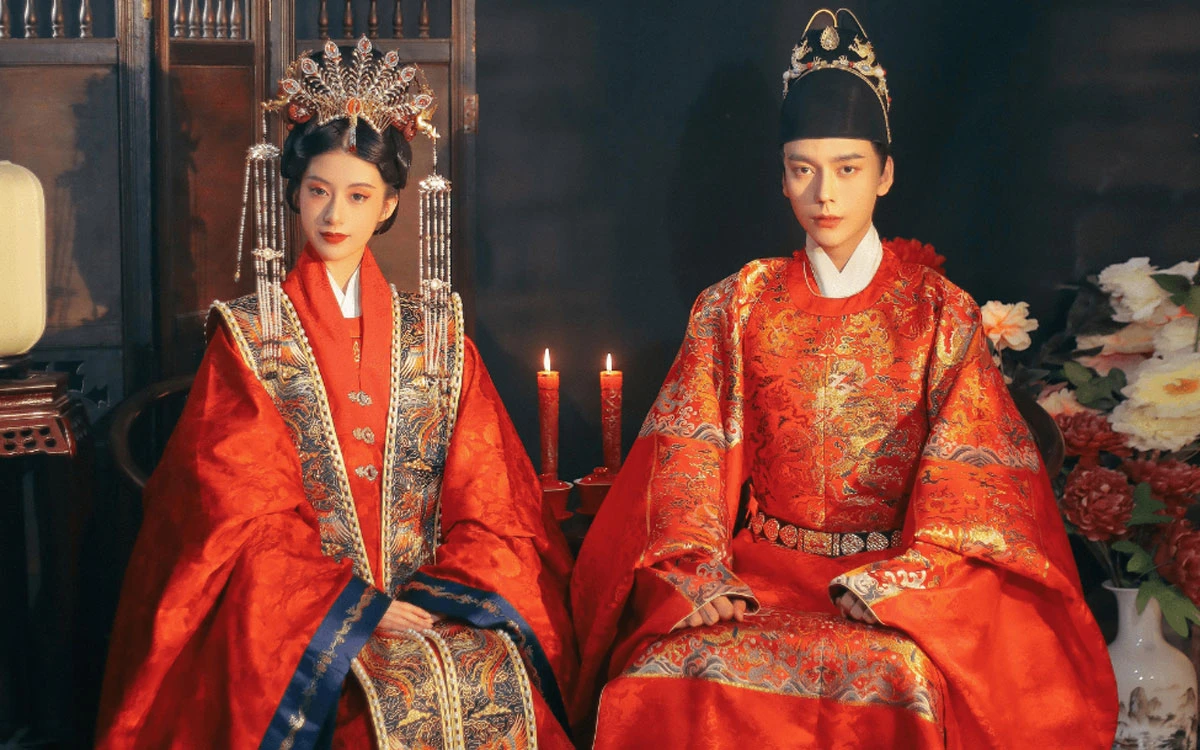
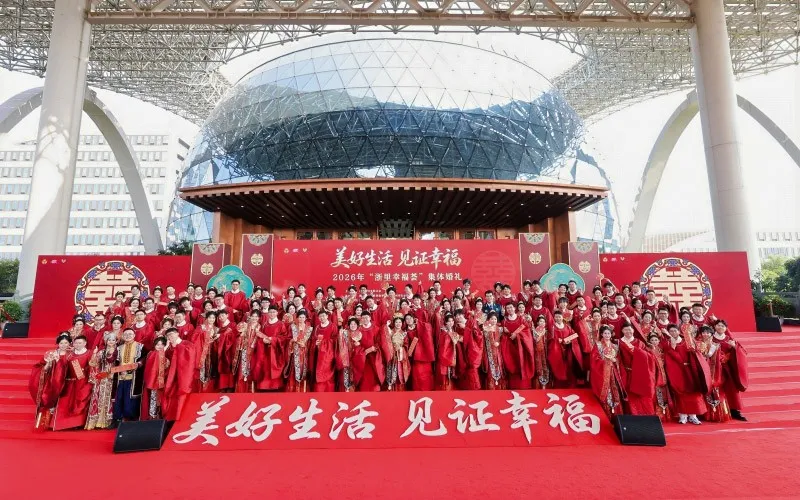
Fifty couples married on the sky garden of the Hangzhou International Expo Centre on the morning of 1 November, all of them in the same Song-style wedding dress, with the Qiantang River behind them. The ceremony was organised by the Zhejiang Women’s Federation and ran through four rites: hand-washing, the lowering of the bride’s fan, three bows and the exchange of tokens.
A Garden, a Red Carpet and a Bronze Basin
The setting did most of the staging. Pavilions and covered walkways around the garden were dressed in red, a carpet ran across a magpie bridge to the platform, and a bronze basin for the hand-washing rite stood at the bridge. Couples walked in together, stopped at the basin, then took the platform in sequence, with the fan rite following the washing and the bows closing the ceremony.
Contemporary equipment shared the space without friction. Robot dogs danced to silk-and-bamboo music while the couples waited, and a calligrapher from the provincial calligraphers’ association wrote out marriage certificates on the spot for each pair. Representatives of golden-anniversary couples and of families honoured under the province’s family awards sat in the front rows, and the couples finished by reading a joint proposal on marrying simply, sharing household responsibility and resisting extravagance.
Officials attended in the roles the format requires rather than as guests of honour. Wu Jing, deputy director of the provincial people’s congress standing committee, gave the officiating address; Wu Hongmei, chair of the provincial women’s federation, gave the main address; Chen Weiqiang of the Hangzhou congress standing committee attended. The guest list also carried matchmakers, women entrepreneurs and family members, which is who a public wedding is actually for.
Engineers and Couriers on the Same Carpet
The fifty couples were drawn from across the province’s workforce: engineers, technicians, teachers, police officers, company staff, and couriers and ride-hailing drivers from the platform economy. One couple from Xiaoshan had been together twelve years, including two years apart in different cities, and used the ceremony to finish what they had started. Another pair met through an outdoor social event run by the federation, saw the recruitment notice for the collective wedding and registered their marriage early so they could take part.
One bride, Xiao Hui, came in both capacities the programme runs on. She had found her partner through the same network and works as a volunteer matchmaker herself, and she described folding what she had learned about the province’s marriage and childbearing campaign into every introduction she makes.
Why the Song Wardrobe Became the Default
The detail worth recording is not the number of couples but the uniformity of the dress. Fifty pairs wore one specification of Song-style wedding garment rather than fifty versions of the embroidered bridal suit that most commercial studios rent out, and the rite order was fixed in advance. Each step gives onlookers a visible cue: the washing is cleaning, the fan hides the bride’s face until it is lowered, the three bows cover heaven and earth, the parents and the couple themselves, and the token exchange puts the promise into an object.
Cost explains the choice. A Song-style set, drawn from the plainer end of Song dynasty clothing, has fewer layers and a closer silhouette than the phoenix crown and cape that Ming dynasty clothing reserves for brides, which makes it cheaper to rent in bulk and easier to keep uniform across fifty people on one stage. It also lands neatly on the policy message: a restrained version of Chinese dress does not depend on stacked gold and silver to look correct, which is exactly the argument the frugality campaign is making.
The service network behind the event is the part that continues after the confetti. The provincial federation has run the programme since 2023 around three strands, publicising new norms, providing introductions, and training volunteers, and it leans on two corps of volunteer matchmakers and marriage mentors. Its method is to take the blind-date format out of the event hall and put it inside things young people already do: Hanfu outings that pair a craft session with making kumquat cakes, pet meetups on a lawn, a Qixi game in an old town where participants play residents and solve riddles by lantern light.
Scale, at least, is documented. Federation branches across the province report more than 7,200 matchmaking events to date, contact with over a million people, and a volunteer matchmaker corps of more than 8,400. A survey on attitudes to marriage ran alongside the wedding itself. Whether any of that moves the birth rate is a different question; what the morning in Hangzhou shows is that a public wedding can be staged at a cost a couple can afford, in dress that a rental shop can supply in fifty identical sets.