The 31st International Heritage Exhibition ran from 29 October to 1 November in the Carrousel du Louvre in Paris. A team from Wenchuan, in Sichuan’s Aba prefecture, took Qiang New Year, Qiang embroidery and sheepskin-drum dance into the hall, together with a plan for a heritage park back in the mountains and a language model built on craft records.
| Dates | 29 October to 1 November 2026 |
| Venue | Carrousel du Louvre, Paris |
| What it is | China’s western intangible heritage presented as Huotang Zhiguang, a firepit-centred stand |
| Scale | Live embroidery and drum dance; a panda character pair; craft products; a European centre announced on site |
| Who took part | Wenchuan delegation, French cultural institutions, the French overseas Chinese association |
A Firepit Instead of a Display Case
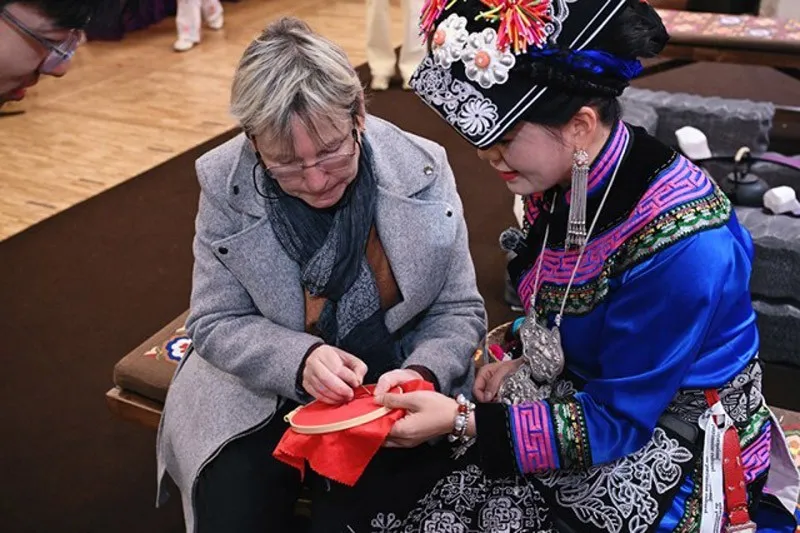
The stand was built around a hearth rather than a vitrine. Visitors could sit at the firepit while inheritors worked Qiang embroidery and danced the sheepskin drum, and the panda figures Wenwen and Chuanchuan stood alongside products derived from Qiang patterns. New Year, recognised by UNESCO in 2024 when it moved from the urgent-safeguarding list to the representative list, framed the whole presentation: the shift from a tradition that needed rescuing to one that could be experienced is a shift in how it is shown.
Ma Baoyong, described by the team as the youngest Qiang shibi, or ritual specialist, opened the programme in traditional dress. He struck a sheepskin drum, a single-headed instrument on a bamboo hoop that is played with a stick while the player turns, and then played the Qiang flute, a double-tube, double-reed pipe whose narrow tone echoes hard off glass and stone. Choosing those two instruments first pulled an exhibition crowd out of looking and into listening.
A Centre, Not Another Exhibition
On the sidelines, Qinxin Holding signed a framework agreement on heritage exchange and industrial cooperation with the French overseas Chinese association, and unveiled a plaque for the Huotang Zhiguang Aba Intangible Heritage Europe Centre. International Online put the signing on 28 October, local time. Three lines were announced for the centre: a route for overseas display, transmission and commercial conversion; a global call for multilingual heritage material; and licensing and export support for Chinese heritage brands.
The difference between a centre and a show is what stays behind. An exhibition leaves catalogues and coverage. A centre leaves a standing channel for contact, language data and licensing, which are the two things that decide whether a European museum, school or brand can actually work with a Chinese craft group. Knowing whom to ask, and on what terms, is the part that usually stalls after the crates go home.
Back in Wenchuan, the counterpart is under construction at Yingxiu. The Aba heritage park is scheduled to open around Qiang New Year in early November, built on the firepit as a social unit, with six themed hearths and a digital art hall. Its daily programme runs a village-walking route that begins with calling the mountain to open the settlement, moves through opening a sealed jar of grain wine, and ends with circling cups and answering songs.
That design has an obvious risk. Fix the rites into a timetable and living practice becomes a performance; leave them to the festival calendar and the site cannot carry weekday visitors. Running the village walk as a regular activity is a compromise between the two, keeping the actions while loosening them from a once-a-year date.
Five Hundred Gigabytes of Qiang Knowledge
The digital side is a heritage-specific language model built by Xinfeixiang AI Research Institute, part of Qinxin Holding. The team says the model has completed its generative AI service filing and its deep synthesis algorithm filing, and that it runs on roughly 500 gigabytes of heritage text, about 20 billion tokens.
For knowledge that travels by voice and demonstration, the value is not in generating elegant copy. It is in turning workshop talk, interview recordings and local gazetteers into descriptions that can be searched and aligned: the direction of a stitch, the ratio in a dye bath, the dimension of a vessel. Once those are retrievable, they can be translated, cited and reused.
The team’s own timeline explains the shift. It came to Paris in 2018 with pewter repair, returned in 2023 with heritage brands from several ethnic regions of western China, and this year took part for the third time. Three appearances, and the cargo changed from a single craft to a system. That is also a fair description of how Chinese traditional dress and craft have moved abroad in the same period: first renting a stand, then building a platform.