Murong Street in Chaoyang, Liaoning, was shoulder to shoulder on the evening of October 16, when the fourth China Intangible Cultural Heritage Protection Annual Conference opened its public market. Stalls ran down both sides under the lamps of restored Ming and Qing houses: Jinyun flatbread from Zhejiang, New Year prints from Yangliuqing in Tianjin, Jian ware bowls from Fujian, purple pottery from Yunnan, with haggling and drumming overlapping. Among them, a 22-year-old from Hejian in Hebei stood behind a crown.
Sun Jiaqi is a municipal-level inheritor of Hejian Chanhua, and the piece in front of him was a hand-built replica of the three-dragon, two-phoenix crown worn by Empress Xiaojing of the Ming. More than a hundred separate components, dragons, phoenix birds, cloud scrolls and side wing panels, were wound from soft copper wire in different gauges, then dressed in silk thread.
Building a Crown From a Hundred Wire Parts
Chanhua and Ronghua get confused constantly, and the difference matters. Velvet flowers are made by twisting silk into pile and then shaping it, so the surface carries a soft nap. Chanhua wraps silk thread around a wire frame, layer on layer, and the angle and tension of the winding produce the posture of a leaf or a petal. One judges the silk; the other judges the line. Sun explained the crown’s difficulty as a proportion problem rather than a dexterity problem, since each gauge of wire corresponds to a specific part and a wrong choice throws the whole silhouette out.
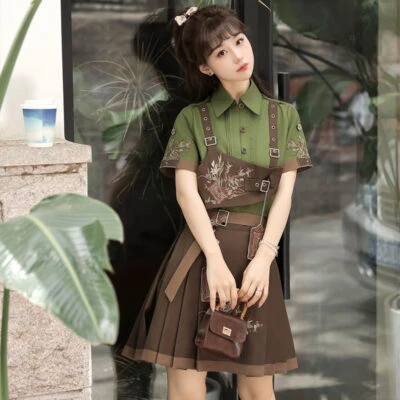
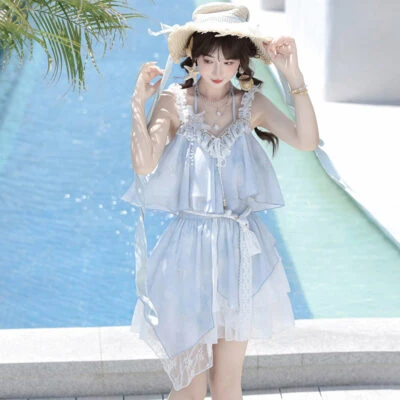
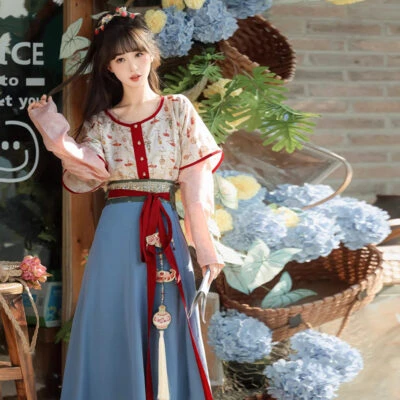
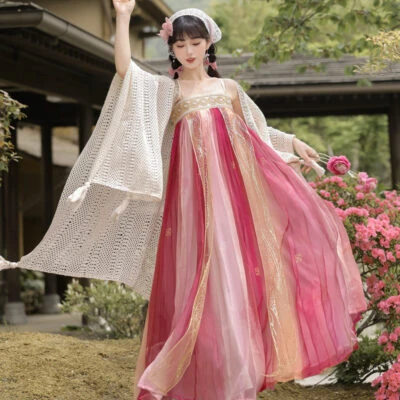
He started at 12, founded a craft society at university, and now runs shops in Hangzhou and in his home city of Cangzhou. Much of his custom comes from Hanfu wearers, and he organizes shows with them. “Machines cannot make these,” he said. “I want people to feel what an old hand trade is like.” Next to him, Tang Zhongren of Longquan celadon was explaining kiln behaviour to buyers: above 1,300 degrees the glaze decides for itself, and the same firing can yield many different colors.
The Fair Around the Crown
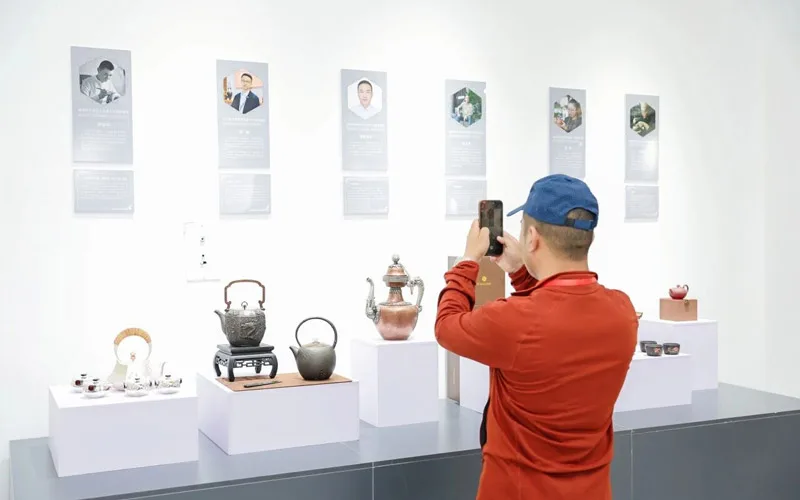
Tang holds a doctorate, teaches at Lishui University and runs a celadon company, and his answers are those of a man used to a syllabus. The company develops 30 to 40 new products a year, and he has five apprentices, the youngest 18. That profile, a young person with a second career and a teaching post, is what the conference was built to display. A parallel exhibition gathered 70-odd works from 50 young inheritors, covering embroidery and dyeing, ceramics, metalwork, lacquer carving, weaving and tea making.
Liaoning’s own contingent showed the same pattern. Zhao Congzhuo, a post-1990 inheritor of Gaizhou Yiergenjueluo paper-cutting in its twelfth generation, spent a decade moving the craft from salvage to reinvention: silk-fabric cutting that survives washing, a low-carbon dye that resists fading, and an augmented-reality programme built with universities. Sun Peng, born after 1995 in Yingkou’s Laoshixing gold and silver workshop, works on vessel shapes that suit contemporary taste while keeping the hammering, forging and engraving sequence intact.
What the Support Scheme Changed
The conference published this year’s list of young inheritors entering the national support programme, run by the China Intangible Cultural Heritage Protection Association under the guidance of the Ministry of Culture and Tourism’s heritage department. It concentrates on traditional crafts and works through grants, mentorship, sales platforms and brand promotion. The first cohort of 20 has already moved on skills, branding and job creation; 30 more joined this year. Nationally, 3,994 people hold national-level inheritor status as of June, and more than 200 universities take part in the training scheme.
Ding Lanying, a provincial inheritor of Yi embroidery from Chuxiong in Yunnan, came through the first cohort and is the clearest measure of what the scheme can shift. Her work has shown at fashion weeks in Milan, Paris, New York and Beijing, and she has travelled to 11 countries in two years to exhibit and sell. For a licensed 2026 World Cup programme she built 30 products around Yi motifs, including caps, key chains and a jersey. Her daughter Chen Haiyan, born after 2000, is now the youngest prefectural-level inheritor in Chuxiong. Wang Xiaofeng, the association’s president, put the logic plainly: the craft survives through people, and the future of that transmission is young.