A Ming scholar who never returned home left the clearest written description of the Pifeng (披风). Zhu Shunshui (朱舜水), who fled to Japan after the fall of the Ming, appears in a compilation of his sayings, the Zhushi Shunshui Tanqi (朱氏舜水谈绮), describing how the coat was cut: “The fabric and color match those of the Daopao, but the Pifeng closes at the front with no piping. The lappet edges fall apart front and back, unconnected. On the chest there is a button worked in jade patterns, or a small cord will do.” Garment historians used that passage, together with the illustrations that accompany it, to attach the name Pifeng to surviving Ming robes. For Hanfu wearers this autumn, the same coat answers a more everyday question: what goes on top as the evenings turn cool.
A Cut Documented in Three Sources
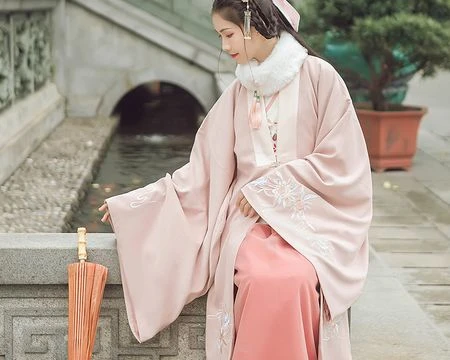
The Pifeng is a long overcoat with a Duijin (对襟) front opening, sleeves and side slits, worn by both men and women, and it was common in the late Ming. People who picture a sleeveless cape are usually thinking of the Doupeng; the Ming garment that carried the name Pifeng was a full-sleeved coat. The Palace Museum’s Illustrated Guide to Ming Court Dress records that the Pifeng was a popular informal garment for men in the late Ming, similar in function and material to the Changyi and close to it in outline.
Lineage traces the Pifeng to the Beizi (褙子) of the Song and Yuan periods. The Sancai Tuhui (三才图会), Wang Qi’s illustrated encyclopedia compiled in the Wanli era, states the connection in one line under its “Beizi” entry: “That is today’s Pifeng.” The cut itself is consistent across Ming descriptions: a straight collar, a front opening, a collar roughly one chi long, large open sleeves, side slits, and a closure of cords or a flower-shaped jade button. The collar, sleeves and front edges carry no dark piping. That last detail is what separates it from the Changyi, which normally has dark edging and usually lacks slits. The Suzhou Silk Museum holds one exceptional Pifeng with extremely wide piping and slits, a rare variant of the type.
Three Ming Overcoats, Compared
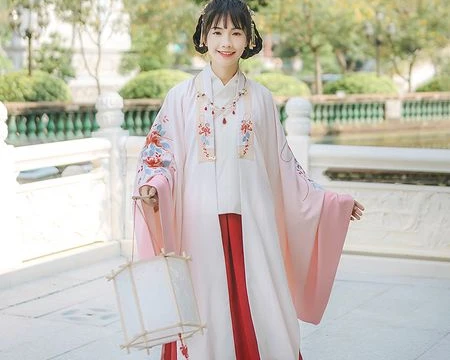
In the Ming men’s wardrobe, the Pifeng, the Changyi and the Daopao are the three long coats most often confused. The Changyi, also called Hechang (鹤氅), is the older informal style, worn through spring, autumn and winter over a Daopao for warmth. It shares the straight collar, front opening and large sleeves, closes with a pair of long cords, generally has no side vents, and is more often seen in light colors. Its collar, sleeves and front are edged in dark fabric, and its cuffs stay open, unlike the gathered cuffs of a Daopao or Zhishen. The Ming court record Zhuozhong Zhi (酌中志) notes that Changyi with Daopao-style sleeves were “a crude recent fashion” and that “in the old system the sleeves were not sewn shut, which is why it is called a Chang.” Winter Changyi were lined with cashmere or sable.
The Daopao, despite its name, is not a priest’s robe but a very common men’s casual garment of the late Ming. It has a Jiaoling (交领) crossover collar, wide sleeves, a broad white protective collar band, and its signature feature: overlapping hidden panels at the back that stop the underlayer from showing when the wearer walks. The Confucius Museum’s collection of the Confucius Mansion holds many Ming Daopao in person, with moderately wide sleeves that grew extreme in the late Ming, some reaching the ankles.
For the 2026 September issue of MiniBAZAAR, the garment historians Chen Shiyu (陈诗宇) and Dong Jin (董进), known online as Xiefang Zhuren (撷芳主人), staged a Wanli-period reconstruction on the model Zhao Lei (赵磊): a blue, unpiped, cord-fastened solid-ground gauze Pifeng over a light solid-ground gauze Daopao, with dark shoes, closely matching the Wanli-era portrait of Li Liufang (李流芳). The fabrics were true silk solid-ground gauze of Ming construction, and the motifs were the cloud patterns with assorted treasures common in the period. The pairing of Pifeng over Daopao is the most representative autumn layering formula for Ming men.
The Women’s Pifeng and Its Descendant Ribbons
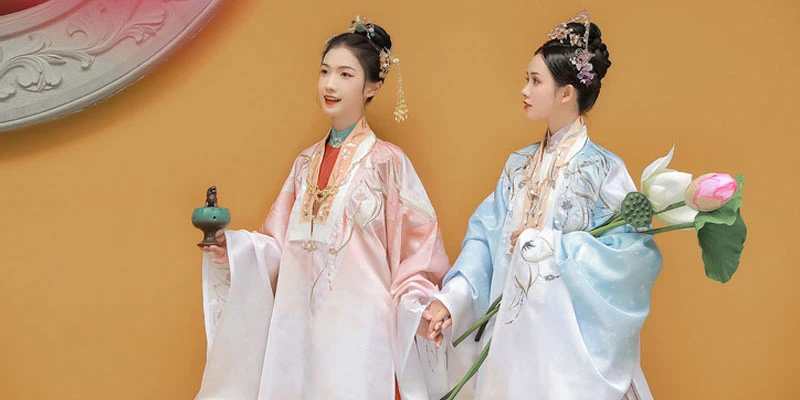
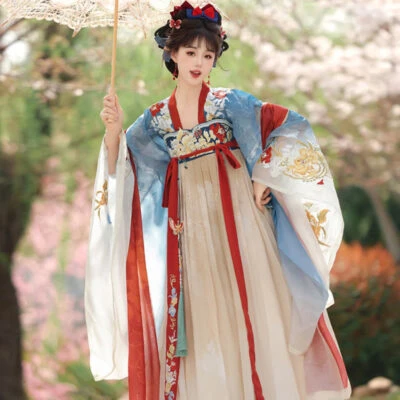
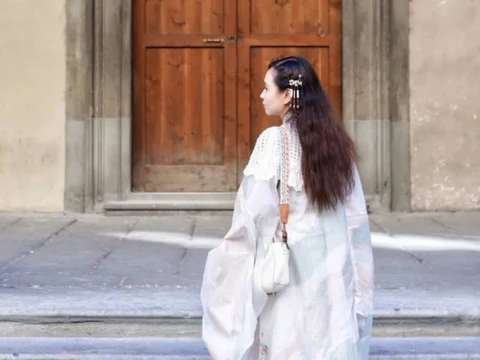
In the Ming, the women’s version was also called the Pi’ao coat (披袄), and it usually carried collar edging only at the front placket. Women’s Pifeng came in two forms: one with a plain front opening, and one with a front opening under a standing collar. Opera terminology distinguishes them as Pei (帔) and Guimen Pei (闺门帔). The standing-collar form was worn by both sexes, so Ming writers put a “women’s” marker in front and called it the women’s Pifeng.
The name Pifeng survived into the mid-Qing. As the plain-opening women’s version faded from daily wear, only the standing-collar form remained, and the cords that once fastened the front became decorative. On today’s bridal jacket-and-skirt sets, those two straps are known as descendant ribbons.
Excavated pieces anchor the record. The Ming tomb of Zhang Shouzong (张守宗) and his wife in Sinan (思南), Guizhou, yielded a camel-colored plain-satin Pifeng with a V-shaped neckline. The tomb of Lady Wu, wife of Prince Ningjing (宁靖王夫人吴氏), in Nanchang, Jiangxi, produced a plain-satin large robe. The Confucius Mansion collection includes a white gauze long robe with dark cloud motifs, cut with large sleeves, a standing collar and an asymmetric front. Together they give the Pifeng family a solid archaeological base.
Three Ways to Layer It This Autumn
Layering is the whole game in the change of seasons, and the Pifeng, as the outermost layer, adapts to every thickness of inner wear.
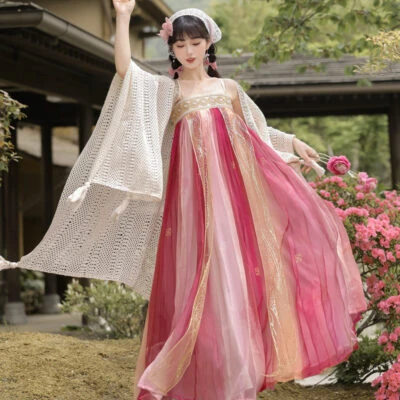
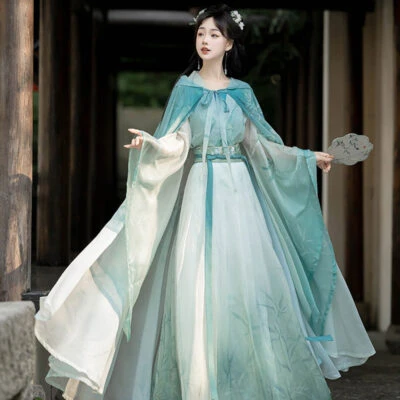
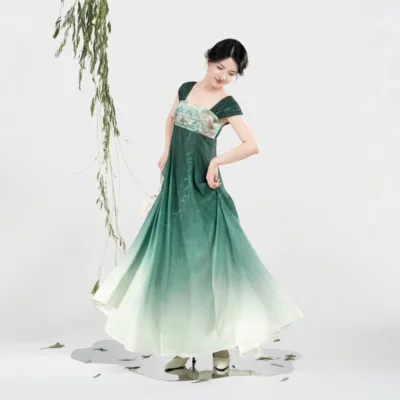
Above 20 C, the lightest formula works: a thin Jiaoling shirt or camisole under a Mamianqun (马面裙) or pleated skirt, finished with a lightweight Pifeng. Thin gauze Pifeng were worn in Ming summers for shade and breeze, so a sheer woven-gold, jacquard or matte-satin piece reads as period-correct while staying breathable. Keep the Pifeng about one shade lighter than the inner layer so the whole outfit does not turn muddy.
Between 10 and 20 C, the classic Ming pairing takes over: a standing-collar long jacket or Daopao under the Pifeng. The three-piece formula of short jacket, Mamianqun and Pifeng suits wearers who want to hide a broader back or shoulders: the short jacket ends above the hips, the Pifeng drops from the shoulder to the calf, and the fuller Pifeng sleeves create a three-layer cuff that makes the arms look slimmer. Mid-weight woven-gold or jacquard gauze works here.
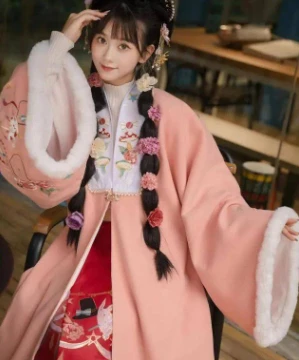
Below 10 C, switch to a padded Pifeng or a Doupeng over a thick Jiaoling jacket and Mamianqun. Ming winter Changyi were lined with cashmere and sable; modern equivalents add fleece or cotton batting. Both the Pifeng and the Doupeng block wind well, and a Pifeng with a plush trim reads playful rather than heavy if the color stays bright.
Two fit details settle most styling questions. Let the inner collar and cuffs show slightly at the front opening for depth, and let the waistline decide the belt: a slender waist can take an outside sash, while a fuller middle is better served by letting the Pifeng hang open. A shoulder bag, a round fan (Tuan Shan) or a hairpin finishes the look.
Pifeng as Everyday Wear
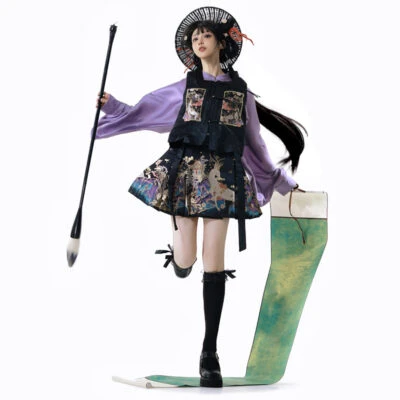
The Pifeng is one of the few Hanfu pieces that sit comfortably next to ordinary clothes. A Pifeng with little embroidery and a muted color works over a long dress, or over a shirt and wide-leg trousers in the popular “Hanfu-adjacent commute” style. A thin one doubles as a sun jacket in summer and an air-conditioning layer in early autumn; a heavier one stacks over a sweater in deep autumn. One coat spans three seasons, which is why regular Hanfu wearers call it the highest-use item in their wardrobes.
From a noble’s casual coat in the Ming to a commuter’s autumn layer today, the Pifeng keeps the same dignified front-opening silhouette and the same flexible layering logic. The old documents settle what it is; the new outfits decide how it is worn.