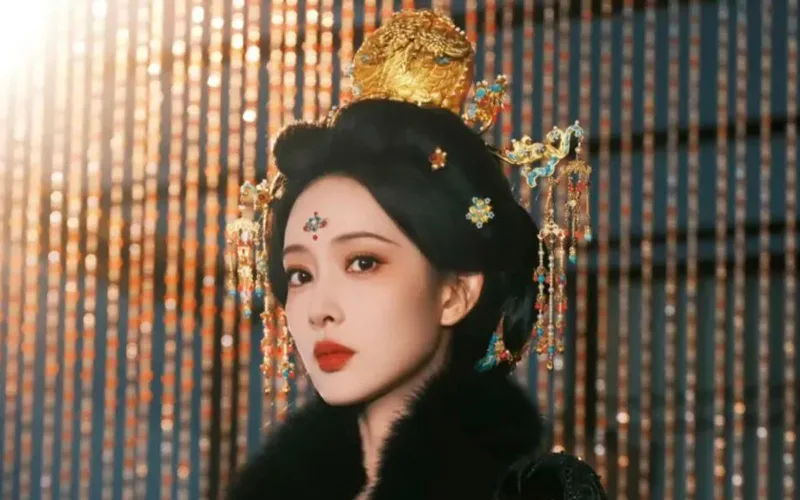
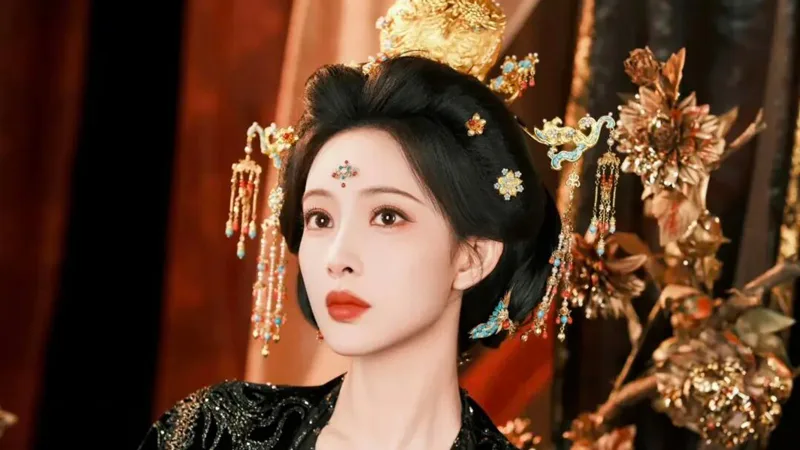
Why would a princess wear a peach on her head? In Tigers Sniff the Rose (尚公主), Meng Ziyi (孟子义) plays Mu Wanyao (暮晚摇), a royal woman whose peach-shaped crown catches the eye at once. It looks strange beside the familiar phoenix crowns and flower-hairpin crowns of many period dramas. The design is not a writer’s whim. Its outline borrows from murals in Dunhuang (敦煌), especially images linked to the Tang and Five Dynasties. A single peach sits at the center, clean and strong, without a dense forest of gold flowers. That shape points to a real mixing of tastes along the Silk Road. The crown is a small object with a long conversation behind it.
Desert Blend
The peach outline did not begin in the Central Plains. It grew from Uyghur women’s headwear. Those wearers liked tall shapes that rose upward and could be read at a distance. The crown gave a grave, formal presence. In the Central Plains, noble women used another set: phoenix pins, flower ornaments, hairpins and swaying steps. Those pieces worked as groups, with phoenix patterns and rules of rank. One side favored a bold silhouette; the other favored fine symbols and ceremony. Neither style was waiting to become the other. They met because people moved, traded, married and sponsored Buddhist works in the same oasis towns. The result was not a simple copy. It was a new object made by contact.
Cave 61 at Dunhuang shows this blend. The cave was built under the Guiyi Army (归义军), a local power. Cao Yuanzhong (曹元忠) and his wife helped fund it; his family name marked the era. On the wall, the crown keeps a Uyghur frame: a peach-shaped body with a clear, lifted line. Its decoration, however, speaks the language of the Central Plains. Phoenix motifs, engraved patterns, and matched pins sit on that frame. The wearer is a donor, not a model in a fashion plate. The crown shows what local elites chose to present in a sacred place. It also shows how a border town could hold several visual languages at once without breaking them.
Why did this shape survive? Dunhuang sat on busy routes. Merchants, monks, brides and officials passed through. Trade goods were not the only cargo. Dress, prayer and taste traveled too. A crown could be ordered, copied, adjusted and worn again. The Guiyi Army period made such exchange normal. Marriage ties and temple gifts gave families reasons to display foreign and local signs together. The peach crown fits that habit. It does not hide its mixed roots; it wears them. For a modern viewer, the surprise comes first. Then the details pull the eye closer: a foreign outline, local phoenix work, and a donor’s wish held in gold and paint.
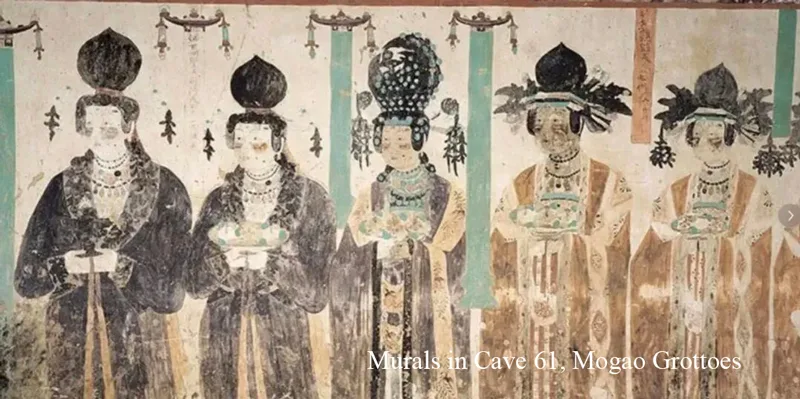
The crown in Cave 61 is often called a peach-shaped phoenix crown. That name is useful, but it can mislead. The frame is not a Central Plains phoenix crown with a peach stuck on top. The frame is Uyghur; the phoenix language is local. Metalwork gives the surface its fine lines. Pins and side ornaments complete the set. The mix is practical, not abstract. A workshop had to make one object that could be worn by a real woman in a real ceremony. That pressure produced balance. The crown is a compromise that looks confident, not confused.
Peach as Prayer
The peach is not only a pretty fruit. In old Chinese thought, it stood for long life and a complete, safe future. The Jade Pool myth gave peaches a sacred shine. A peach-shaped crown, then, carried more than style. It turned a wish into something a person could wear. Donors paid for caves and murals as acts of devotion. Their portraits placed them near holy figures. The crown acted like a small crown for the living donor. It joined public wealth, private hope and ritual display. That is why the object feels serious even when it looks playful. It is a prayer with a clear outline, set above a human face.
In Tigers Sniff the Rose, the crown suits Mu Wanyao. Her world is crossed by rival groups. She moves among different customs and must read them quickly. A tight Central Plains diadem might make her look sealed off. The peach crown gives her a more open edge. It marks her rank, yet it also hints at travel, contact and duty. She can be soft and still have backbone. The crown does not make her a passive ornament. It gives her a visual task: to stand between groups without belonging fully to one. That tension is useful for a character in a border story. The object does dramatic work.
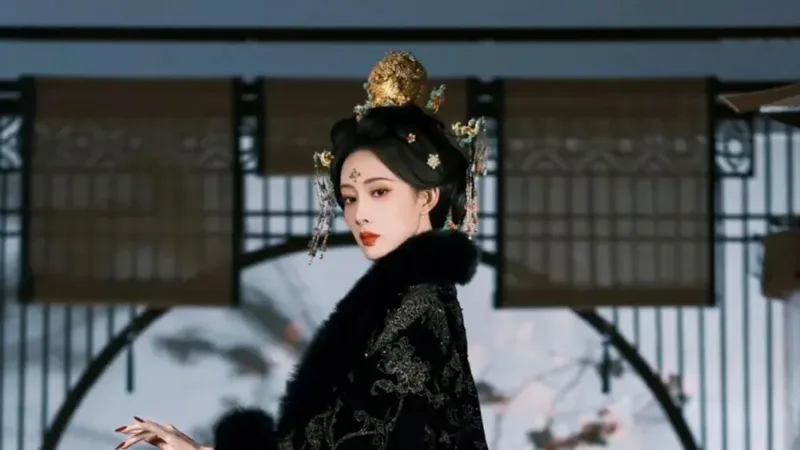
The show’s choice also reminds viewers that period design can be research, not guesswork. A peach on a princess’s head may look like fantasy. Behind it sit murals, donor portraits, local politics and craft. The crown traveled across time before it reached a screen. It was painted in a cave, studied by designers, rebuilt as a prop, and worn by an actor. Each step changes it a little. Still, the core remains: a shape made when people did not live in separate boxes. Does that make the crown strange? Yes. Does it also make it memorable? Very much so.
Today, viewers may see the crown as a cute oddity. That reaction is fair; the peach is large, and the outline is unusual. But cuteness is not the whole story. The crown asks a better question: who gets to define a royal look? In a border zone, the answer is rarely one court, one tribe or one school. It is a chain of makers, patrons and wearers. The show places that chain on a princess’s head. The result is not a lecture. It is a visual hook that leads to history. A strange shape can open a door.