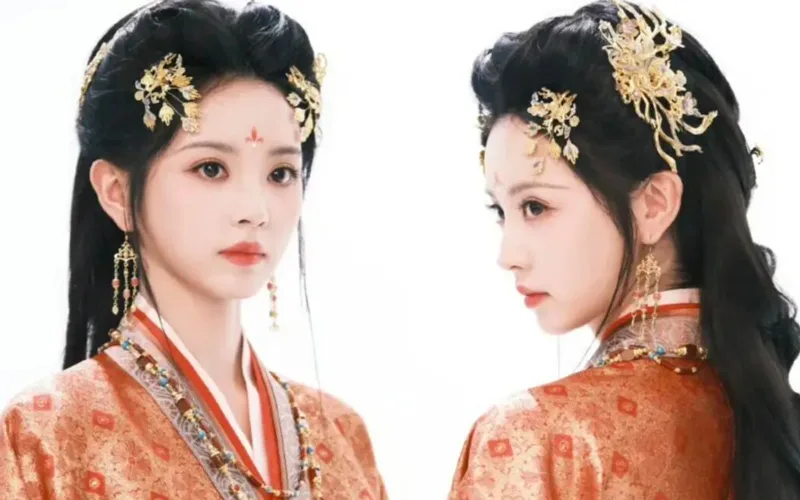
In the new costume drama Where the Mask Ends (嫁金钗), Tian Xiwei (田曦薇) wears a Han-style look that has caught many viewers’ eyes. Most period shows fill hair with phoenixes, silk flowers, and long gold tassels. Her leaf ornaments are quieter. They look clean, soft, and easy to keep watching. Many people assume the crew invented a small trend. The shape is older. It points to real jewelry from the Han Dynasty, and it carries an early view of nature: respect, copying, and hope. The surprise is not the leaf itself. The surprise is how much a simple shape can say when the details are right. A small choice on screen can open a door to older taste.
Han Roots
The leaf pieces borrow from an early dangling hair ornament. In many dramas, that ornament means long bead strings and heavy movement. Early Han examples were not so showy. An Eastern Han dictionary, Shiming (释名), gives a plain definition: it has hanging beads, and it shakes when the wearer walks. That is the basic rule, not a fixed fancy style. Once you drop the modern image of a giant golden tassel, the leaf shape makes sense. It hangs, it moves, and it stays light. The show turns that old rule into a screen-friendly look without losing the main idea. It keeps the swing and cuts the noise.
Objects and images support this. The silk painting from Mawang Dui (马王堆) tied to Xin Zhui (辛追), plus Western Han finds, show leaf and petal pendants as common hanging forms. Western Han taste leaned toward plain, clear lines. Small chains and beads did the work. Later, in the Eastern Han, craft grew more complex. Tassels became longer. Shapes became richer. Her ornament follows the earlier, quieter side of that history. It is not a random fantasy piece. It is a modern filter on an old form, and the filter works because it keeps the form’s simple weight.
Wearing it also made practical sense. Han dangling ornaments often used a long, densely toothed base with holes, not a single stick. That base gripped the hair. It also gave leaves and beads a place to hang. The result stayed firm during movement. So the soft look did not mean a loose fit. This matters on screen. A costume piece can look delicate and still be built with clear logic. The leaf ornament is a good example: light in appearance, stable in structure. That balance is why it reads as calm rather than careless.
Natural Logic
Why did Han people like leaves and petals? Nature was close and serious. Plants stood for life that keeps going. People lived by rivers, fields, and trees. Good seasons meant food; bad seasons meant risk. Over time, that daily dependence became respect. A leaf on a hair ornament was not just a pretty copy. It carried a wish for growth, safety, and a smooth year. The shape was simple, but the feeling was not small. It joined beauty to a plain hope that most people could understand.
Leaves also fit the ornament’s job. A leaf is a pure natural form. Its lines open and spread. It does not need carved beasts or crowded flowers to hold attention. When the wearer walks, the leaf sways with the step. The movement is relaxed, not noisy. That easy swing gives the look a calm lift. Han design often placed the human body inside nature rather than above it. A leaf at the side of the head can suggest that idea without a speech. It is a small object, but it lets the body, the material, and the air work together.
Later courts preferred richer displays. Phoenix birds and full flowers became common. The plain leaf ornament slowly left the main stage. That loss was not about quality. Taste changed. Modern costume dramas often repeat the richer side: more gold, more beads, more height. Too much at once can feel heavy. A leaf shape gives the eye a rest. It also asks for close looking. The quiet detail, not the pile, holds the frame. This is why the look stands out even beside louder designs. It does not fight for attention; it earns it.
So the leaf hairpin is not a small gimmick. It is a clean link between an old form, a natural idea, and a modern camera. The show does not need to explain it in dialogue. The shape does the work. Real Chinese style is not always a stack of gold and silk. Sometimes it is a leaf, a thin chain, and a steady base. Do you like this kind of simple ornament with fine detail? It may look modest, but that is exactly why it stays in mind.