
The Zhiju (直裾) is one of the most basic — and most misunderstood — forms in the traditional Chinese wardrobe. It stands alongside the Quju (曲裾) as one of the two branches of the Shenyi (深衣), yet claims like "the Zhiju equals the chanyu" and "the Zhiju equals the straight-hem Shenyi" have confused Hanfu enthusiasts for years. This guide follows the physical evidence — the Zhiju plain-gauze unlined robe in the Hunan Museum's Mawangdui collection and the Warring States straight-hem robes from the Mashan Chu tomb in Jiangling, Hubei — alongside the Jijiu Pian (急就篇), the Book of Han (汉书) and the Records of the Grand Historian (史记), to trace how the form evolved through the pre-Qin and Han periods and how it returned in the modern Hanfu revival.
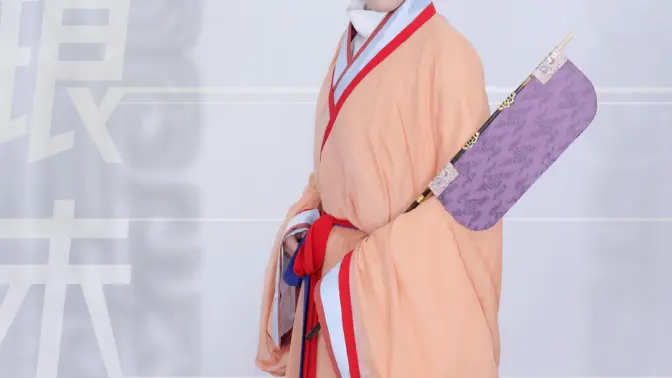
What Zhiju Is: A Hem That Falls Straight
"Ju" (裾) means the front skirt or lapel extension of a garment. On a Zhiju, the lower hem is cut vertical: the skirt falls beside or behind the body, there are no sewn-on ties, and the robe is held by a cloth or leather belt. Compared with the Quju Shenyi — whose lapels wrap around the body layer by layer down to a trailing hem — the Zhiju's lapels fall straight down without binding the body, giving a clean, brisk line.
The Han dynasty primer Jijiu Pian records: "The chanyu is a straight-hem unlined garment" (襜褕,直裾禅衣). The Tang commentator Yan Shigu (颜师古) glosses "ju as the skirt of the garment; the chanyu has a large skirt." Scholars point out that the unlined dan garment and the same-cut Shenyi "do not separate top from skirt, and the hem runs straight through" — which is why equating "Zhiju" with "straight-hem Shenyi" outright is a mistake: the Zhiju is a way of cutting the hem, while the Shenyi is an integrated upper-and-lower structure. The two are overlapping categories, not synonyms.
The earliest Zhiju garments yet excavated come from Mashan Tomb No. 1 in Jiangling, Hubei. The mid-Warring States tomb yielded more than ten straight-hem robes in silk, gauze, leno and brocade, all with crossed collars, right lapels, straight hems and long sleeves, with the upper and lower parts joined in one piece — the most direct physical proof of the pre-Qin form.
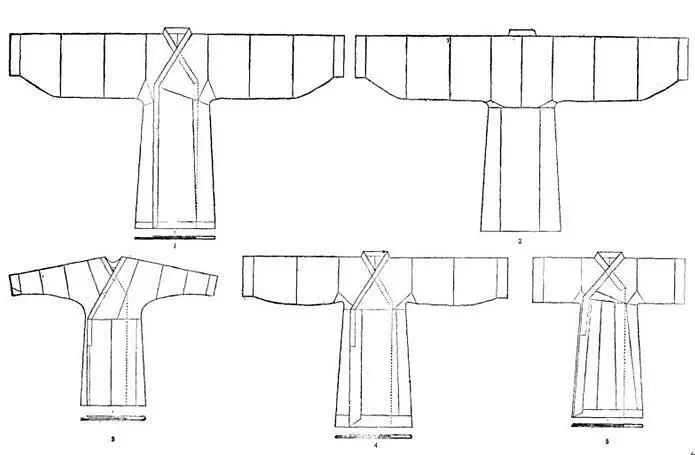
Mawangdui: The 49-Gram Plain Gauze Robe
By the Han, examples multiply. The most celebrated is the Zhiju plain-gauze unlined robe (素纱襌衣) from Mawangdui Tomb No. 1 in Changsha, excavated in 1972. The Western Han garment is 128 centimeters long with a sleeve span of 190 centimeters, uses about 2.6 square meters of fabric, and weighs just 49 grams — under one liang. Strip out the cuffs and collar, and the robe proper weighs only about 25 grams; folded, it fits inside a matchbox. It has been praised as "thin as a cicada's wing, light as mist." Its cut is a crossed collar, right lapel and straight hem, in the style of the upper-and-lower-joined Shenyi popular at the time; the body is plain gauze edged with geometric velvet-loop brocade, and because it has neither color nor lining, the tomb inventory listed it as a "dan garment." The Shuowen Jiezi (说文解字) defines "dan" as "a garment without double layers," and Zheng Xuan's note to the "Yuzao" chapter of the Book of Rites glosses it as "unlined."
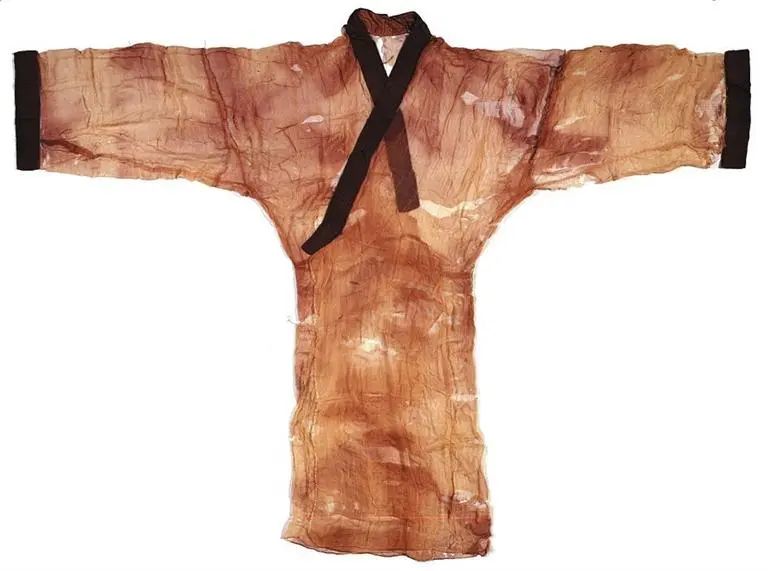
The weaving represents the peak of early Western Han sericulture and textile technology. The robe is a square-mesh plain weave of single warp and single weft: warp density of 58 to 64 threads per centimeter, weft density of 40 to 50 threads per centimeter, about 75 percent open space, and a fabric weight of just 15.4 grams per square meter. The silk filament runs only 10.2 to 11.3 denier — modern premium silks still run about 14. When the Tang poet Bai Juyi (白居易) wrote in "Liaoling" (缭绫) that the tribute silk was "like a waterfall of forty-five chi before the bright moon on Tiantai Mountain," the excavated robe proved the hyperbole was, in fact, a report.
Mawangdui Tomb No. 1 actually yielded two plain gauze robes: beside the 49-gram Zhiju one, a Quju plain-gauze robe measuring 160 centimeters long, 195 centimeters in sleeve span, 27 centimeters at the cuff and 48 centimeters at the waist, weighing 48 grams — the earliest, best-preserved, most finely made and lightest garment surviving in the world. The tomb also produced a printed-and-painted gauze Zhiju silk-padded robe and a crimson printed-gauze extended-lapel Zhiju padded robe, cuts that continue the line of Warring States women's padded garments.
Why the Straight Hem Replaced the Wrapped One
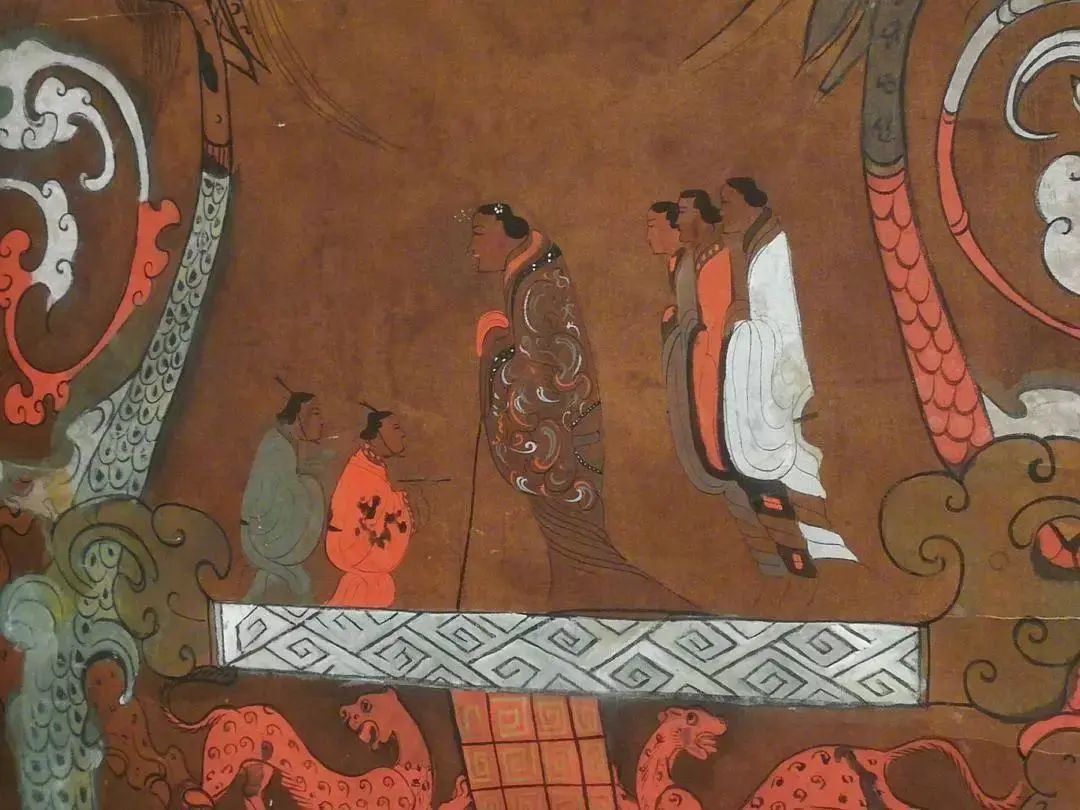
The chanyu steadily displaced the Quju through the Qin and Han to become everyday wear for both men and women. The Book of Han notes: "The zhuyu (chanyu) is a large-flapped garment, like the guiyi worn by women." In the last years of Wang Mang's Xin dynasty, soldiers of the Three Auxiliaries who went east to welcome the Gengshi Emperor's troops mocked the generals for wearing "women's clothes — embroidered zhuyu," evidence that the chanyu was a fashionable women's outer garment in the Han: both sexes could wear it, but in its early days it could not serve as formal dress and had to be worn under a Quju Shenyi.
The Records of the Grand Historian, in the biography of the Marquis of Weiqi and the Marquis of Wu'an, records that in the third year of Yuanshuo (126 BCE), Tian Tian (田恬), the Marquis of Wu'an, was convicted of "disrespect" and stripped of his fief for entering the palace in a chanyu — proof that even in the Western Han, the straight-hem garment was still bound by ceremonial rules in formal settings. The root cause lay in the underwear system: trousers of the time had no crotch, and the open straight hem risked exposing what lay beneath. As undergarments improved after the Han, the body-wrapping Quju that had prevailed in the pre-Qin and early Western Han became redundant, and the vertical-hemmed Zhiju, no longer binding the body, spread and won.
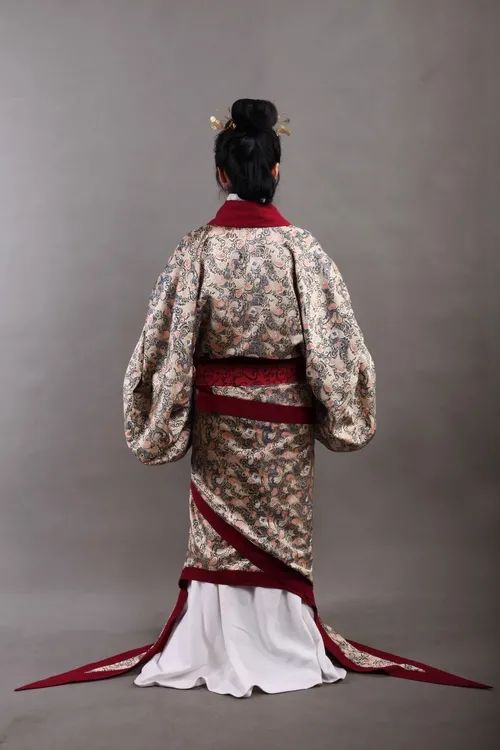
Only in the Eastern Han did the chanyu appear at banquets and other formal occasions, becoming shared fashionable dress for men and women, and it gradually converged with the robe. The pao was cut through in one length and adopted the straight hem, whereas the Shenyi was joined at the waist; as the pao and the straight hem merged, the word "chanyu" itself faded from the stage. In the Eastern Han the pao was fixed as court dress, graded by fabric quality and color. The straight-hem cut had a long afterlife: it later gave rise to the Zhiduo (直裰) and the Zhishen (直身), forming one of the major lineages of traditional Chinese menswear.
Modern Afterlife
Modern transmission of the Zhiju is most vividly told through the replication of the Mawangdui gauze robe. The Hunan Museum once commissioned a reproduction of the 49-gram Zhiju plain-gauze robe, but the first copy weighed more than 80 grams. Researchers discovered that modern silkworms, having evolved to larger bodies than their Han counterparts, spin thicker, heavier silk. The team shrank the silkworms with a special diet, and the slender insects' silk finally produced a 49.5-gram replica — thirteen years of work in all. On May 18, 2024, the Hunan Museum and the Nanjing Yunjin Research Institute completed a reproduction of the printed-and-painted gauze Zhiju silk-padded robe after more than two years, reaching 95 percent similarity to the original. In 2002 the Western Han Zhiju plain-gauze robe was placed by the State Administration of Cultural Heritage on the first batch of national relics prohibited from being exhibited abroad, sealing its status as a national treasure.
In the Hanfu revival, the Zhiju has regained popularity on the strength of its clean lines and scholarly poise. The 2026 autumn-winter Hanfu consumption rankings put the Zhiju (Jin-style crossed collar) among the hot sellers, alongside Warring States robes with trailing hems and Song-style "airplane sleeves." From Lady Xin Zhui's (辛追夫人) gauze robe in Mawangdui to the straight-hem robes in young people's wardrobes today, this "hem that runs straight through" has remained one of the most enduring forms in Chinese aesthetics across two thousand years.
