
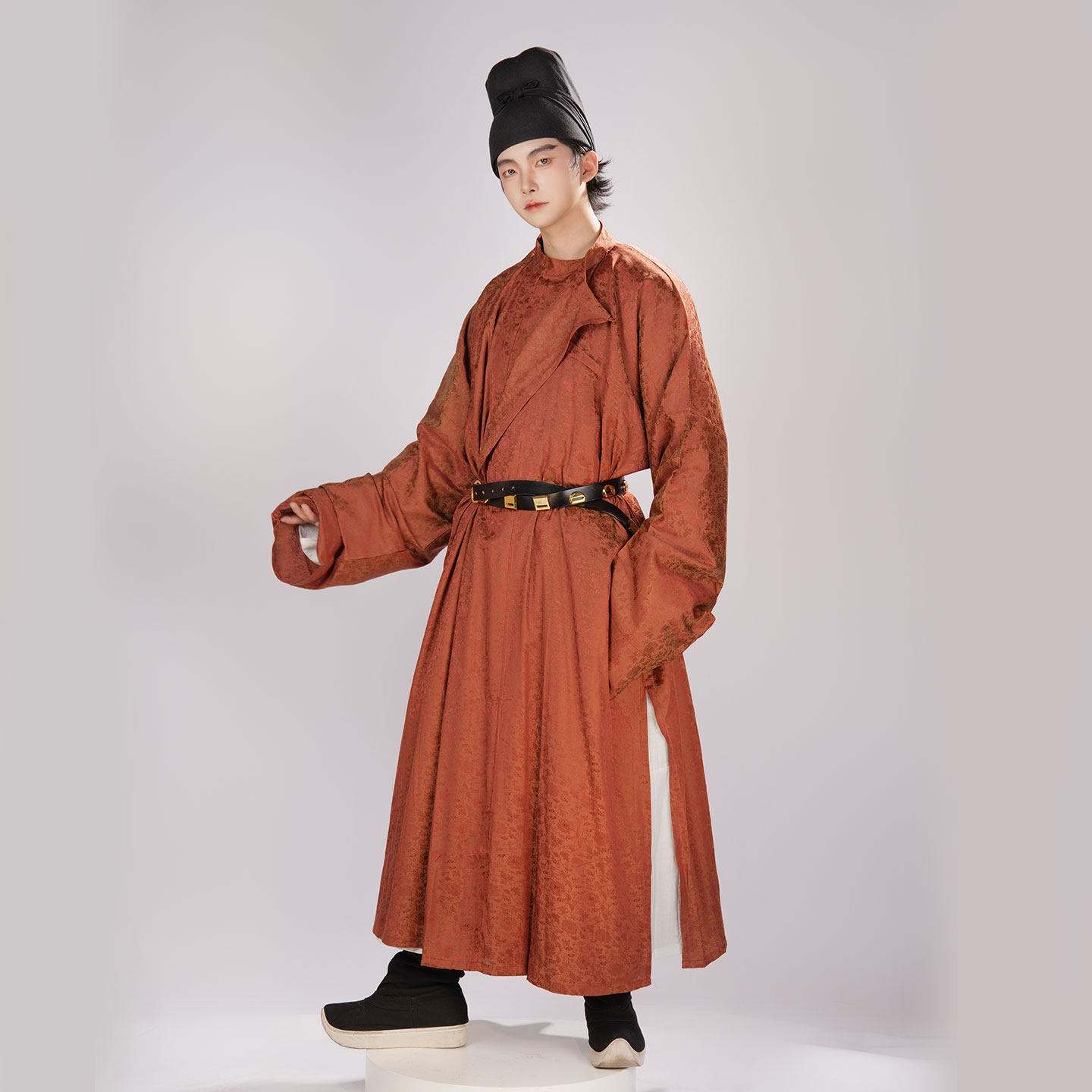
Closed with crossed lapels and cloth or metal buttons, the Yuanlingpao (圆领袍) covered the body more tightly than any Jiaoling (交领) garment of the older Han wardrobe — yet within three centuries it became the most common dress in the Tang empire. Emperors wore it, officials wore it, and commoners wore it, to the point that contemporaries could say of Tang men that "from the Son of Heaven down to the hundred offices and the mass of the people, one and the same style prevailed." This guide traces how a steppe garment was absorbed, ritualized, and turned into the national dress of Tang China, and how its descendants still appear in East Asian costume and modern Hanfu styling.
Origins: A Slow Move from Underlayer to Outerwear
The history of the round collar reaches back to the Han dynasty. Murals and excavated objects show round-collared garments worn beneath outer robes in Han times and earlier, mostly as underwear, with only isolated cases of direct outerwear. After the Eastern Han, round-collared clothing gradually moved outside. During the Wei, Jin, and Northern and Southern Dynasties, the great ethnic migrations of the period carried the tight, practical short jackets, trousers, and long boots of the northern peoples far and wide, and the Yuanlingpao began to appear as an outer garment, its cut maturing into a stable form. By the late Northern Dynasties, the narrow-sleeved round-collar robes favored by Central Asian peoples were widespread: in the murals of the Jiuyuangang Northern Dynasties tomb in Xinzhou, Shanxi, warriors, guards, attendants, and even women all wear them, evidence of how thoroughly the style had spread.
The Tang fashion for "women in men's dress" was closely tied to this spread. Northern Dynasties figurines and murals already show the phenomenon — the hand-in-hand female figurines from the Northern Wei tomb of Yang Ji (杨机墓) and from the Wanzhang Northern Dynasties tomb in Ci County (磁县湾漳) are dressed in male trousers-and-jacket outfits (裤褶). The trend flourished in the Tang, where dashing women in men's clothing could be seen in both court and streets.
Sui-Tang Adoption into State Dress
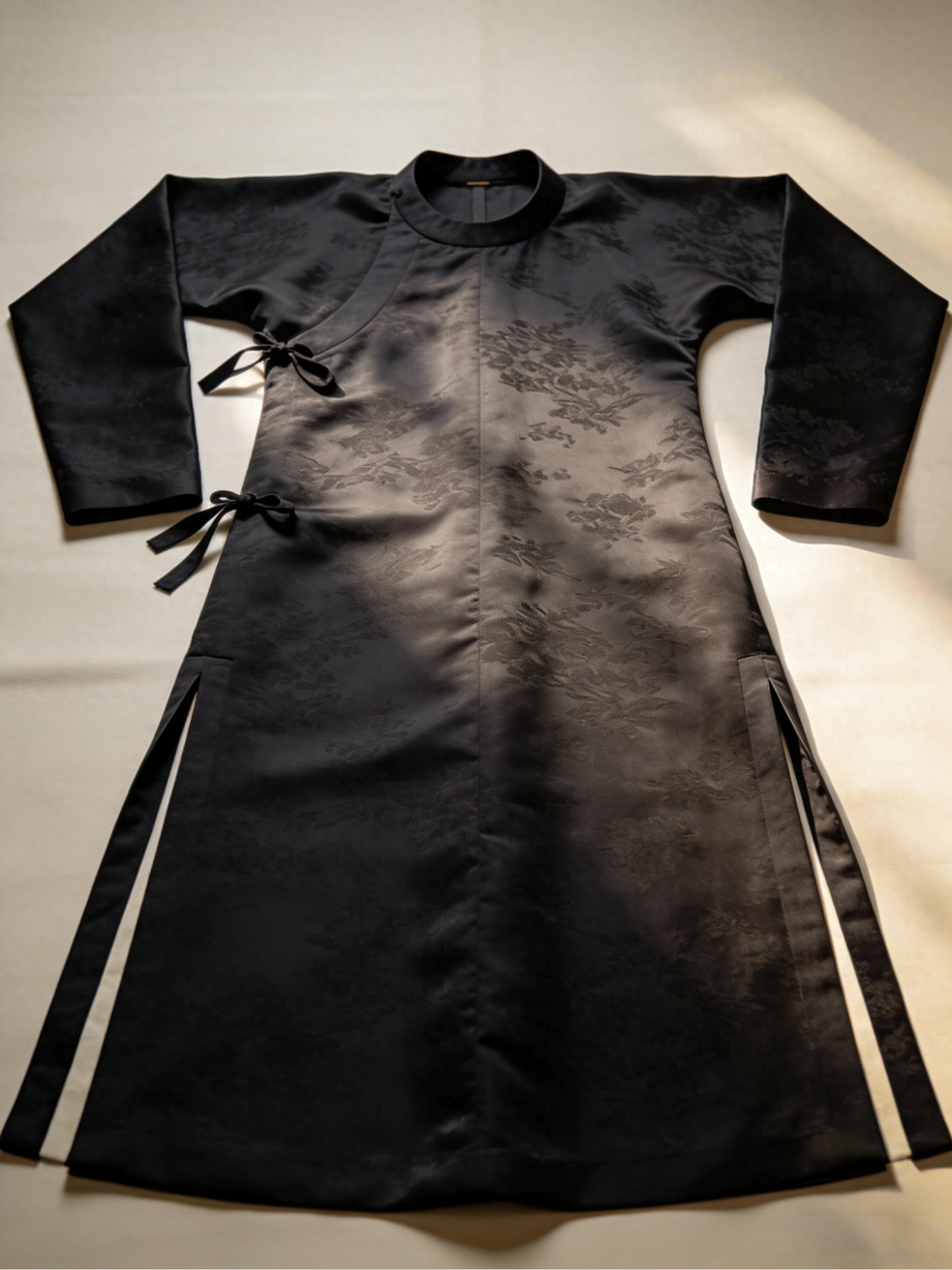
With the Sui-Tang reunification, the blended Hu-Han dress culture that had built up since the Northern Dynasties reached maturity. Trousers-and-jacket sets, the Yuanlingpao, and long-shaft boots were written into the state's sumptuary regulations. According to the Old Book of Tang (旧唐书), in its section on dress regulations (舆服志), Tang clothing was organized into four grades — casual dress, semi-formal dress, court dress, and sacrificial dress. The round-collar robe served as the core of the casual dress grade, and its status rose steadily as the outfit worn by aristocrats and officials for government business and refined gatherings, while the older-style grades of court and sacrificial dress retreated into ever-narrower ceremonial occasions.
The murals of the tomb of Li Xian, Prince Zhanghuai (章怀太子李贤墓), visualize this institutional blending. In the wall painting Envoys (客使图), officials of the Court of Diplomatic Reception wear the wide-sleeved, sashed robes of the old ritual system; in Hunting Excursion (狩猎出行图) and the corridor guards, by contrast, the same court's men wear Futou (幞头) headwraps, narrow-sleeved round-collar robes, and black boots. Motifs fused along the same lines: Sasanian linked-pearl roundel medallions and Buddhist baoxianghua flower patterns (宝相花) merged with indigenous auspicious motifs to mark an official's rank.
Yan Liben's (阎立本) famous scroll Emperor Taizong Receiving the Tibetan Envoy (步辇图) depicts the audience given in 641 (the fifteenth year of Zhenguan) to the Tibetan envoy Ludongzan (禄东赞), who had come to Chang'an to escort Princess Wencheng to Tibet. Every figure in the painting — including the emperor himself — wears a narrow-sleeved round-collar robe. Shen Congwen (沈从文) singled out Ludongzan's small-sleeved round-collar brocade robe as a textbook example of the type. The administrative code Six Statutes of the Tang (唐六典) records that the court ordered Yizhou (益州, modern Chengdu) and Guangling (广陵, modern Yangzhou) to present "guest envoy brocade robes" as imperial gifts each year; in 729 (the seventeenth year of Kaiyuan), when the Turgesh chieftain Yezhi Abusi came to court, he was "appointed general and presented with a purple robe, gold belt, and fish tally."
Ma Zhou's Lan and the Birth of the Lanpao
The Yuanlingpao did not enter the Chinese wardrobe unchanged; it underwent a process of ritual domestication. During the reign of Emperor Taizong, the Grand Councilor Ma Zhou (马周) submitted a memorial: "The rites contain no provision for a robe of this kind, but the institutions of the Three Dynasties had the Shenyi (深衣). Let a cross-band be added at the hem, with cuffs, borders, and edging, to make it the formal upper garment of the scholar-official. A slit-sided version is called the quekua shirt, and it is for commoners." Zhangsun Wuji (长孙无忌) added: "Let those who wear the robe have a cross-band added below; crimson, purple, and green according to rank, and white for commoners." Two forms resulted. The slit-sided quekua robe (缺骻袍), open at both side seams for ease of movement, became the everyday wear of the common people; the hem-banded robe (襕袍), closed at the sides with a horizontal band added at the hem in imitation of the archaic Shenyi's "upper garment and lower skirt" principle, was worn by officials and on ceremonial occasions. With this codification the Yuanlingpao, originally a tight, narrow-sleeved steppe garment, began its long evolution toward the wide-sleeved, full-bodied Han style of the Song and Ming dynasties.
Rank Colors: Purple, Crimson, Green, Blue
Because the round-collar robe was so uniform in cut, the old ritual system's distinctions were hard to read at a glance, so Tang officials were graded by color. The Tang Huiyao (唐会要) records: "Third rank and above wear purple; fourth and fifth ranks wear crimson; sixth and seventh ranks wear green; eighth and ninth ranks wear blue. Women follow the color of their husbands." After the An Lushan Rebellion the colors of semi-formal dress were adjusted — third rank and above kept purple, while ranks four through nine were distinguished by darker and lighter shades of crimson, green, and blue, the darker reserved for the higher of the two grades. In the later Tang, color violations that the authorities could not suppress became a running theme — commoners chasing purple and crimson robes, some even forging "military commission" documents to justify their dress — and the sumptuary order eroded from within.
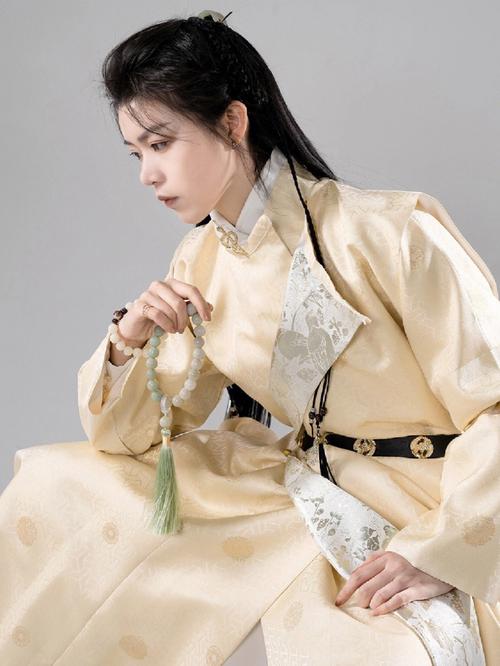
In the Ming dynasty the robe carried rank through embroidered square badges called Buzi (补子): civil officials wore birds, military officials wore beasts, with python-like mang motifs and qilin (麒麟) added at the top levels. Ming dress also reached beyond the border: the official robes of the Korean Joseon court were modeled on the Ming Yuanlingpao almost exactly, differing only in hem length and the size of the badges.
Women in Men's Dress: The Boldest Fashion of the Kaiyuan Era
Nothing shows Tang openness better than the vogue for women in men's dress, which became common in the Kaiyuan and Tianbao years. Lady Guo (虢国夫人), sister of the imperial favorite Yang Guifei, appears in the scroll Lady Guo's Spring Outing (虢国夫人游春图) — of the nine women riding in the procession, five wear men's round-collar robes, trousers, and boots under Futou headwraps — and the fashion also appears in the scroll Ladies with Fans (挥扇仕女图). Excavated figures agree: the tomb of Princess Jinxiang (金乡县主), a granddaughter of Emperor Gaozu, yielded a female rider figurine in a peacock crown, round-collar robe, leather belt, and black leather boots; two further female hunting figurines from the same tomb wear white narrow-sleeved slit-sided round-collar robes, waist chains, and black boots — unmistakably male ensembles. Where men's robes were plain, women's round-collar robes were bright and heavily patterned: the Dunhuang mural The Lady Governor Paying Homage to Buddha (都督夫人礼佛图) shows a woman in a round-collar robe, and the contrast between men's solid colors and women's florid decoration was itself a portrait of Tang taste.
Song-Ming Evolution
In the Song dynasty the Yuanlingpao became a formal garment for officials, paired with the hem-banded robe in deference to ancestral institutions. Scholar-officials of the Song and Ming wore white round-collar robes with black edging and a single horizontal band at the hem — a cut that never opened at the sides, echoing the ancient Shenyi. The Ming added the Buzi badges, enlarged the sleeves, and introduced mang and qilin motifs, making the robe the direct ancestor of the official uniforms of the Ming and Qing civil service.
The Yuanlingpao's influence ran beyond China. Japan's Asuka period adopted the robe into its own costume system in imitation of Tang institutions, and the Korean Joseon court's version was, as noted, nearly identical to the Ming original. Together with Silla and parts of the Central Asian world, these courts shared a common vocabulary of dress — a round-collar garment culture that became one of the collective memories of East Asian civilization.
Wearing the Yuanlingpao Today
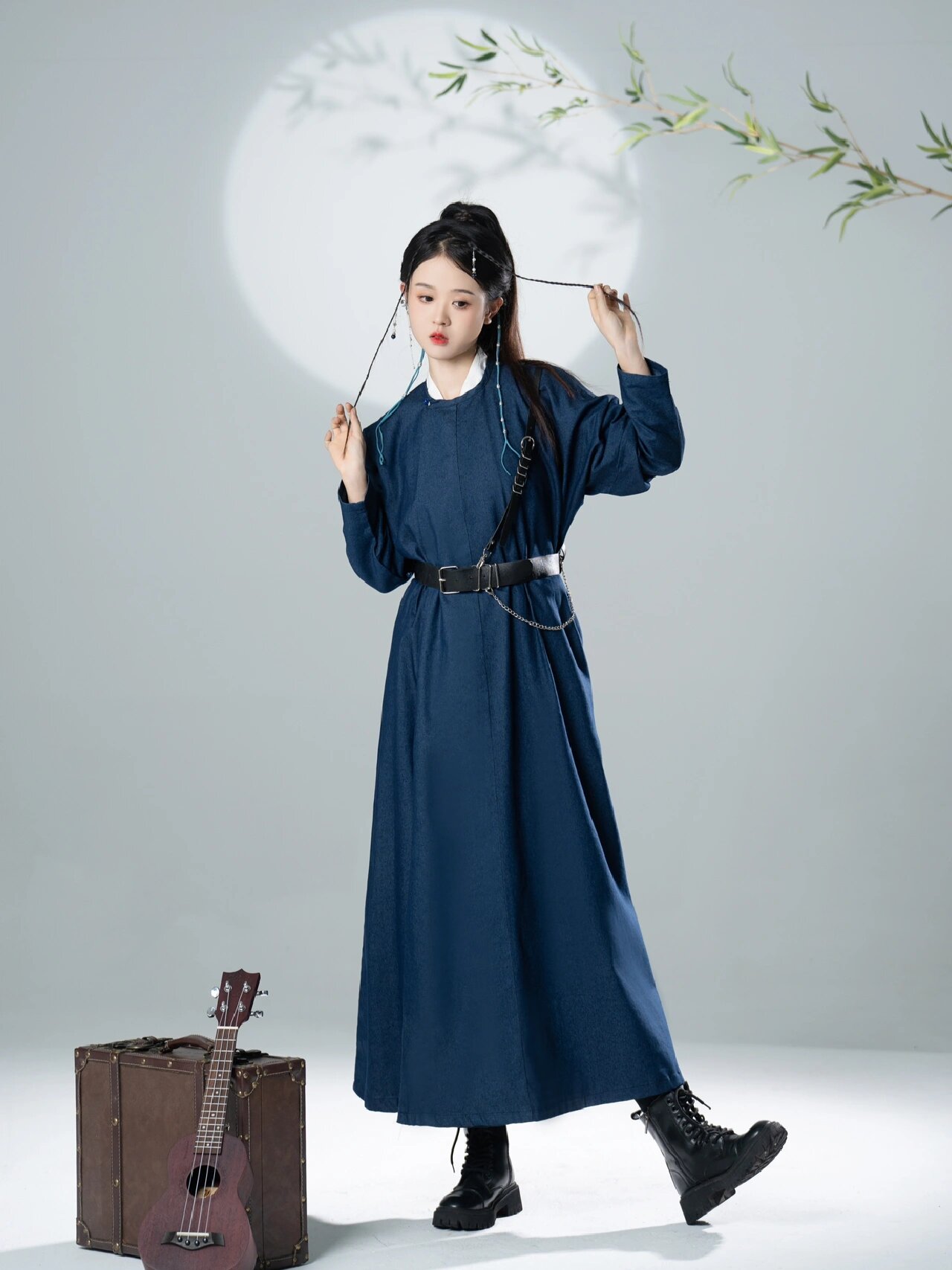
Modern styling follows a clear layering order: first the round-collar under-robe and trousers; over them a Banbi (半臂) short-sleeved jacket; then the Yuanlingpao itself, secured with a leather or cloth belt. Typical accessories are the Futou headwrap, a Diexie belt hung with small straps (蹀躞带), and boots. The sleeve evolved through straight, arrow, and wide forms, and modern wearers choose by occasion: a straight- or arrow-sleeved slit-sided robe for daily wear, a wide-sleeved hem-banded robe for formal events. The round collar's comfort and practicality need no defense — it survives in contemporary clothing design as a constant, one more proof of a thousand-year-old garment that never quite went away.
