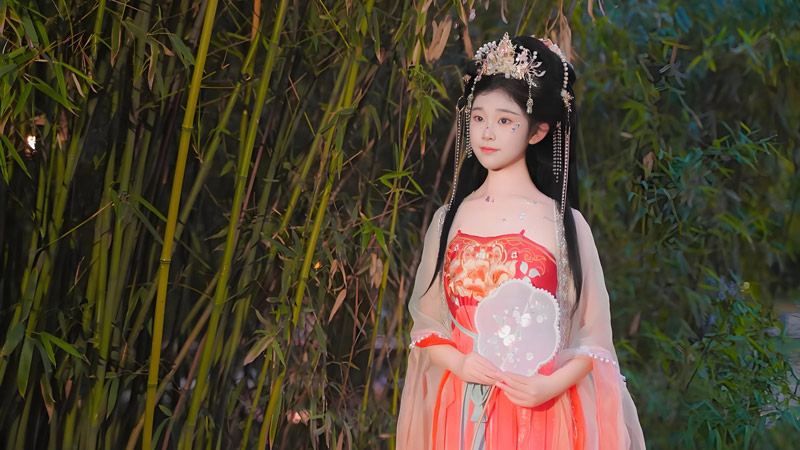
Hanfu isn't just clothing. It is a walking philosophy, a visual etiquette manual, and a three-thousand-year-old aesthetic system that the Chinese people have worn on their backs. If you have strolled through any historical site or popular Instagram spot in China recently, you have seen it—flowing robes, wide sleeves, and a quiet elegance that stands out in a crowd.
Yet, ask the average person what it is, and they will likely say it is the costume of the Han Dynasty. That is the most common misconception. Hanfu is not the fashion of a single dynasty; it is the complete, mature, and unbroken clothing system of the Han Chinese people, stretching from the Zhou Dynasty to the Ming Dynasty. It carries the weight of ritual, the balance of nature, and the very definition of what it means to be "Hua" (华)—the character for splendid civilization.
Where Did It All Begin?
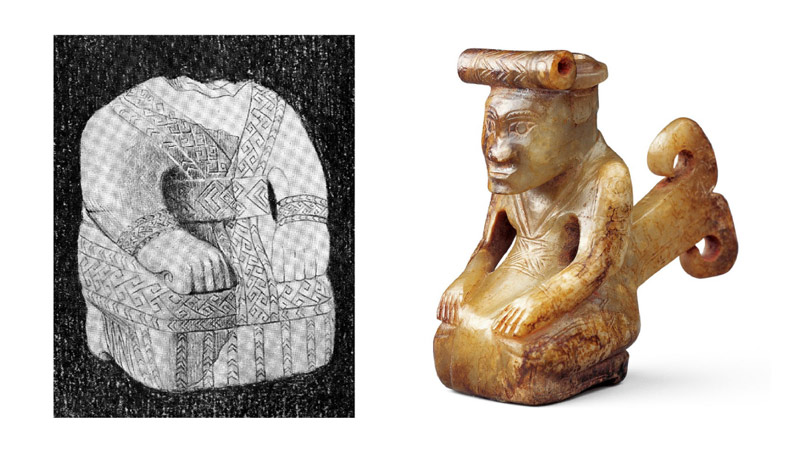
While the system matured later, its clear origin—the basic form and ritual concept—can be traced back to the Shang Dynasty. Excavations at Yin Xu (殷墟), the ruins of the Shang capital in Anyang (安阳), have revealed jade figures and bronze engravings that showcase a distinct style: crossed collars, right-over-left lapels, upper garments paired with lower skirts, and waist belts.
If the Shang was the era of foundational forms, the Zhou was the age of complete ritual. It was Zhou Gong (周公), the Duke of Zhou, who established the rites and music, meticulously linking clothing to rank, ceremony, and occasion. This system became known as the "Fuzhang System" (服章制度), a visual code that declared, "See the robe and know the ritual; see the emblem and know the rank." It turned abstract morality into visible attire.
The 4 Pillars of Hanfu
The system is vast, but its structure rests on four core archetypes, each with its own profound significance.
The Upper-Lower Garment System: This is the highest level of formal attire, used for imperial crowns and court robes. The top represents the sky, and the bottom represents the earth. It embodies the separation of heaven and earth, symbolizing cosmic order and majestic authority.
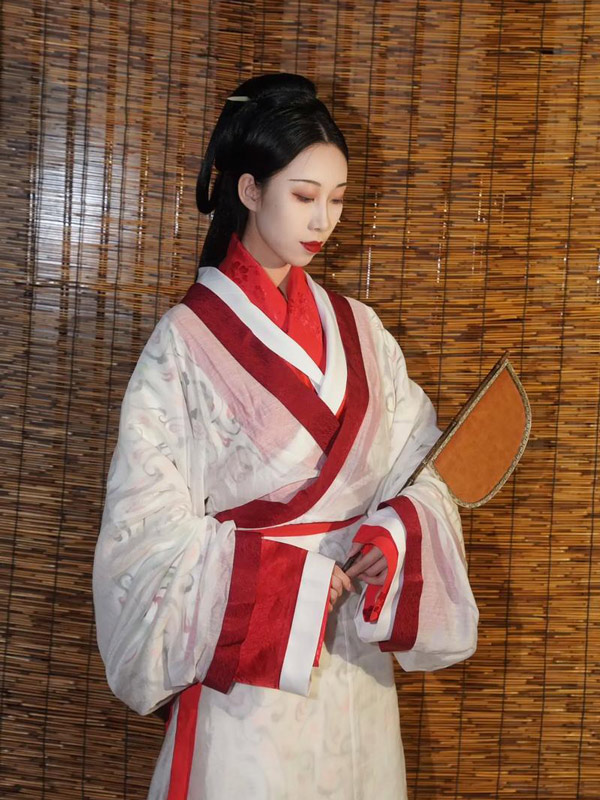
The Shenyi (深衣) System: Considered the philosophical heart of Hanfu, this garment is cut separately for the top and bottom but sewn together at the waist, signifying a unity of body and spirit. Its design is a map of the cosmos and morality. The round sleeves mirror the sky, the square collar reflects the earth, and the straight back seam stands for integrity. The four panels of the upper garment represent the four seasons, while the twelve panels of the skirt correspond to the twelve months of the year. Wearing a Shenyi is not just about covering the body; it is about embodying the rules of heaven and earth. During the Han Dynasty, the popular Quju (曲裾) style featured a long, wrapped hem, while the later Zhiju (直裾) offered a more practical, straight-hanging lapel.
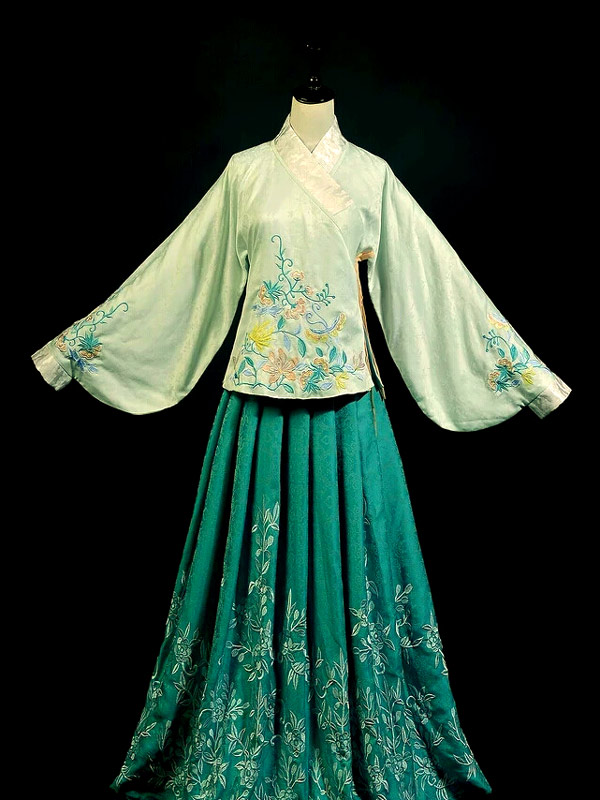
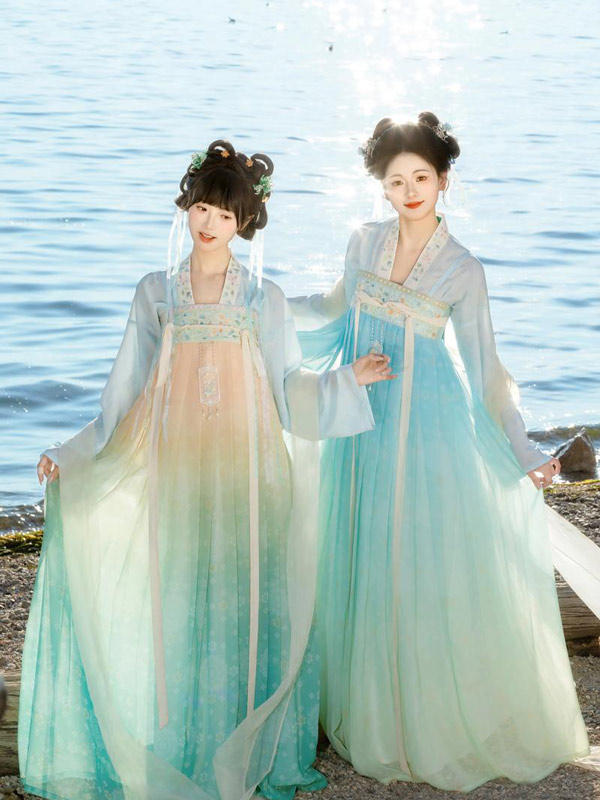
The Ruqun (襦裙) System: This is the most enduring style for women, consisting of a short jacket and a long skirt. It is a timeline of female fashion. The Tang Dynasty brought the magnificent Qixiong Ruqun (齐胸襦裙), a high-waisted style with a wide, flowing skirt that perfectly captured the open, confident, and cosmopolitan spirit of the era. The Ming Dynasty elevated it to the elegant Aoqun (袄裙), featuring a long jacket over the skirt, often with the distinctive standing collar and intricate embroidery.
The iconic Mamianqun (马面裙), or horse-face skirt, which is wildly popular in the modern revival, originated in the Song and flourished in the Ming. It features four panels at the front and back, with a flat, smooth section in the middle and pleats on the sides, allowing for graceful, fluid movement.
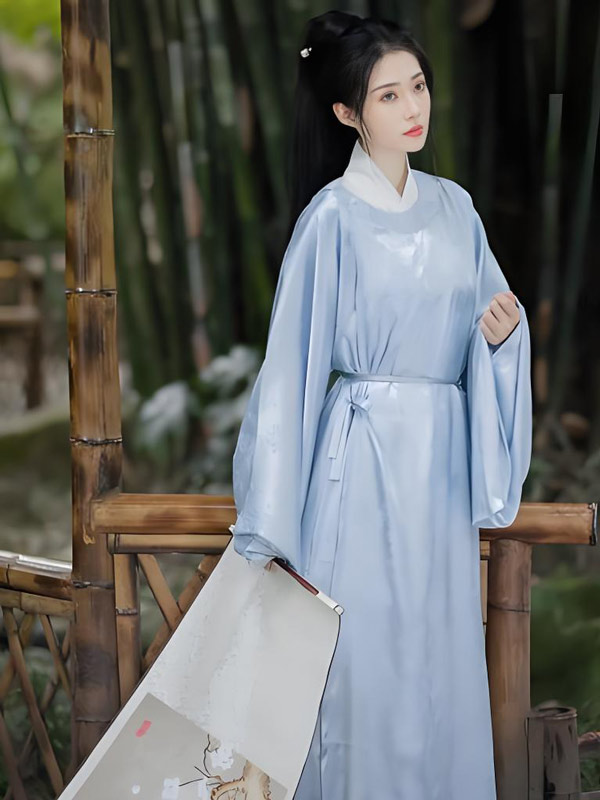
The Paofu (袍服) System: This refers to one-piece robes like the Yuanlingpao (圆领袍) and the Daopao (道袍). The round-collared robe, which evolved from northern nomadic styles, became the standard for men, both official and common. It is practical and streamlined. The Daopao, despite its name, was not just for Taoist priests; it was the favorite of Ming Dynasty literati, featuring large sleeves and a flowing, scholarly silhouette that symbolized the refined spirit of the intellectual.
Dynastic Personalities
While the core philosophy remained, each dynasty added its own flavor. The Han style was simple and flowing, with a loose cut and a sense of ancient simplicity. The Tang was grand and colorful, reflecting an empire at its peak. The Song favored understated elegance, with slender silhouettes like the Beizi (褙子) jacket, which is highly praised for its daily wearability. Finally, the Ming style, which you see in 90% of modern street-style Hanfu, is characterized by its structured, tailored fit, standing collars, and rich, exquisite decorative techniques like woven gold and embroidery. It is the epitome of dignified composure.
The thread of tradition was forcefully cut during the Qing Dynasty with the imposition of the "shave the head and change the clothes" policy, leading to a significant rupture in the Hanfu lineage. Yet, it is the young generation of today who are stitching that heritage back together. They wear Hanfu not as a strict uniform of a bygone social order, but as a modern, eclectic expression of identity. The rigid rules of rank have faded away. What remains is the rhythm of the fabric and the indomitable flow of Eastern aesthetics.
It started with robes and hats. It reaches far beyond. This, in its flowing sleeves and crossed collars, is Hanfu.
