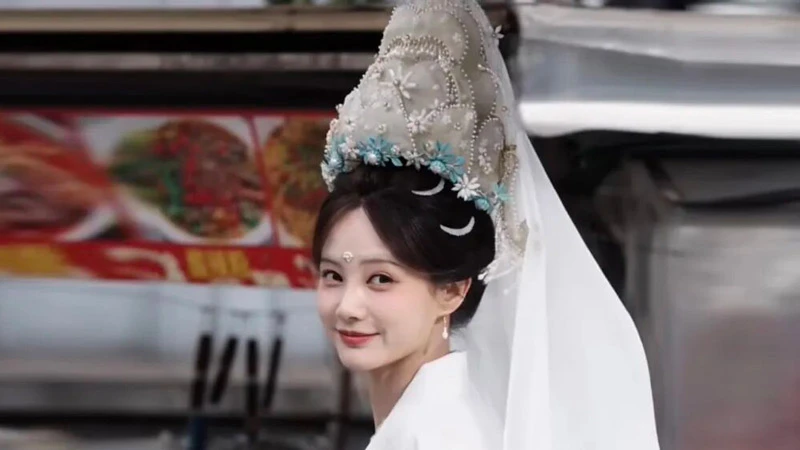
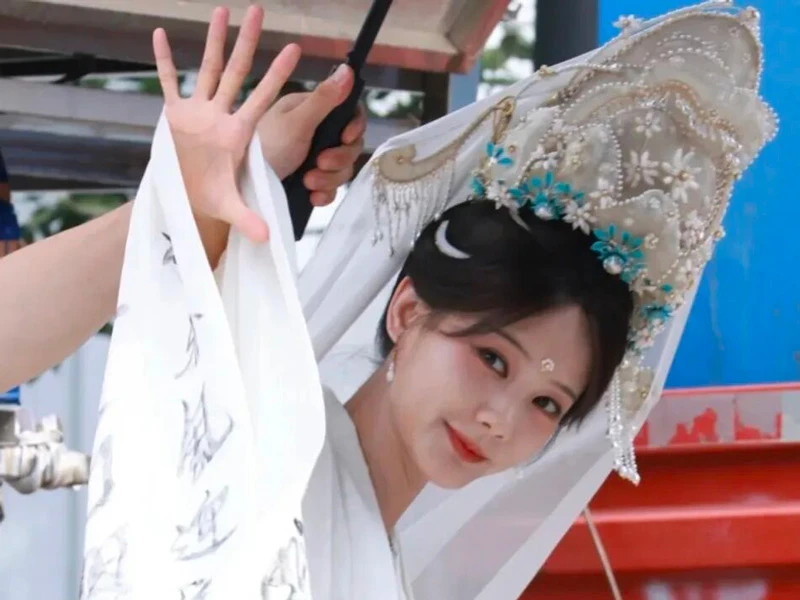
Why is everyone laughing at Li Yitong’s (李一桐) latest costume drama headpiece? In the recently aired Jin Zhi (金枝), her character wears an extraordinarily tall white crown made of multi-layered gauze. It resembles a tiny pagoda rather than a traditional headdress. Screenshots went viral, with netizens joking: “Did such a ridiculous thing actually exist?” But before we dismiss it as another lazy prop designer’s fantasy, let’s pause. That “crazy” crown has a name. And its roots run deeper than most people imagine. What if the strangest-looking accessory in the show turns out to be the most historically accurate one of all?
A Flower’s Name
That towering white headpiece is no random invention. It’s a direct descendant of the Chong Lou Zi (重楼子), or “multi-storied tower” floral crown, first recorded in the Song Dynasty text Luoyang Flower Records (洛阳花木记). The name originally belonged to a rare peony variety cultivated by Song gardeners. Using specialized grafting techniques, they grew double-petal peonies that reached nearly two feet (about 63 cm) in height, with petals stacking in layers like a miniature pavilion. That’s where the nickname “Chong Lou Zi” came from—literally “repeated towers.” Soon after, artisans began crafting headpieces that mimicked the flower’s cascading, tiered shape.
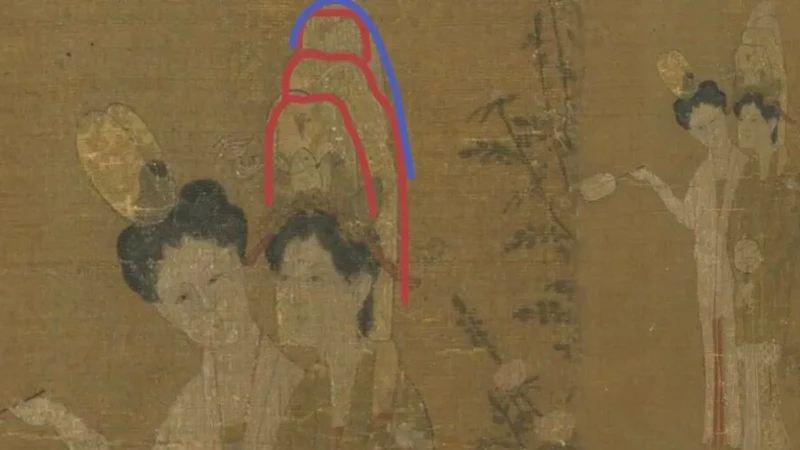
But here’s the twist: the version Li Yitong wears adds a pair of hanging temple ornaments called Bo Bin (博鬓), which historical paintings suggest were never part of the original Chong Lou Zi design. Those dangling side pieces belong more properly to formal court crowns. So the show’s stylists took creative liberties. Yet the core structure—the white gauze, the stacked layers, the ethereal verticality—is firmly rooted in Song aesthetic reality. Even the exaggerated height finds precedent. In Qian Xuan’s (钱选) Yuan-era painting Zhao Liang Shinü Tu (招凉仕女图), a woman wears a Chong Lou Zi crown that, based on figure proportions, stands nearly two feet high—three full tiers of gauze and greenery, with a trailing veil that seems to float like morning mist. Compared to that, Li Yitong’s version is actually quite restrained.
Vertical Elegance
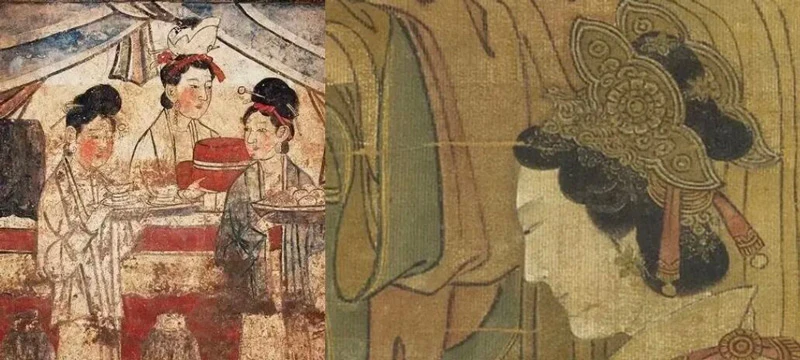
Why would anyone want to wear a two-foot tower on their head? The answer lies in the dramatic shift of Song Dynasty taste. By the Southern Song period, the ideal female silhouette had gone from plump and opulent to lean, slender, and almost ascetic. Narrow-sleeved jackets, side-slit robes called Beizi (褙子), and form-fitting silhouettes dominated fashion. To complement this vertical line, headgear had to rise upward. A tall crown elongated the entire figure, much like the sharp, upright strokes of Emperor Huizong’s “Slender Gold” calligraphy. It was a visual trick: the higher the crown, the longer and more graceful the wearer appeared.
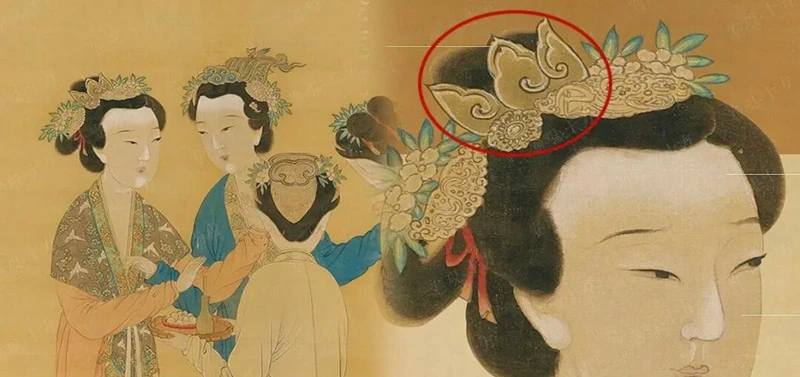
This wasn’t a niche trend. Flower-pinning, or Zanhua (簪花), had become a mania across all genders and classes in the Song capitals of Bianjing (汴京) and Lin’an (临安). Women wore artificial flowers made of silk or paper in their hair; men pinned real blossoms on their hats for court ceremonies. The state even formalized it: imperial marriage dowries listed “seasonal crowns and flowers” as required gifts, and the emperor would bestow flowers on loyal officials during grand celebrations.
In this flower-obsessed culture, the Chong Lou Zi crown was the ultimate expression—a wearable sculpture that turned a woman into a walking, blooming garden. And it didn’t stop there. Artisans also crafted the “Year-Round Scenery” crown, which combined flowers from all four seasons into one dizzying piece. We only know it from written records, but the very idea reveals how deeply floral aesthetics permeated Song life.
Back to the Future
Of course, towering headwear isn’t exclusively Eastern. In 18th-century France, Marie Antoinette famously debuted the pouf—a hairstyle that grew warships, gardens, and even scenes of childbirth on top of her head. One particularly extreme version featured a full-scale model of a French frigate. The parallel is uncanny: both the Song Chong Lou Zi and the French pouf emerged from court cultures obsessed with novelty and vertical drama. Both were mocked by outsiders as absurd. And both eventually fell out of fashion, only to be rediscovered centuries later as artifacts of their time’s wild creativity.
That rediscovery is happening right now. Contemporary Chinese fashion designers have begun digging into museum collections and ancient paintings for inspiration. They’re not copying the Chong Lou Zi directly—no one wants a two-foot crown on the subway—but they are borrowing its visual language: tiered layers, translucent fabrics, and a deliberate mix of natural motifs with architectural structure.
A 2021 runway collection from M Essential featured sheer organza headpieces that echoed the stacked silhouette of Song floral crowns. Another brand, Uma Wang, incorporated trailing veils and asymmetrical layering that felt distinctly Song in spirit. The point isn’t nostalgia. It’s that a thousand-year-old design idea—use verticality to elongate, use flowers to express joy, use craftsmanship to blur the line between human and nature—still feels fresh. When we stand in a museum and gaze at those delicate gauze crowns behind glass, we’re not just seeing old things. We’re seeing a civilization that once asked: what if a hat could be a garden? And then built it. That’s not strange. That’s extraordinary.