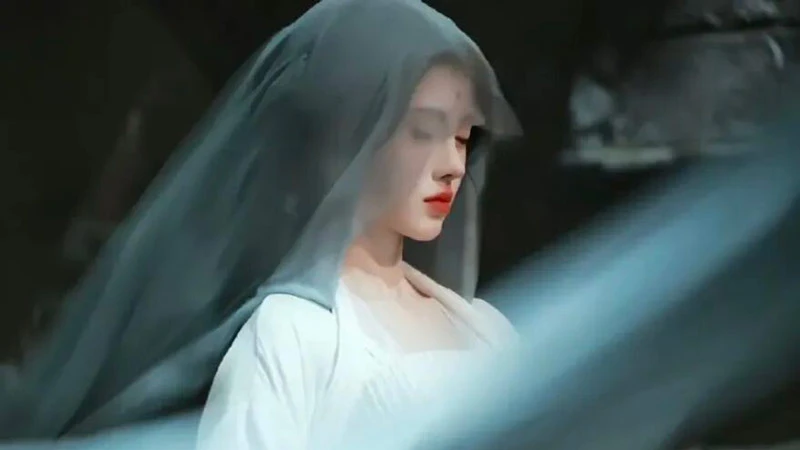
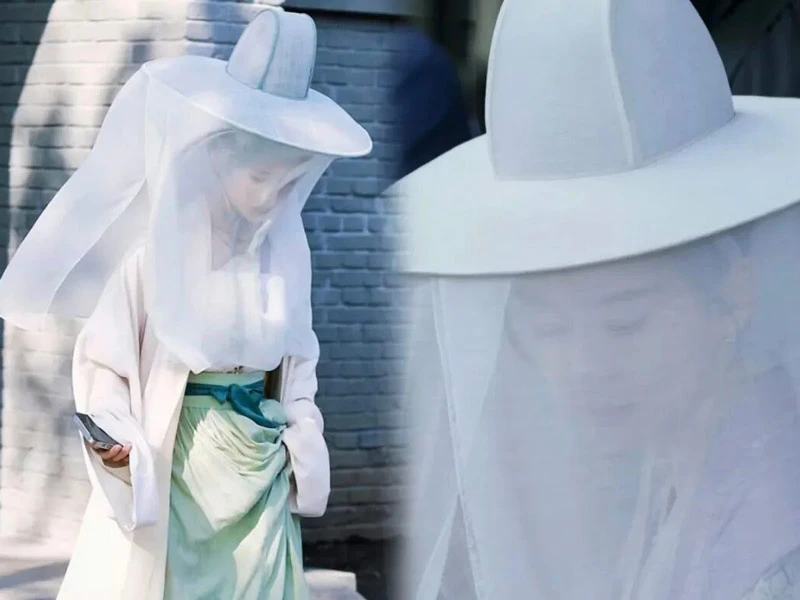
In a recent promotional still from the Chinese costume drama Veil of Shadows (月鳞绮纪), actress Ju Jingyi (鞠婧祎) appears with a translucent veil draped over her head. Within hours, the internet lit up with comparisons to Guan Yin (观音), the bodhisattva of compassion. But here’s the twist: that “divine” look wasn’t invented for deities or bridal photos. Your great-great-great-grandmother—or rather, her Song Dynasty ancestor—might have worn the exact same thing to buy tofu at the market.
Long before Western wedding veils or Hollywood red carpets, Chinese women threw a square of purple silk over their heads and called it a day. They called it Gai Tou (盖头), and it was as ordinary as your favorite hoodie. So why do we now see it as holy? Let’s rewind a thousand years.
Song Dynasty Roots
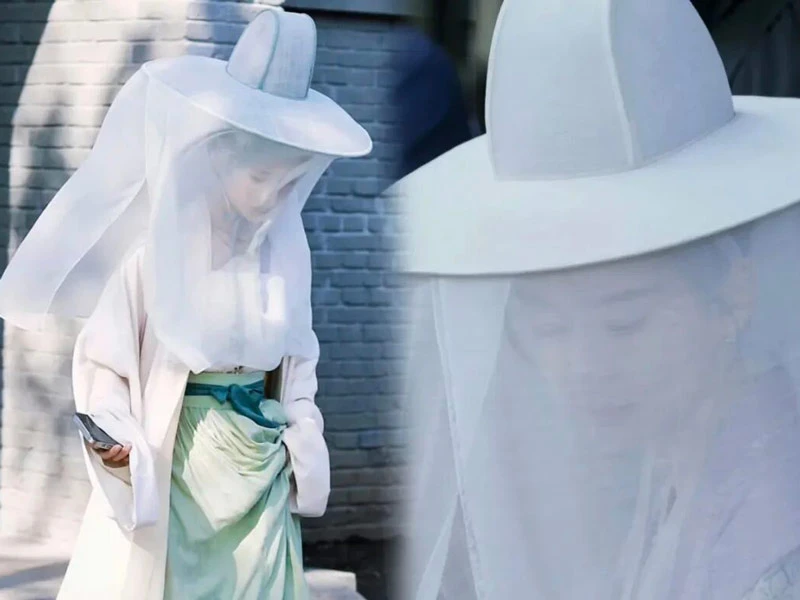
The Song Dynasty (960–1279) inherited plenty from the Tang Dynasty (618–907), including fashion rules. But while Tang women wore a hat called Wei Mao (帷帽)—a stiff bamboo hat with a dangling mesh curtain—the Song version was stripped down. According to Zhou Hui (周煇) in his Qingbo Magazine (清波杂志), “A scholar-official on horseback wears a cool-shirt; a woman walking the street covers half her body with a square of purple Luo silk. It’s commonly called Gai Tou, and it follows the Tang system of Wei Mao.” Picture a simple square cloth, about 158 centimeters on each side (that’s over five feet, using the Song measurement where one chi equals roughly 31.68 cm). No hat. No frame. Just fabric, plopped on the head, hanging down to the lower back.
Literary scholar Shen Congwen (沈从文) clarified the difference: Wei Mao was a rigid hat with a mesh veil, often black. Gai Tou was just a “square of purple Luo”—no hat required. Another writer, Gao Cheng (高承), noted in Origins of Things (事物纪原) that after the Yong Hui(永徽) era (650–655), women switched from Wei Mao to a black square cloth five chi wide, also called Foutou (幞头), and later Gai Tou. His wording is messy—he mixes up men’s headwear terms—but the object itself is clear: a generous, versatile sheet of fabric. It wasn’t sacred. It was your umbrella, your sunscreen, your “I-don’t-want-to-talk-to-neighbors” shield.
Rituals and Restrictions
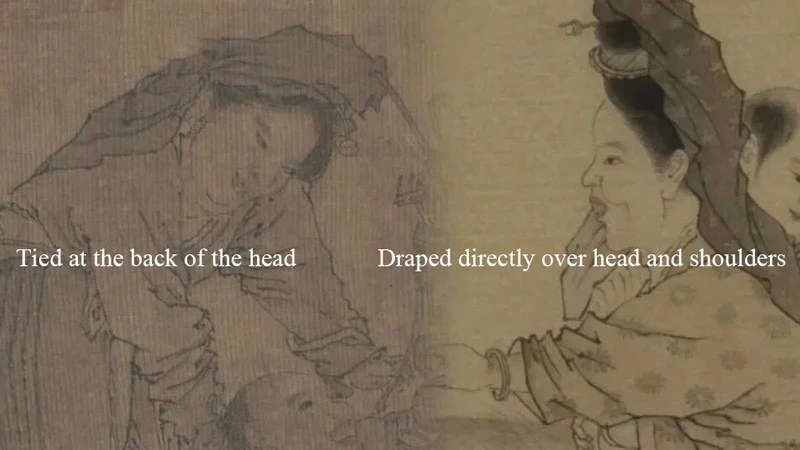
But here’s where the story darkens. The Song Dynasty, under the rise of Neo-Confucianism, turned this practical garment into a cage. Tang women wore Wei Mao to ride horses freely, flirting with independence. Song women, however, faced rules like those from statesman Sima Guang (司马光) in his Household Miscellany (居家杂仪): “If a woman must go out for a reason, she must cover her face. Men walking at night carry candles. Male servants do not enter the inner gate unless for repairs or urgent matters. If they must enter, women must avoid them. If avoidance is impossible, she must hide her face with her sleeve.” The veil became a mobile wall. Two wearing styles emerged: tied at the back of the head (neat and tight) or left loose and flowing (more dramatic, more common in paintings). Neither was about fashion. Both were about obedience.
Yet somehow, that same veil drifted onto statues of Guan Yin. Artists in the Song and Ming dynasties borrowed from real life—why invent a new look when devotees saw holiness in the familiar? A woman kneeling in prayer wore a Gai Tou; the goddess above her wore one too. Over centuries, the “veiled bodhisattva” became a visual cliché. But remember: the original inspiration wasn’t heaven. It was a woman walking to the well, her face half-hidden not out of piety but practicality. The divine image is just a mirror of the mundane.
From Weddings to Today
By the Ming Dynasty, the Gai Tou had specialized. Red silk for weddings—scholar Gao Chunming (高春明) speculates that brides wore crimson veils to symbolize joy. For funerals, undyed coarse linen. Scholar Lü Zuqian (吕祖谦) wrote in Lü Family Norms (吕氏家范): “Women all wear Gai Tou. When they reach the ancestral hall, they place the coffin on a bed, with the head to the north.” You wouldn’t mix them up: red for new life, plain for the end of it. Men had their own head coverings, but women stuck with Gai Tou for centuries—at least on paper. Daily wear faded as dynasties turned. Today, you’ll still find Gai Tou in rural wedding rituals and funeral processions, but not on city streets. Unless you count costume dramas or studio photo shoots. There, it thrives as “atmosphere.”
But don’t write off the veil as purely ceremonial. It’s shockingly practical. A thin scarf keeps off the summer sun; a thick one warms your shoulders in winter. You can fold it into a headband, wrap it as a shawl, or—yes—drape it like a goddess. Ancient Chinese women also used Peibo (披帛, a long draped scarf) as an impromptu Gai Tou. Multi-purpose fashion isn’t a new invention. And then there’s the poetry. Song Dynasty lyricist Liu Yong (柳永) wrote: “Her plain brows and rosy cheeks / Sometimes she lifts the Gai Tou, and I catch a glimpse.” A little mystery, a little romance. That’s the real legacy of the veil. Not a religious icon. Not a patriarchal tool. Just a piece of cloth that knows how to make an entrance—and a quick exit. Would you wear one today? Drop a comment.