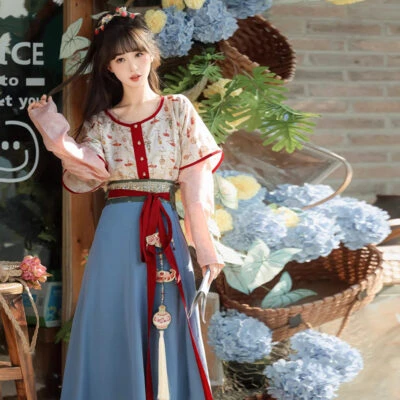
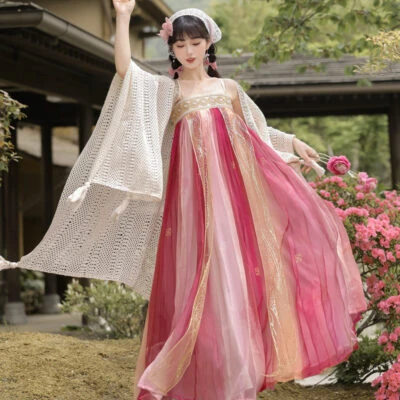
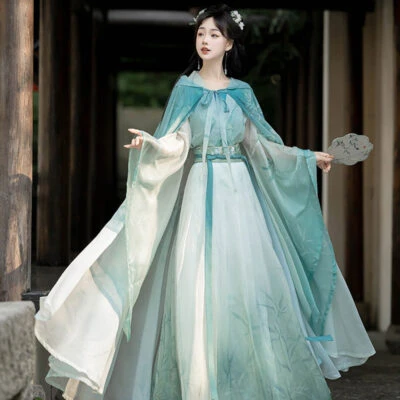
An exhibition that opened at Wuyunjian’s Xiyuan space in Beijing on October 27, 2026, sets out to walk a visitor through two thousand years of women’s dress, one dynasty at a time. It is produced by Wuyunjian, a lifestyle brand, with Song Xiaotao, a film costume designer, and its stated foundation is documentary reconstruction rather than costume invention.
The title, “The One I Seek, Across the Water”, comes from a line in the Classic of Poetry, in the Qin section, about searching for someone on the far bank. The curators use it as the thread: the garment is always just out of reach, and what a show can do is narrow the distance.
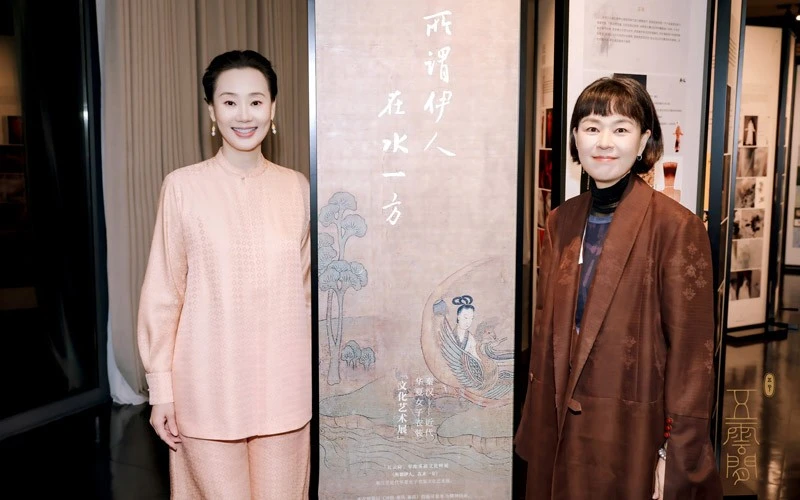
The Rooms Run in Dynastic Order
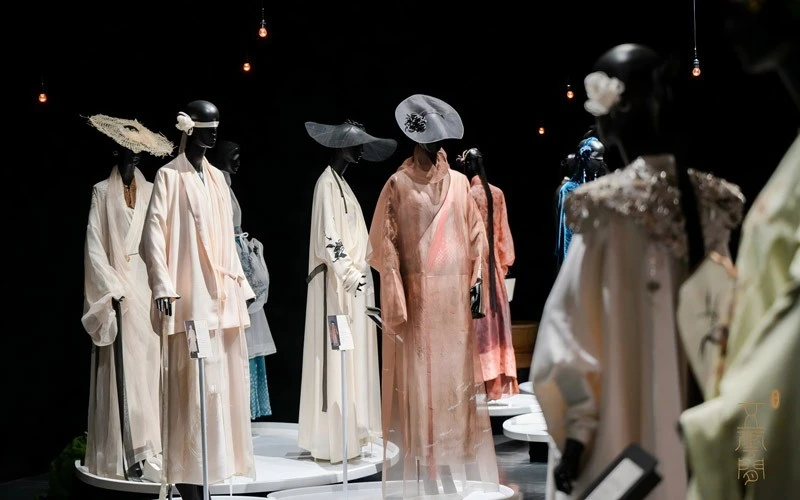
Seven periods are hung in sequence, from Qin and Han through the Wei-Jin and Northern and Southern dynasties, Tang, Song, Ming, late Qing and the early republic. Each carries a characterisation rather than a label. Qin and Han dress is described as grave and plain, its colours drawn from earth; the Wei-Jin rooms set loose widths against narrow cut, so that a period of migration and mixing shows up as two silhouettes in one room.
Tang is the open, extravagant stretch, and the Song rooms tighten into restraint, with the line “the utmost splendour returns to plainness” carried through the palette. Ming is presented as a system that took Zhou and Han ritual on top and Tang and Song cut beneath, ranked by status and dense with auspicious motifs. Late Qing piles on the trims, with heavy Zhang satin, fine Kesi silk tapestry and bright Panjin embroidery. The last room is the republican period, where cut and tailoring meet Western pattern-making and the fitted qipao settles into place.
A full chronological survey of women’s dress is still unusual in China. Most exhibitions of this kind arrange objects by material or by collection, which tells a visitor what the museum owns rather than what happened to the clothes.
Every Piece Is Named After a Text
Naming is the most disciplined part of the show. Each garment borrows a title from a poem or a historical figure, and the citation is the argument. The Qin-Han piece takes its name, “Picking Mulberry”, from a Han yuefu ballad about a woman who stops her work to answer a passing official. It is a Quju Shenyi adapted for the display, worked with chain-stitch embroidery and hand-painted ceramic buttons, carrying Han cloud-scroll and dogwood motifs.
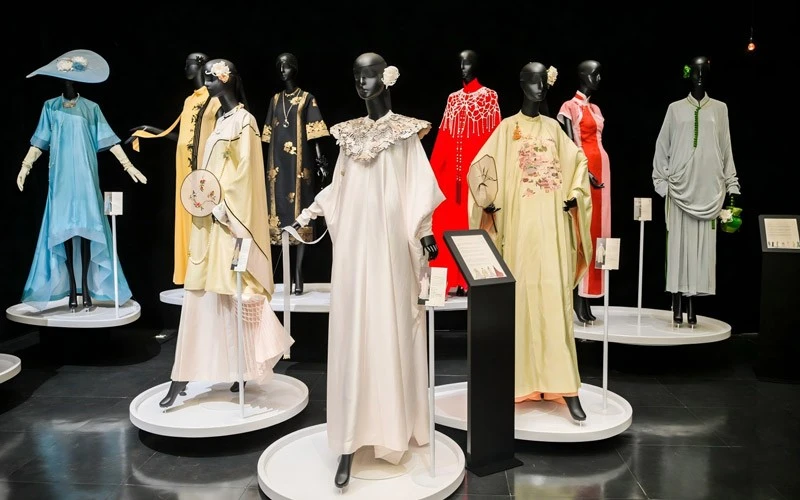
The Tang piece, “Rainbow Robes”, points at the Tang dance tune of that name. It reconstructs a scattered-floral gold-weave cloth and a panelled skirt in alternating colours, and the single garment took 1,500 hours. A Song entry borrows from Li Qingzhao’s lyric about a boat on an autumn river and adapts a Beizi. The Ming piece is named after the horse of Qin Liangyu, the late-Ming woman commander, and adapts a Yisa coat to give the figure a martial line. The republican piece, “Frost Maiden”, is a plain white robe with a hand-worked cloud collar in hammered copper, silver plating and stone inlay; the collar alone took 856 hours.
Two Tang entries and two republican entries fill out the group, which keeps the show from reading as a single costume per century.
Where the Hours Go
The stated source base is old paintings and texts, excavated textiles and dynastic sumptuary records. What that means in practice is a material decision at every step: which weave the period could actually produce, which dye, which closure. The show lists Kesi silk tapestry, Zhang velvet, mother-of-pearl inlay, appliqué and Panjin embroidery among the techniques revived for it.
Hours are the honest cost metric here, and they are quoted. A visitor who reads 1,500 hours on one Tang dress and 856 on a single collar learns something that no general article on traditional Chinese clothing can convey: that the object in front of them is a piece of manufacturing, and that the original was too.
What a Film Designer Adds
Song Xiaotao has spent more than 20 years on dress research and screen costume, with credits on Story of Yanxi Palace, Chinese Paladin and a family saga set across the twentieth century. A designer’s contribution to a project like this is legibility: silhouette that reads at three metres, colour that holds under gallery lighting, and a clear decision about where reconstruction stops.
That boundary is what separates this work from period drama costume. A screen garment is designed to be photographed in motion under controlled light and to signal character; a reconstruction is answerable to a source. The show declares its adaptations in the names, which is the honest way to do it. “Adapted” tells a visitor that the cut has been changed for the body or the budget, and leaves the documentary claim intact for the parts that were not.
Xi Hua, who runs Wuyunjian, frames the intent as treating tradition as something that can be renewed rather than a fixed antique, which is the standard argument for this kind of show and also its main risk: renewal that drifts from the source becomes costume again.
For a reader trying to judge the next exhibition of reconstructed dress, three questions do most of the work. Does each garment cite a source? Does it say where it departed from that source? And does it quote the labour, or only the beauty? A show that answers all three is doing research in public. One that answers only the third is doing something else.