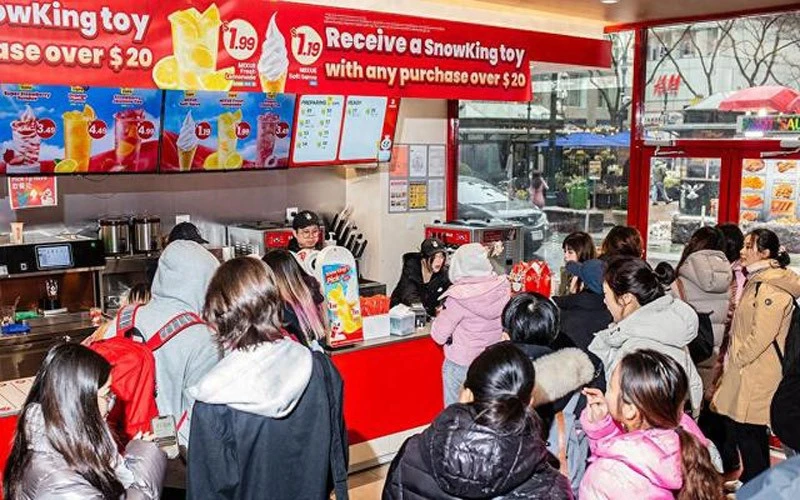
NEW YORK — Chinese coffee and tea chains are now a queue problem in this city. Around Times Square in Manhattan, out in Flushing, and on the West Coast from Los Angeles to Honolulu, brands including Luckin Coffee, Cotti Coffee, Heytea, Mixue and Chagee draw lines at the afternoon peak. Luckin opened its first American store in New York in June 2025 and now runs more than 20 outlets in Manhattan alone. Cotti tested the water in Honolulu in 2024 and has passed 20 stores nationwide.
None of this is accidental timing. The expansion has landed in the middle of a social media wave that Chinese platforms call Chinamaxxing and American users call Becoming Chinese, in which young people film themselves taking up Chinese habits: house slippers indoors, the eight-section exercise routine, hot tea instead of iced coffee. The wave explains the curiosity. It does not explain the queue. Price, menu and the way you order do that.
Half a Block Apart, Two Prices
Near Pennsylvania Station, a seasonal pumpkin spice latte of about 470 millilitres sells for 7.45 dollars at Starbucks. Half a block away, a recently arrived Luckin lists the same drink at the same price, and sells it to first-time users through its app for 1.99 dollars. Same block, same category, same menu price, and a threefold gap at the till. Stanley Rosen, a professor of political science and international relations at the University of Southern California, put it bluntly: the Chinese brands have gone past Starbucks.
Menu is the second lever. American tea drinking is concentrated in a narrow set of products, with milkshake-style drinks and bubble tea taking most of the volume. The Chinese chains arrive with a much finer grid: fresh fruit tea, cheese-foam tops, milk tea built on whole-leaf tea, limited seasonal items, and on the coffee side drinks such as coconut latte that were tested to death in a far more crowded home market. Several brands also sell ice cream, which lets a store serve people who do not want a drink at all.
Mixue made the price point its calling card when it set up its first American stores in Los Angeles and New York late last year: sundaes for barely a dollar, milk tea well under what local cafes charge. Chagee and Heytea moved into New York and Los Angeles in the same period. None of this is improvised. Frequent launches plus a hard price anchor is the standard playbook from the Chinese market, and transplanted to the United States the difference shows immediately, because the local benchmark sits so much higher.
Ordering Before You Arrive
Operational difference is harder to photograph and matters more. Chinese chains are built around the app. Customers order ahead, receive a coupon in the process, and walk in to find the drink already made, often without speaking to anyone. For customers used to queueing at a counter and ordering face to face, the first encounter feels like a different tempo rather than a different product.
Merchandise does the recruiting. Limited plush toys, badges and fridge magnets are used as acquisition tools, and they work on people who had no intention of buying tea. One construction worker in New York, a self-described Starbucks devotee, walked into a Cotti for a badge, ordered a grapefruit and white jasmine tea with strawberry syrup while he was there, and said he would come back for other flavours.
An analysis in the Singapore Business Times traces the capability to the size of the home market. Serving 1.4 billion people taught these companies how to run service at volume, how to use social media, and how to read consumer preference quickly. When domestic cities saturate, going abroad becomes the obvious next move. What travels is not only the drink but the product development cycle, the digital customer base and the marketing built around younger buyers.
Who Is Actually Walking In
Asian customers remain an important base in many Chinese-brand American stores, but the faces are changing. A study published in August by the consumer insight firm Langston gives a measure: among Americans aged 13 to 74, only 23 percent have visited a Chinese-brand tea or coffee chain. Even among Gen Z, the figure is 38 percent. Growth is available, and penetration is still shallow.
That is also why the chains are spending on stores rather than advertising. Brand recognition in the United States is nowhere near saturation, and the barrier to a first visit is location and price rather than awareness. Twenty-odd stores in Manhattan is not vanity. It is the cheapest form of customer acquisition available, because the storefront itself does the introducing.
Whether Low Prices Travel
Constraints here are concrete. Sandy Lin, chief China retail analyst at S&P Global Ratings, points to Mixue’s experience in Japan, where high labour and rent costs did not fit a low-price model and the company cut back its expansion plans. The American market poses the same arithmetic: expensive labour, inflation that has not fully retreated, commercial rents in the major metro areas among the highest in the world, plus tariffs, logistics and geopolitical friction pressing on margins that depend on scale and vertical integration.
Responses differ by company. Heytea says it has set up warehouse hubs on both coasts to supply stores and is building a global sourcing network. Chagee frames the American market as part of a plan to reach 100 countries. Cotti says its ambitions go beyond New York and Los Angeles. Luckin’s line is conditional: once the model is validated in a market, it will scale.
Read together, the moves mark a change of phase. Earlier attempts at going abroad were single-store experiments run to see whether the product would sell. This round is about supply chains, warehouses and cost structures, settled before store count is pushed. Clothing and home appliance exporters went through the same passage two decades ago. The product is the easy part. Recalculating the cost base in a new country is the work.