HANGZHOU, Zhejiang — A blue satin skirt, four centuries old and barely two metres of cloth, sits at the centre of a new exhibition at the Hangzhou Arts and Crafts Museum. The show opened on 20 November 2026 in the first-floor temporary gallery beside Gongchen Bridge on the Grand Canal and runs until 21 March 2027. Entry is free. It is the ninth in the museum’s shared-heritage series and gathers nearly 100 skirts and related garments from six lending institutions on one timeline that begins with the Song dynasty and ends with a skirt made this year.
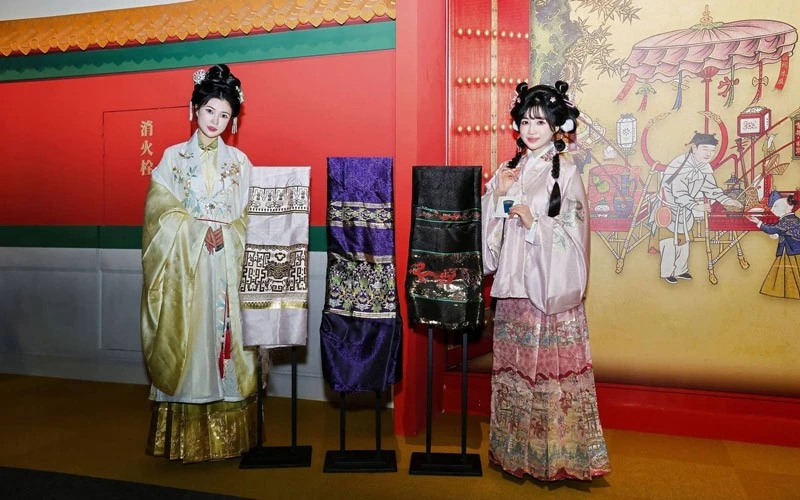
That skirt belongs to the Shandong Museum and comes from the old wardrobe kept at the Kong family mansion in Qufu. Its label reads: blue satin skirt with entwining four-seasons flowers in gold, worked in Zhuanghua. Curators put the number of surviving Ming skirts of this type at five nationwide. The count carries the argument of the whole show. A garment worn on ordinary days and kept for four hundred years is a statistical near-impossibility, and what remains of the Ming skirt wardrobe can be counted on one hand.
A Ming skirt survives only if it stopped being worn. The blue piece comes from the wardrobe kept at the Kong family mansion in Qufu, the residence of Confucius’s descendants, where generations of ceremonial dress were stored in chests rather than used up. After the dynasty changed, the household no longer dressed in Ming fashion, and what had been put away stayed put. A large share of the Ming clothing held in Chinese museums reached the present by that route rather than through excavation, which is why a waistband with its ties still attached can be examined at all.
| Dates | 20 November 2026 to 21 March 2027 |
|---|---|
| Venue | Hangzhou Arts and Crafts Museum, first-floor temporary gallery, beside Gongchen Bridge |
| What it is | A survey of the Mamianqun from the Song dynasty to contemporary dress, built on museum objects |
| Scale | Nearly 100 skirts and related garments |
| Units | Prologue, then four rooms: codification, ornament, simplification, revival |
| Entry | Free, no booking |
| Lenders | Shandong Museum, China National Silk Museum, Tsinghua University Art Museum, Shangrao Museum, Guangfeng District Museum, and the provincial Hanfu committee |
What a Mamianqun Panel Does
Two panels joined to a single waistband make the Mamianqun, with a flat rectangular face at front and back and pleats gathered at both sides. The flat panels are the skirt doors. Because each of the two panels is itself divided, a finished skirt shows four doors, two meeting at the front and two at the back. The name comes from the bastion on a city wall that has the same flat, slightly projecting face, which is why the Ming called the form a horse-face pleated skirt.
Door, pleat and band divide the labour of the garment between them. The door is a flat facade and carries the front silhouette. The pleats sit at the hips and give the wearer room to walk. The band closes the composition horizontally. Put the three together and the result is the shape now filed under Ming dynasty clothing: narrow at the waist, wide at the hem, and flat as a board from the front. That flatness is calculated. A skirt that relies on the weight of silk to fall straight will not hold the line.
Movement is what the structure is for. As the wearer steps forward the two front doors slide apart and the side pleats open, so the skirt widens at the knee and closes again as the feet come together. The Song wrap skirt that came before it was cut for the same reason, and the Ming kept the logic while tightening the proportions. A wearer can climb a step, turn in a doorway or carry something in both hands without lifting the hem.
Excavated material explains where the form starts. The prologue of the exhibition traces the Song wrap skirt through tomb finds and structural drawings, and the case is made on the cut rather than on decoration: a skirt split into panels that overlap, with the excess gathered at the sides. Nothing about that arrangement is ornamental. It exists so that a woman on foot, on a boat or on horseback is not restricted by her clothing.
Pattern Registers on the Shandong Blue Skirt
Take the blue skirt apart layer by layer and the grammar of the Ming skirt becomes legible. The waistband is peach-pink gauze, with green silk tassel ties at each end. The body is deep blue satin. Light gauze against heavy satin concentrates the contrast at the waist, which is where the eye lands first. Above, the satin carries entwining four-seasons flowers in gold, spread edge to edge with no ground left bare. Below, three horizontal bands run around the skirt.
Bands are not repeats of each other. The upper one carries gold-woven clouds and luan birds, a pairing that belongs to ceremonial vocabulary. The middle one shows a phoenix among peonies, the standard auspicious pairing in Ming textiles. The lowest, at the hem, works phoenixes, peonies and lotus scrolls in five-colour silk, a register closer to ornament than to rank. Read downward, the skirt moves from ritual to blessing to decoration, and one garment carries all three.
| Upper band | Clouds and luan birds | Gold thread woven into the satin ground |
|---|---|---|
| Middle band | Phoenix among peonies | Zhuanghua colour wefts on small shuttles |
| Hem band | Phoenixes, peonies, lotus scrolls | Local weft return in five-colour silk |
Three techniques share the surface. Gold weaving draws metal thread into the ground so that motif and ground come off the loom in one piece. Zhuanghua weaving winds coloured wefts onto the ground with small shuttles, which allows colour changes inside a single bolt and frees the palette from the limits of the draw loom. Local weft return carries a colour only as far as the outline of a motif and reverses there, leaving a crisp edge and the heaviest labour bill of the three. All of them build the pattern during weaving, so the motif cannot be unpicked and the reverse of the cloth stays clean.
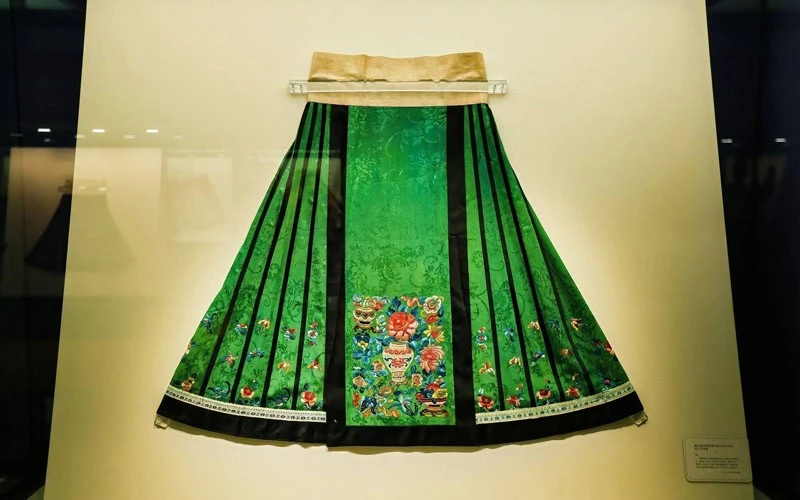
Ground fabric decides how a motif reads. Set the blue satin skirt beside the scallion-green skirt in the next case, worked in Zhuanghua on gauze with a python motif, and the difference is immediate. Satin takes the weight of gold thread and can be woven solid. Gauze is light and half-transparent, so the weaver spaces the colour wefts, draws outlines and lets empty cloth do the work of mass. Same technique, different ground, opposite result: one dense and declarative, one airy and reserved.
Hem Bands and the Order They Set
Rank in a Ming skirt is easier to read at the bands than at the body. The body can be plain. The bands cannot be omitted. The knee band sits just below the knee and the hem band at the bottom edge, and both fall on the two places a skirt wears out first. Weaving gold and colour across those lines adds structure exactly where the cloth takes the most abrasion, so ornament doubles as reinforcement. Nothing here is applied afterwards, and the decoration is built into the weave at the point of stress.
The arrangement also records a division of labour. Skirt cloth left the weaving bureau by the bolt, to a fixed specification. Band patterns were designed separately, mounted on their own looms and joined to the skirt at the garment stage. One skirt therefore preserves two sets of standards, one for the ground weave and one for the band, and the two do not always come from the same workshop. The first room of the exhibition, which covers the Ming codification of dress, is built around that split.
What the Ming fixed was the system: two panels, four doors, gathered pleats, knee band, hem band. Later dynasties changed the density of ornament and the width of the bands, but the skeleton stayed. That is why a Republican-era skirt and a Ming skirt can stand side by side in the same case and read as one garment at different volumes.
The Modern Mamianqun Keeps the Structure
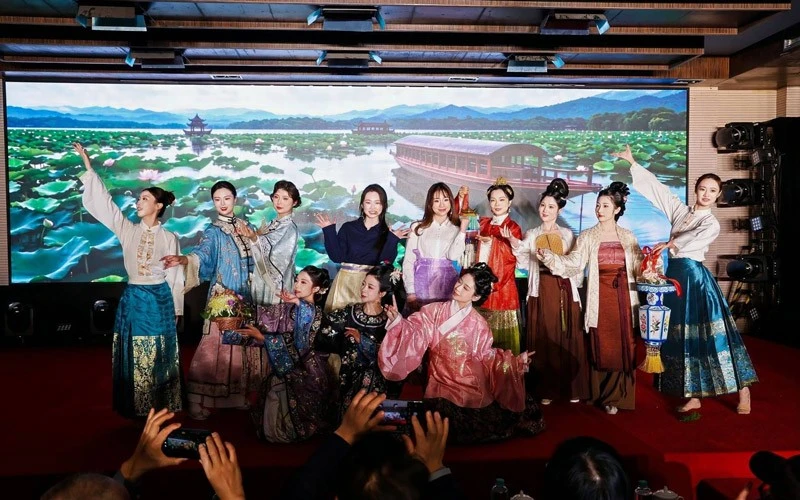
Opening day made the argument physically. A presentation titled “A Thousand Years of Pleats” sent nine ensembles down the gallery floor, one after another:
- Song wrap skirt
- Song pleated skirt
- Ming blue satin skirt with entwining four-seasons flowers
- Ming scallion-green Zhuanghua gauze skirt with python motif
- Late Qing railing-panel skirt
- Qing moonlight skirt
- Republican transition skirt with railing panels
- Early Republican short jacket with Mamianqun
- Contemporary neo-Chinese skirt
Curatorial order is part of the argument. Costume shows usually put the oldest object first and treat the twentieth century as an epilogue. This one opens with a prologue on the name and on the Song skirt, then runs four rooms in sequence, and gives the last room to wedding dress, runway work and everyday outfits. The effect is that the contemporary skirt is examined as a stage of the same object rather than as a revival of it.
Four turns separate the first item from the last. The Ming fixed the structure. The Qing raised the density of ornament until the decoration on a skirt approached the weight of a stage costume. The Republic subtracted embroidery and narrowed the bands, keeping the doors and the pleats while making the garment wearable for a working day. The present changed the occasion rather than the cut, pairing the skirt with sweatshirts, T-shirts and shirts for commuting and travel.
The early Republican ensemble in the lineup explains how the skirt left the formal wardrobe. A short jacket worn over the skirt, the jacket-and-skirt combination that students and office workers adopted, moved the garment into the same logic as a modern two-piece: the skirt became the bottom half of a set rather than a standalone ceremonial piece. That pairing carried the pleated skirt into schools and city streets, and it is the reason the form was still familiar enough to be picked up again in the 2010s.
Curators note that many commercial skirts on the market still borrow Ming patterns and Ming proportions, and that workshops also produce Qing-style reproductions for buyers who want the denser look. Both routes keep the same base. The skirt survives because it was revised repeatedly, not because it was preserved intact. Structure held, surface changed, and each era spent its effort on a different layer of the same object.
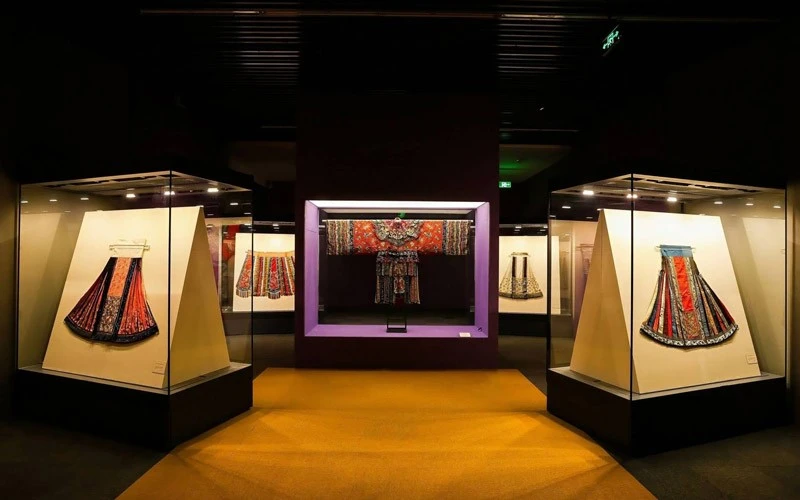
After the Ming, the Weave Changes Hands
Qing cases are the loudest in the show, and deliberately so. Railing-panel skirts, moonlight skirts, fish-scale pleated skirts and phoenix-tail skirts follow one another, worked with auspicious animals, flowers and birds, and scenes lifted from opera. Blessing outweighs ritual in this stretch, and craft density reaches its peak. So does cost. The decoration on a single skirt can run close to what a theatre wardrobe would carry, which is one reason the form narrowed again in the next century.
Then the volume drops. Under the Republic, machine-made textiles and a changed working day pushed embroidery off everyday dress, and the skirt lost most of its surface. The doors stayed, the pleats stayed, and the three bands shrank to narrow edging. What disappeared was labour, not structure. That is the difference between a garment that goes out of use and one that is simplified into a new use, and it is the reason the shape is still legible on a commuter today.
For a visitor, the practical route through the show is three stops. The Shandong blue skirt has the most complete sequence of bands and the clearest stack of techniques. The scallion-green gauze skirt is the control sample for ground fabric. The Qing railing and moonlight skirts mark the high point of density, and seeing them after the Ming cases makes the later subtraction readable.
Museum staff have said that individual objects will rotate during the four-month run, so a second visit is unlikely to repeat the first. Opening day added a tea-whisking session, a short play set on the Su Causeway in which two young women mistake a Mamianqun for foreign fashion before working out what the doors and pleats are for, and a dance piece built around court posture. All three return to the point the cases make. The garment is a set of decisions about cloth, and the decisions can still be read four hundred years later.