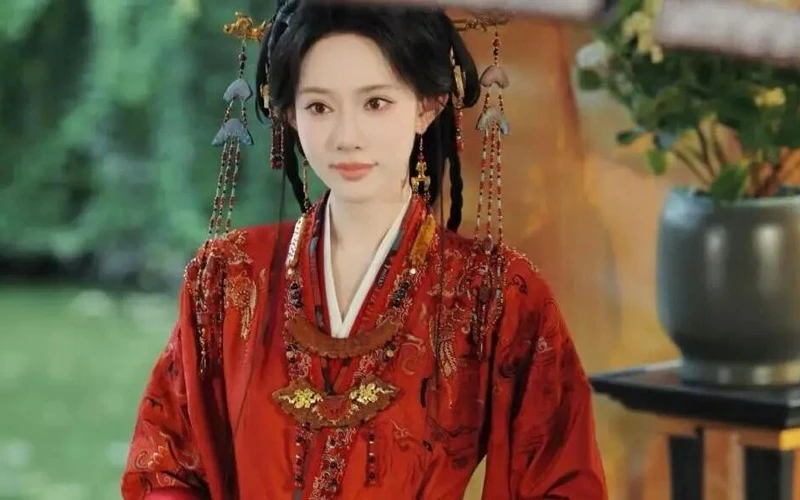
Behind-the-scenes photos from the set of Jiangmen Duhou (将门独后) have drawn attention to one particular look worn by Meng Ziyi. She appears in a red formal robe with a set jade pendant at her neck, her hair braided and gathered with gold ornaments, but the detail that caught viewers’ eyes sits at either side of her head. The hanging hairpins there carry two dark, arc-shaped jade pieces at their centers. Most people recognize that shape immediately as a jade huang (璜), a curved ritual stone usually strung into necklaces or hung from waist pendants. Seeing it suspended from a hairpin felt wrong to some and intriguing to others, so where does the idea actually come from?
Traditional Ritual Jade
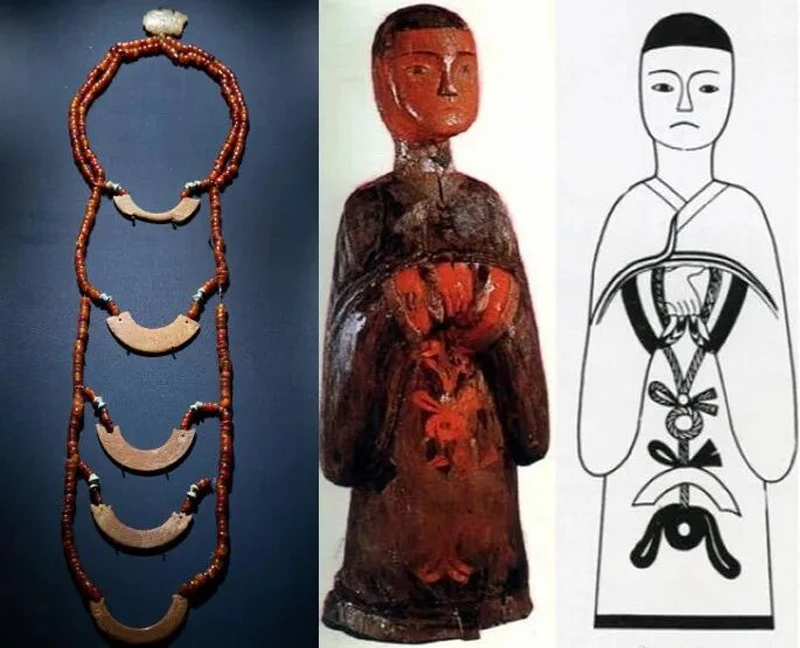
The jade huang ranks among the oldest formal jades in China. It is typically carved as a half-disc curve, decorated along the edges, with drilled holes at both ends so it can be worn alone or strung together with beads, tubes, and other components. In noble pendant sets from the pre-Qin period through the Han Dynasty, it served as a core piece and a marker of rank.
Early pendant sets were worn around the neck, draping across the chest. A set excavated in Henan and dating to the Western Zhou period functioned as a necklace. By the late Spring and Autumn period, the custom had shifted toward the waist. Painted wooden figures from a Warring States tomb in Xinyang, also in Henan, show pendant strings hanging from belts rather than collars. By ordinary standards, then, a jade huang belonged on the body, not in the hair.
That said, the object’s earliest history predates the strict ritual codes. The Rites of Zhou later fixed its ceremonial role, but before that system hardened, its use was more flexible. It functioned first as decoration for the elite, and only afterward accumulated the formal meanings that later generations associate with it.
Headwear Precedents
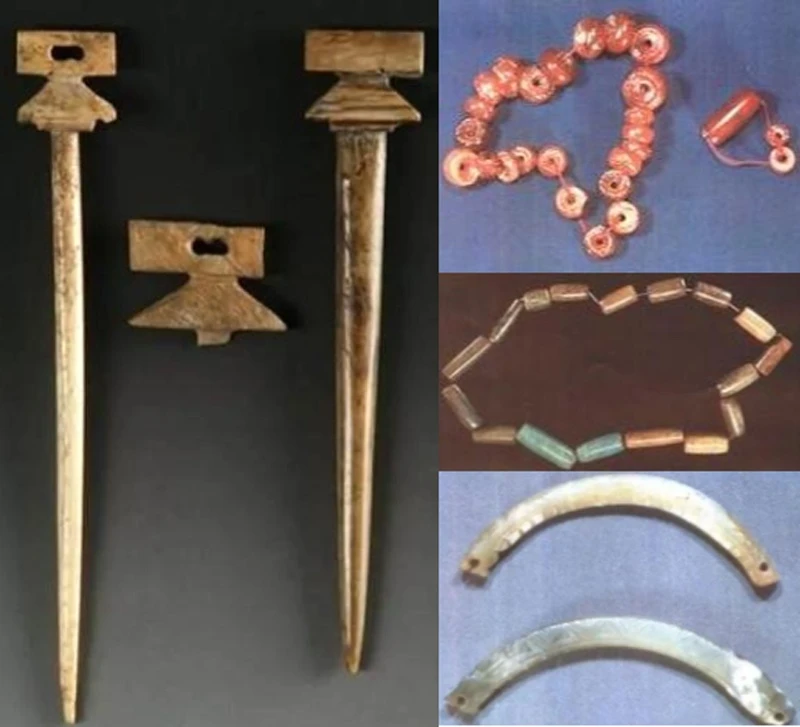
Archaeology offers hints that ancient people did place jade huang near the head. In Liangzhu culture burials, combinations of huang and tubes have been found positioned at the skull of the deceased, which suggests some early headwear use was possible.
The tomb of Fu Hao at the Yinxu site in Anyang produced two coiled-dragon jade huang alongside jade hairpins, tubes, and agate beads. Some scholars argue these pieces could be assembled into a complete head ornament, with the huang and bead strands creating a hanging effect not unlike later buyao (步摇) hairpins. The evidence remains indirect, since no surviving image confirms that nobles actually wore huang this way.
The buyao itself has a long history. The name appears in Warring States writing, and the Han Dynasty brought it into formal dress codes, with the Tang period marking its height. Its defining trait is simple: beads or metal leaves hang from a hairpin and sway as the wearer walks. A curved jade piece with holes at both ends fits that logic naturally, since it can receive strands above and below.
Design Reasons Here
The shape does practical work. A jade huang spreads horizontally and already functions in pendant sets as a connector between bead strings. Mounted on a hairpin, its upper end attaches to the pin while its lower end can be drilled to split into several strands. Beads then fall along the curve in an unbroken line. The stone also carries real weight, which steadies the sway and lets the strands travel through a wider arc instead of fluttering loosely.
Color plays a role too. Dark jade against a gold pin head and reddish-brown beads picks up the red robe and the neck pendant, tying the whole outfit to one palette. That consistency reads as formal and high-status. The curves also sit beside the cheeks, softening the jawline and taking edge off the face.
Distinctiveness matters as well. Most historical dramas reach for gold flowers, shaking leaves, or pearls when building a buyao. Borrowing an ancient ritual stone instead, especially in a double-layered tassel arrangement, gives the look a signature that audiences can recall later.
Character And Setting
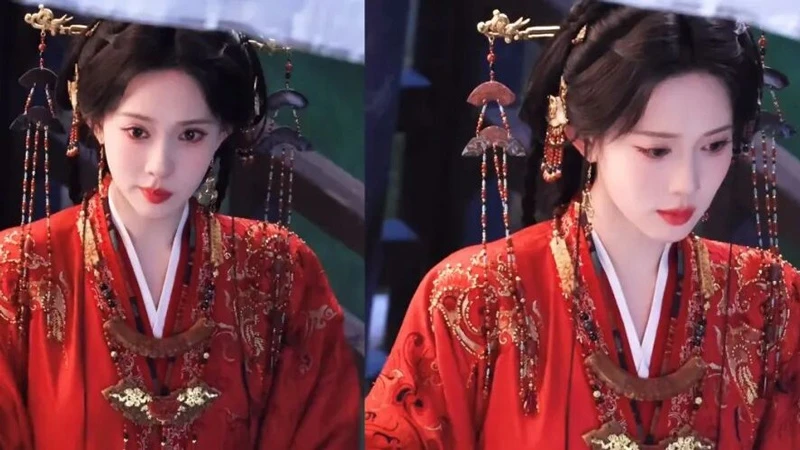
The production does not need to obey a single dynasty’s rules. Jiangmen Duhou is set in an invented world with a rebirth premise, so its costumes answer to character first and history second. Meng Ziyi plays Shen Miao, a general’s daughter who appears gentle on the surface but holds firm opinions and sharp methods underneath.
A jade huang suits that construction. The stone carries quiet, restrained nobility rather than display, which matches a woman who conceals her intent. Its weight and solidity also contrast with the softness of her manner, echoing the tension between the sweet exterior and the calculating interior that defines her arc.
Whether this reading satisfies you depends on what you want from costume design. Some viewers want strict accuracy and will fault any liberty. Others accept a plausible historical fragment reused in a new place, especially when it helps a character read clearly on screen. By that measure, the jade hairpins do their job, and they give the production something worth talking about.