One new still from Si Gong Ling (司宫令) made viewers pause. Song Zuer wears a small floral crown, and fans soon filled the comments with a museum memory: “I have seen that shape behind glass!” The piece looks quiet, almost plain, yet it carries a sharp Southern Song mood. It is not a random prop. Its shape borrows from a silver crown dug from a tomb in Liyang (溧阳), Jiangsu (江苏), and that detail changes how we read the whole look. Why does a tiny crown, not a towering one, feel so convincing?
Crown or Relic?
The prop points to a real object: a Southern Song silver crown excavated in 1992 from a tomb in Liyang. Its owner was Zhou Deqing (周德清), an elderly woman who lived near the dynasty’s end. The crown is only 6.5 centimeters high and 13.5 centimeters long. Two thin silver sheets meet like a small shell, with an opening below for a hair bun and an openwork Ruyi (如意) cloud top above. Because the lower edge curls into Ruyi shapes and the surface carries many flowers, it is often described as a hundred-flowers Ruyi crown.
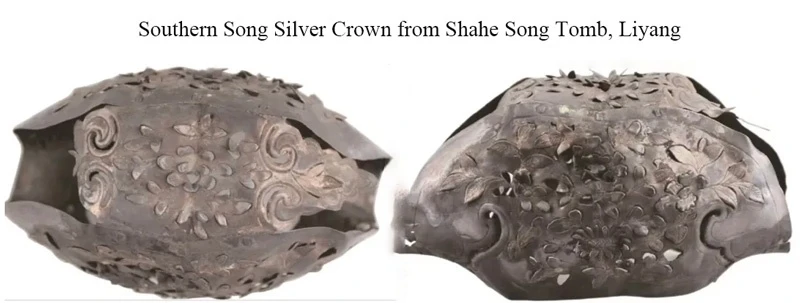
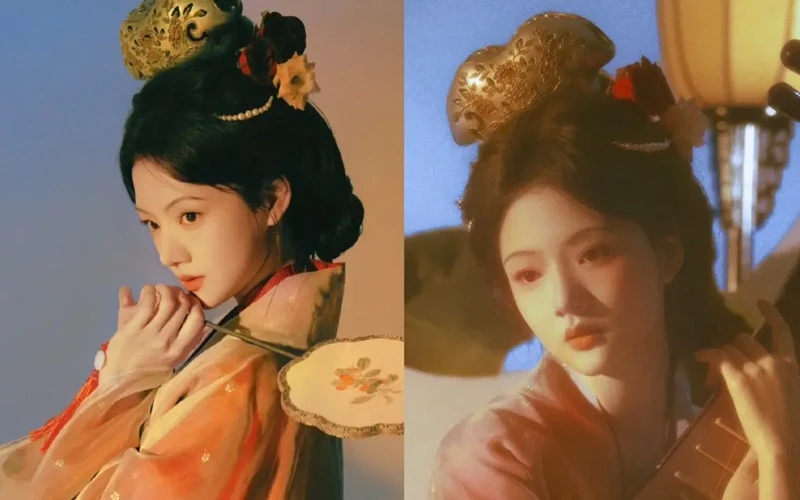
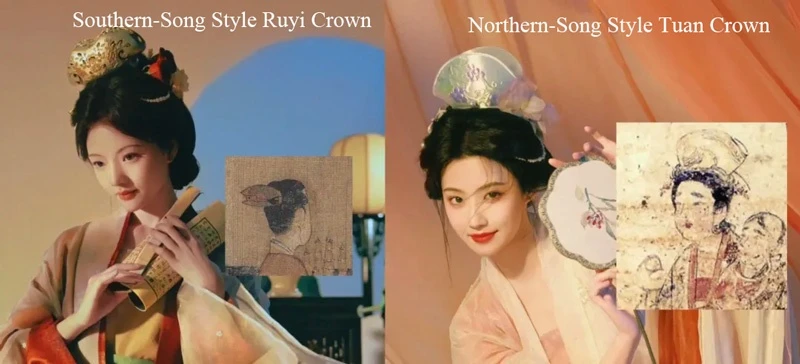
The crown also appeared on Ren Min (任敏) in a photo shoot, which helped the shape travel beyond museum labels. On Song Zuer, it sits low and close to the hair. It does not shout for attention. That restraint is the point. Northern Song taste often liked tall, wide, round crowns, such as the Tuan (团) crown and the equal-shoulder crown. They gave a wearer a grand outline. Southern Song women moved toward smaller pieces, and this little silver shell shows the shift with unusual clarity.
Look closely, and the crown is less jewelry than architecture. The top openwork lets patterns breathe. The silver body would have caught lamplight without flashing. It framed the face and then stepped back. That balance explains why viewers connect it to a museum case. A replica can copy the outline, but the original carries the weight of a daily habit: a woman tying her hair, placing a light silver shell on top, and going about her day in a late Southern Song town.
Small, Not Loud
Why did Southern Song style shrink? The court had moved south, and public taste turned inward, toward neat details and portable luxury. A crown no longer needed to announce rank from across a courtyard. It could sit on a bun like a private punctuation mark. Mengliang Lu (梦粱录) mentions crown shops in the capital, a small clue that these objects were not only for elite tombs. They belonged to street life, weddings, festivals, and ordinary errands.
The silver crown’s proportions tell the same story. At 6.5 centimeters tall, it is shorter than a finger. Its two halves clasp together, and the open top covers the crown of the head while the lower gap holds the bun. There is no heavy jewel box, no forest of pins. The design trusts line, cut, and curve. In a modern display, that confidence reads as minimalist. In its own time, it was simply a well-made answer to a practical need: look composed without looking burdened.
That is why Si Gong Ling still works as a costume clue. It does not use the crown as a loud symbol. It lets the shape do quiet work. The viewer sees a young face, a soft dress, and a small silver echo of a much older woman’s grave goods. The link is not forced. It sits there, small enough to miss, strong enough to make someone search a museum catalog later.
Craft Still Speaks
Silver was not the only material. A Southern Song gold crown from a tomb at Qipan Mountain (棋盘山) in Anhui (安徽) shows a related idea in a richer metal. Two gold sheets were hammered into shape, their edges chased with fine lotus patterns, their bodies worked with dragon-tooth orchid scrolls. The result is formal but not stiff. The gold crown sits between Song and Yuan habits, yet the same preference is visible: small scale, exact craft, patterns that reward a second look.
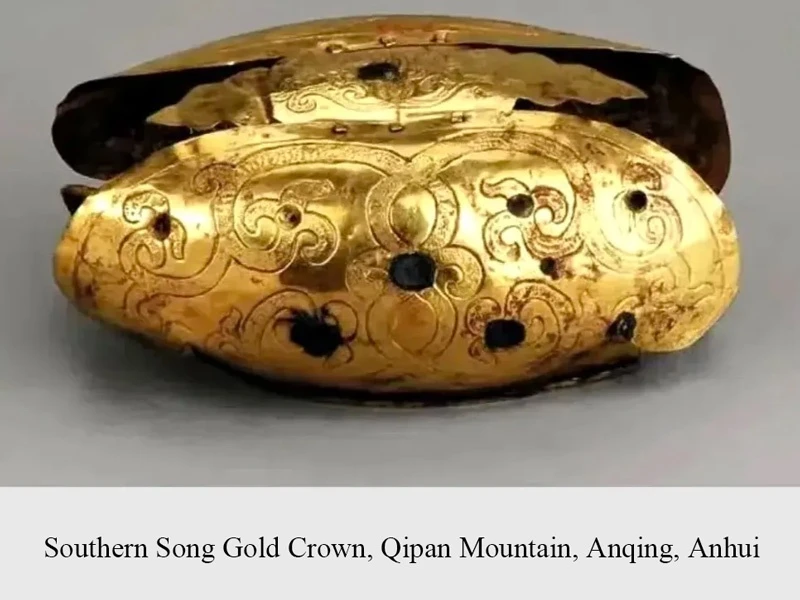
Both crowns depend on skills that are still alive in Chinese metalwork: hammering, chasing, and openwork. Many excavated silver crowns have oxidized black. Their surfaces carry peony and chrysanthemum scrolls, cut with clean, flowing lines. There are no added gems. The beauty comes from the metal’s own response to pressure and from the patience of the hand. That is why a plain silver piece can feel richer than a pile of stones. It asks the eye to slow down.
A tiny crown links a drama still, a tomb in Liyang, a shop in an old capital, and a modern viewer’s double take. It also makes a useful point about style: more decoration is not always more beauty. Detail, proportion, and restraint can do the heavy lifting. So which version wins for you: the silver original with its dark patina, the gold crown with its chased lotus, or Song Zuer’s clean replica? Would this quiet Southern Song shape earn a place in your own cabinet of favorites?