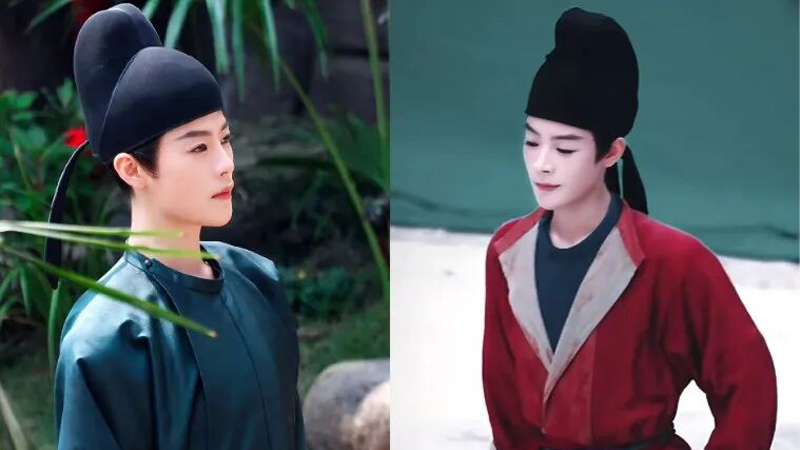
Leaked stills from Zhu Gu Niang (祝姑娘) have made viewers stop and look twice. Chen Lijun (陈丽君) appears in several male official outfits, and the usual markers of a woman dressed as a man are hard to find. No stiff beard, no obvious softness, no sense that the costume is merely borrowed. The effect is not caused by one secret. Her stage body, her face, her clothes, and the role itself all pull in the same direction. Long before the cameras rolled, she had already learned how to stand, walk, and look like a young man.
Opera Foundation
Chen Lijun works at the Zhejiang Xiaobaihua Yue Opera Theater (浙江小百花越剧院), where she performs in the Yin (尹) School as a young male lead. That means more than twenty years of playing men on stage. She has appeared as Jia Ting (贾廷) in New Dragon Gate Inn (新龙门客栈) and as Jia Baoyu (贾宝玉) in My Grand View Garden (我的大观园). Those parts brought her wide attention. Through them, she absorbed a male rhythm: how shoulders settle, how hands rest, how the chin lifts, how a glance can be calm rather than coy. Actors who cross-dress only for one project often change clothes but keep their old physical habits. Chen Lijun changes her center of gravity.
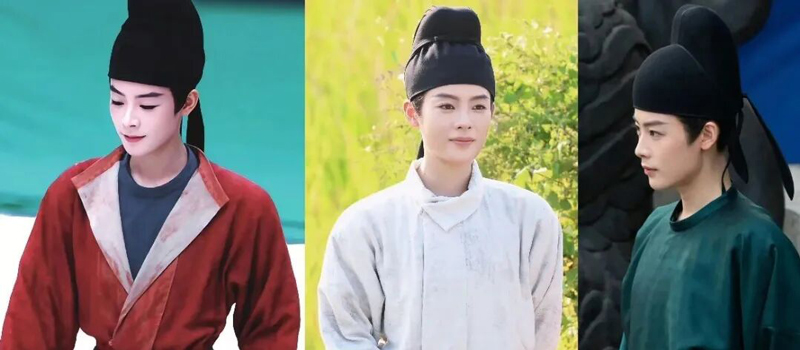
Yue opera also gives her a special vocabulary. The young male role is not a rough imitation of a muscular man. It is slender, clear, scholarly, and controlled. A performer can seem handsome without looking heavy. In Zhu Gu Niang, Zhu Ying (祝缨) is not a giant general. He is a clean, capable young civil official. That figure fits Chen Lijun’s stage presence almost perfectly. If the part demanded a broad warrior, the result might differ. Here, casting and skill meet in the same lane.
Her training also teaches restraint. A slight angle of the wrist, a slower blink, a firmer neck—these small choices signal gender without shouting. Audiences read them without knowing why. That is why the first glance fails. People see a young official, not a woman in a man’s robe. The stage trained her to hold masculinity in stillness, not in noisy swagger.
Costume and History
The makeup does not add; it removes. Her base is matte, hiding the soft shine of skin. Lip color stays close to her natural tone, nearly muted. Blush and highlighter are absent. There is no fake beard to distract the eye. The face looks dry, angular, and cool. The aim is not to make her unattractive. It is to strip away the signals viewers usually use to identify a woman. A clean young man may have smooth skin, but he does not glow pink under office light.
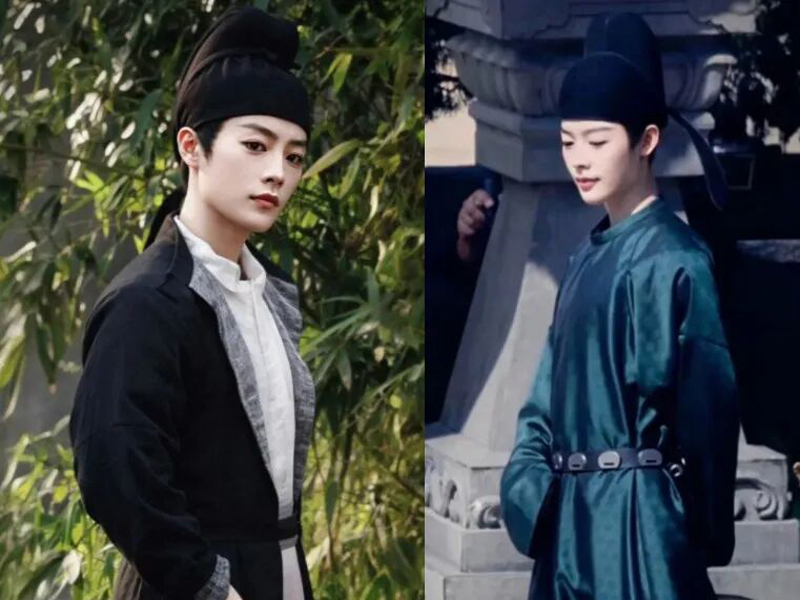
Clothing finishes the work. A tall cap lengthens the head, so her face does not read as small and delicate. Shoulder lines are straightened and widened, removing any slope. Robes hang loose, covering curves. The belt sits low, stretching the legs and torso. The whole silhouette becomes upright, relaxed, and official. Even without padding, the eye accepts a male body because proportion, not muscle, carries the illusion.
Such disguises have long roots. Hua Mulan (花木兰) joined the army in her father’s place. Zhu Yingtai (祝英台) studied dressed as a boy. Operas and stories love learned women and wandering heroes who pass as men. These tales shaped what audiences expect from a male disguise. They also show that men’s clothes could be a tool for movement, study, or survival, not merely a playful trick.
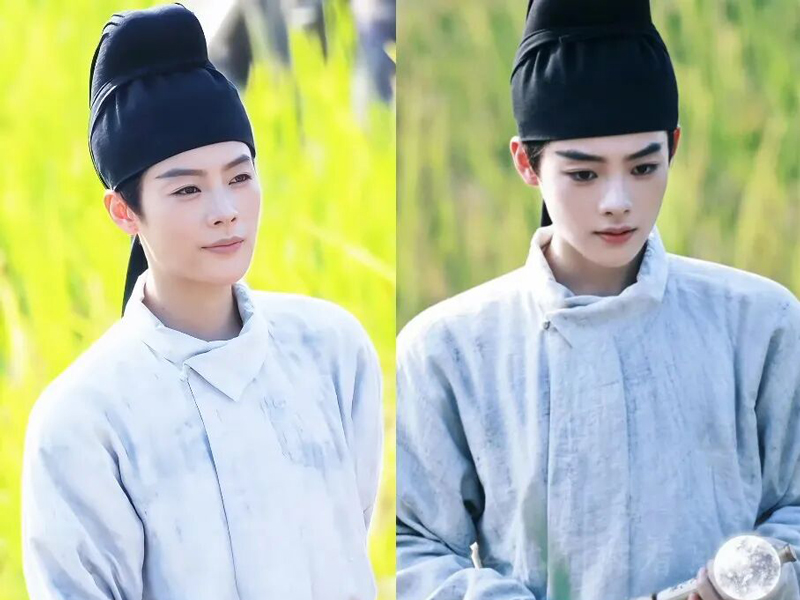
History offers real cases too. Lou Cheng (娄逞) in Southern History (南史) traveled and held office as a man until discovery. Huang Chonggu (黄崇嘏) impressed Zhou Xiang (周庠), who recommended her and even wanted her as a son-in-law; she had to reveal her sex. Tang Dynasty women also wore male-style robes for convenience and style. In Zhu Gu Niang, adapted from “Has Zhu Gu Niang Fallen into a Pit Today?”, Zhu Ying is a sharp young official. Chen Lijun’s stage presence, makeup, and tailoring meet the role. That is why the disguise convinces.
The effect is not magic. It is training, subtraction, and fit. When those align, the audience stops asking who is underneath and simply sees the official. Then the disguise works.