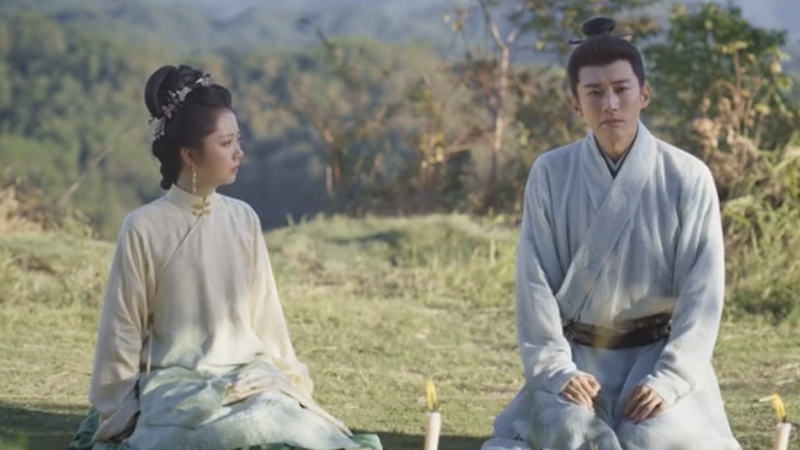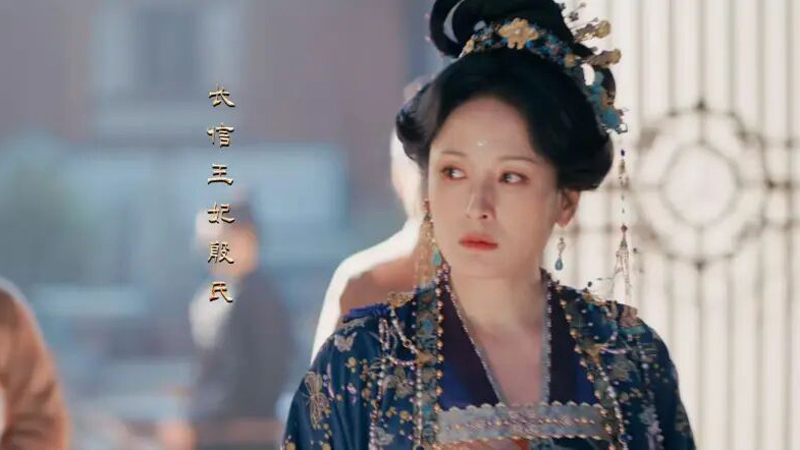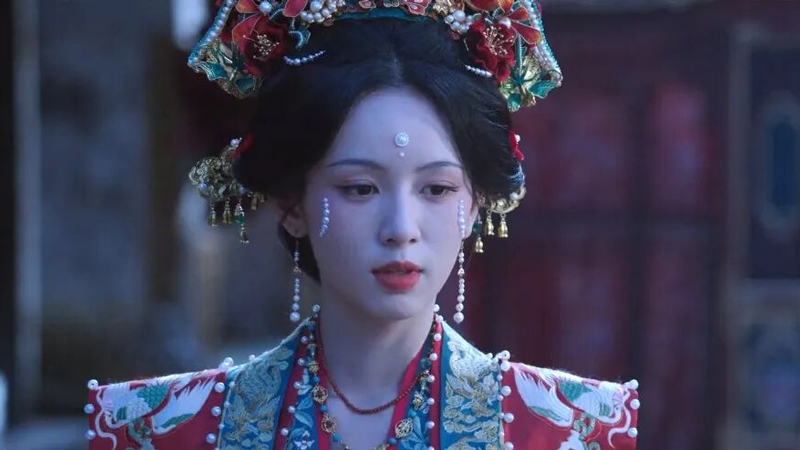
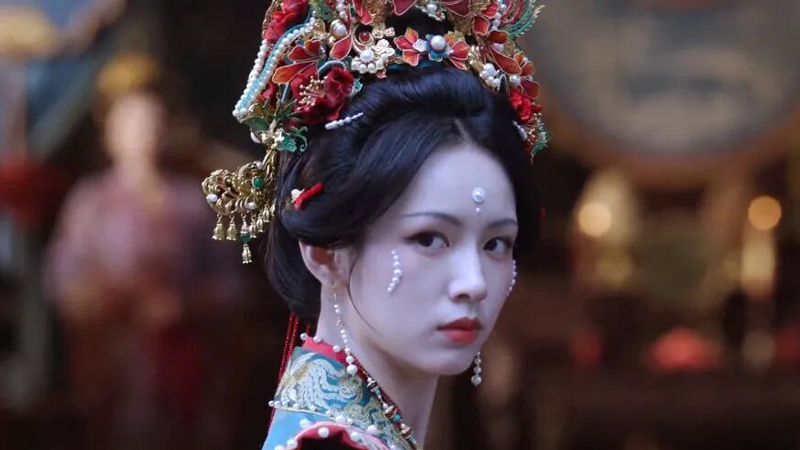
In Spring of the Blade (一瓯春), Zhou Ye plays Xie Qingyuan (谢清圆). One look has tiny pearls fixed to her face: two in the center of her forehead, seven on each cheek. Modern viewers often blink and ask, “Why would anyone wear pearls there?” The actress first caught wide attention in Word of Honor (山河令) as Gu Xiang (顾湘), a bright, quick-tempered girl. That memory makes this new image even more startling. Pearls usually sit on necks, ears, or hairpins. On a face, they seem alien. Yet this is not a random fantasy choice. It borrows from a real cosmetic custom that flourished in the Song Dynasty. To understand why it looks odd on screen, we must first see how it worked in daily life and court ritual.
Song Pearl Fashion
Long before pearls reached cheeks, Chinese women used cut shapes. In the Qin period, Wuse Huazi (五色花子) meant colorful paper, gold foil, or mica clipped into small flowers and dots. These were pressed onto the forehead and cheeks. Zhonghua Gujin Zhu (中华古今注) records the practice. During the Wei, Jin, Southern and Northern dynasties, Huazi (花子) spread widely. Some women painted yellow pigment on the forehead, creating Huahuang (花黄). Others cut plum blossoms and placed them between the brows, a style called Meihua Zhuang (梅花妆). Ballad of Mulan (木兰诗) mentions “pasting flower yellow.” Northern Qi Scholars Collating Classics (北齐校书图) shows the decoration, while Za Wuxing Shu (杂五行书) tells the plum-blossom story. These early stickers prepared the way for pearl makeup.
Tang and Five Dynasties women moved the idea closer to pearls. In Tang times, some placed a pearl at the center of a Huadian, the ornamental mark between the brows. Pearl gave a soft gleam that paper could not match. During the Ten Kingdoms, noblewomen in the south began to set pearls directly on their cheeks. They used them instead of the red dot called Mianye (面靥). The look stayed experimental, not mainstream. Still, it showed that pearls could do more than decorate hair. They could catch light on a living face.
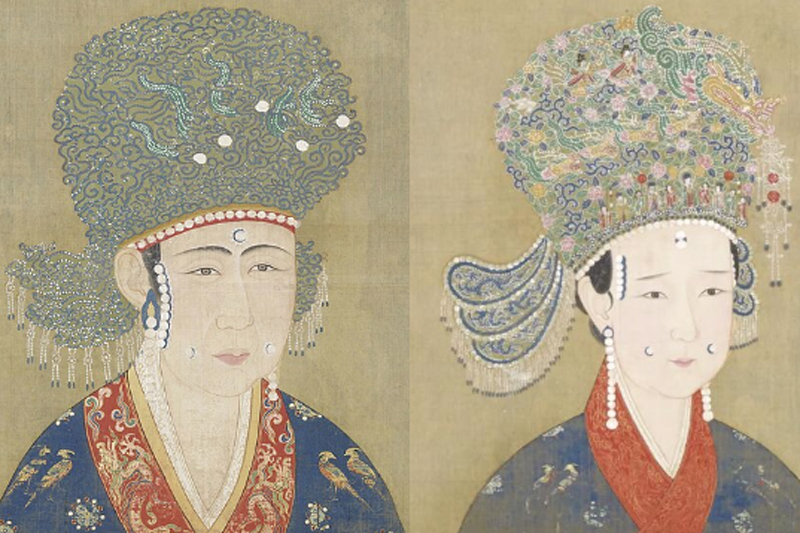
Making the look was delicate. Artisans polished small pearls until they were smooth and even. Women fixed them with fish glue or He Jiao (呵胶), an adhesive warmed by breath. The paste had to hold through ceremonies, yet not damage skin. Pearls could not be too heavy, or the face would look stiff. A single misplaced bead could break the balance. In court portraits, the effect is subtle; in daily life, it required patience. This craft explains why pearl makeup stayed elite. It demanded time, steady hands, and costly materials, not just a fashionable idea.
By the Song era, Zhenzhu Zhuang (珍珠妆), also called Zhenzhu Mianye (珍珠面靥), reached its peak. Early Song courts issued many pearl bans, but elite families ignored them. Palace consorts and respectable daughters alike glued pearls to their skin. Some wore one pearl in the middle of the forehead. Others arranged small pearls into flower shapes. Song History: Treatise on Carriages and Robes (宋史舆服志) lists Zhucui Mianhua (珠翠面花) among a queen’s ceremonial ornaments. Poems such as Lang Tao Sha (浪淘沙) and Jiang Cheng Zi (江城子) mention pearls on faces. Surviving portraits of Song queens and maids show the same detail. Under the Yuan Dynasty, taste turned plainer. In the early Ming Dynasty, ritual texts still named the ornament, but ordinary women rarely used it. Pearls returned to hairpins and necklaces.
Screen Makeup Shift
Why did Song women like pearls on their faces? First, pearls moved more freely. Overseas trade brought South China Sea pearls by ship, and Lingnan (岭南) had its own pearl diving. Markets held more pearls than in Tang times. Second, beauty ideals changed. Tang makeup was bold, with large Huadian and slanted red strokes. Song taste favored restraint. Pearls looked warm and polished, rich but not loud. Third, pearls signaled rank. Once Zhucui Mianhua entered court ritual, nobles copied it. Pearls were costly, so common people could not join in. A pearl on the cheek was not just decoration; it was status made visible.
Zhou Ye’s look in Spring of the Blade follows that history, then bends it for camera. The team consulted Song queen portraits and the Zhucui Mianhua system. But television has different needs. The forehead pearls are arranged as one large and one small, creating a deliberate imbalance. Pearls that once sat near the temples have been moved to the cheeks below the outer eye corners. This placement catches close-up light and pulls attention toward the gaze. On a phone or TV screen, the face must read in seconds. Historical accuracy gives way to framing. That is why the result can feel strange: it is a ritual ornament rebuilt as a visual hook.
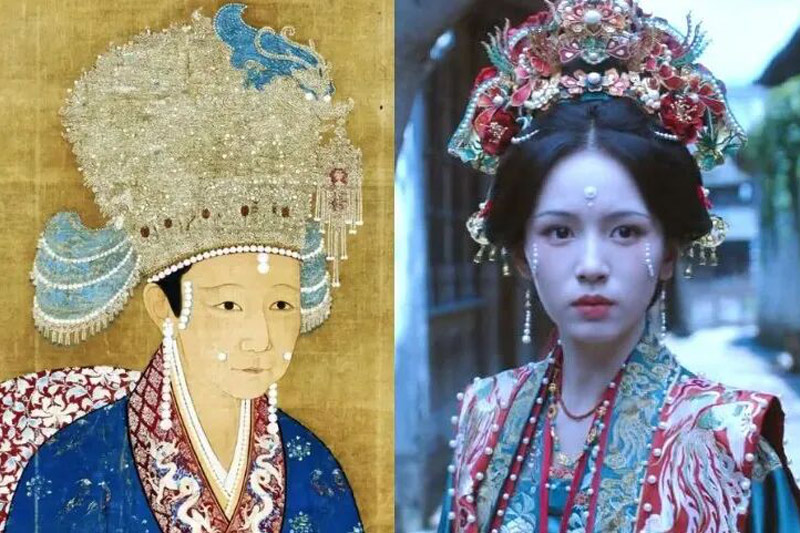
Once we know the background, the oddity changes shape. It becomes a gap between two viewing habits. Song women saw pearls as trade goods, cosmetic tools, and rank markers. Modern viewers see them as jewelry that belongs on ears or necks. The show mixes both languages. It keeps the old name and the old glow, but rearranges the map of the face. Xie Qingyuan’s pearls are not a mistake. They are a compressed history: Song commerce, court rules, quiet beauty, and the close-up demands of drama. What looks weird at first may simply be the past, cut and pasted for a new frame.