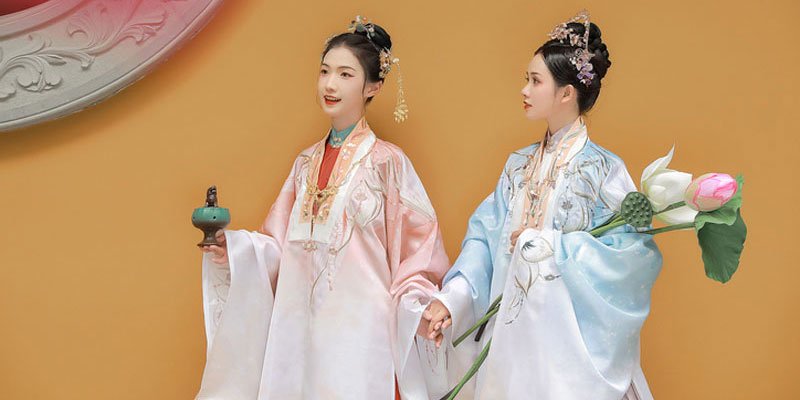
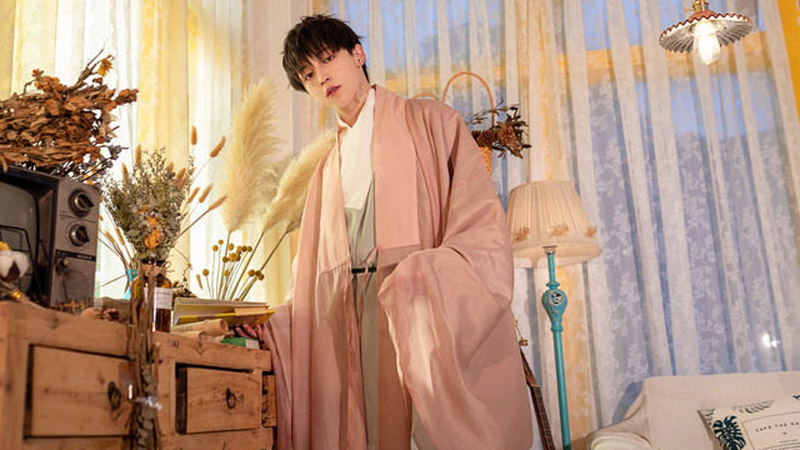
No robe appeared more often in a Ming dynasty man’s wardrobe than the Daopao. From the emperor down to scholars and ordinary townsmen, almost everyone wore one as everyday dress. It was neither a ceremonial garment nor a robe reserved for the literati: it took the form of a one-piece long coat with a right-lapel front and a slit on each side, and because nearly every student owned one, people simply called it the Daopao, the robe of a man who had read enough to know the Way. What set it apart from the other long robes of its day was not the body of the garment but something hidden inside the side slits, a strip of fabric known as the hidden flap.
The hidden flap is made by extending a piece of cloth from the left edge of the outer lapel and the right edge of the inner lapel, folding it forward into two or three fixed pleats against the inside of the front, and then turning the remaining cloth back and anchoring it to the centre seam of the back panel. Worn, the cloth stays entirely on the inside and cannot be seen from without, which is where the word “hidden” comes from. Its job was never a single one.
What the Hidden Flap Actually Does
Left raw, a high slit would expose the legs and the under-layers as a man walked. The middle robe and the trousers beneath would show through the opening, which breached the composure Ming dress was meant to keep, and the flap covers exactly that gap. At the same time, when a long robe is slit high, the pull of striding, riding or crouching gathers at the top of each slit, the point most likely to split its stitching. Stitching the flap to the body spreads that stress across the seam, reinforcing the robe at its weakest point while leaving the wearer room for a longer step.
In practice the flap was cut in three parts. From the outer lapel a panel extends left; from the inner lapel a second panel extends right; both are pleated forward against the inside of the front and the surplus folds back to the spine. The pleats are taken as two or three fixed folds, and the anchoring point is the centre line of the back. So the three pieces are not stitched into a single visible band but folded into the interior, which is why a finished robe can show no sign of them from the front.
Reading a Robe Through Three Sources
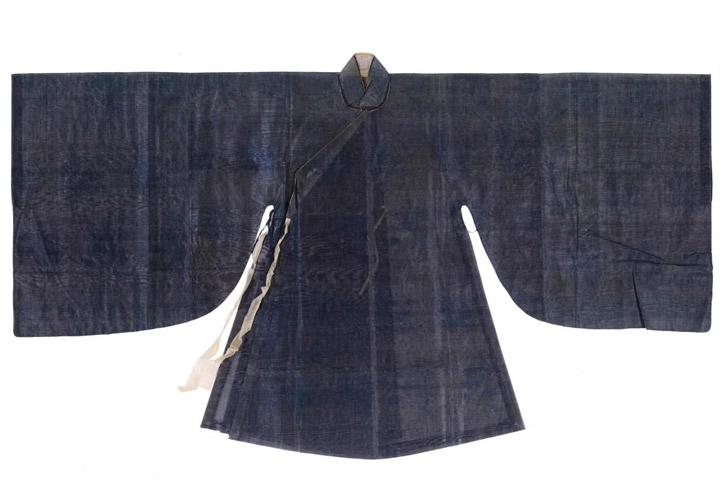
To pin down the structure of the Ming Daopao, researchers use what they call the triple-evidence method: excavated finds and the eleven Daopao held in the Kong family collection as the physical basis, images and documents for comparison, and structural reconstruction as the result. The conclusion is a robe cut in one piece from shoulder to hem, closing right lapel over left, its body widening below the waist into a soft A shape and falling to the ankle.
Collars are mostly crossed, in three forms known as straight-cut, slant-cut and continuous; sleeves come in two, a narrowed cuff and a wide, flared cuff. Front and back carry a centre seam, the robe is tied with three pairs of cloth tapes, and the hem is the classic two-slit hidden-flap build, itself divided into a standard type, a simplified type and a patched type. In other words the hidden flap was not one fixed method but a structural scheme adjusted to how a tailor cut the body and chose the sleeve. The form was not decorative; it was a set of answers that changed with the garment around it.
Tomb Finds and a Family Hoard
Buried pieces supply the direct evidence. A damask robe with a scrolling peony motif from the Ming tomb at Fengjiquan in Ningxia, a padded silk robe patterned with drifting clouds and flowing water from a Ming grave in Suzhou, and a cotton robe with a silk collar from a Ming tomb in Huishui, Guizhou, all come close to one another in how the flap is built. The Huishui cotton robe even carries an explicit note of two pleats taken under the arm, almost identical to the construction of a white cotton Daopao in a private collection: plain-weave cotton, a silk protective collar, a wide-sleeved crossed collar, side slits joined to a flap that is pleated, pieced, folded back and fixed to the inside of the back, with two seams visible on either side of the front where the double pleating opens the hem wider. The details show that this seam work was a common craft across regions and materials, not the habit of one workshop.
The Kong family collection is the second thread. Shandong Museum’s Ming dress holdings come mainly from two sources. One is the tomb of Zhu Tan, Prince of Lu, excavated in Zoucheng, Jining, in the 1970s, which yielded a group of early-Ming princely robes and regalia, high in rank, broad in type, large in number and well preserved, some of them unique in China and beyond. The other is a group of Ming heirloom garments transferred from the Confucius Mansion in Qufu in the 1950s, covering court, ceremonial, official, everyday, festive and informal dress, whose cuts, motifs and techniques mark the high point of Ming costume art. Among them are Daopao, including a tea-brown robe in Zhuanghua gauze woven with gold python roundels, a piece that lets researchers see, beyond excavated goods, the fuller textile, gauze-weaving and gold-work of a garment that was handed down rather than buried.
Built for Daily Life, Not Ritual
In function, the Daopao belonged to the category of dress for leisure at home. Fan Lian’s Ming miscellany Yunjian Jumu Chao (云间据目抄) records that from the Longqing and Wanli reigns onward men generally wore the Daopao, and that the Yangming robe common in earlier years came to look like novelty, a matter of taste rather than of antiquarianism. Wang Shizhen, in Gu Bu Gu Lu (觚不觚录), placed the robe inside the everyday wardrobe of his time: a long-sleeved variant was the Yesa, and one without a woven cord was called the Daopao, also the zhiduo, and all three were the ordinary dress of daily life.
So the Daopao sat alongside the Yesa and the Chengzi robe as a garment for home, worn by scholars, local gentry, retired officials and well-off townsmen for staying in, reading and meeting friends, while ordinary families also used it as a wedding robe or as an inner layer beneath another coat. It descended from Song and Yuan Daoist robes, existed by the early Ming and reached its peak in the middle and late dynasty. It is worth separating the secular Daopao from the robe of the ordained Daoist, with which it shares an origin but not an identity. The Daoist robe of later practice differs in part of its build, carrying a Sanqing collar and an inner flap, so the two cannot be treated as one. By use, the Daoist robe divides into the dagua, deluo, jieyi, fayi, huayi and nayii: the blue dagua with a cuff of about 14 cun for daily wear; the deluo, also blue, with a cuff over 18 cun, as formal dress for religious occasions; the jieyi, its cuff beyond 24 cun, worn at ordination; and the fayi, or “celestial grotto robe”, often embroidered with sun, moon, stars, pagodas, dragons, phoenixes, cranes and qilin. The Ming History’s treatise on robes (明史·舆服志) notes that Daoist everyday dress was blue, the colour of the east, of wood and of life, which carried a wish for the preservation of life.
Sleeves That Ran to Three Feet
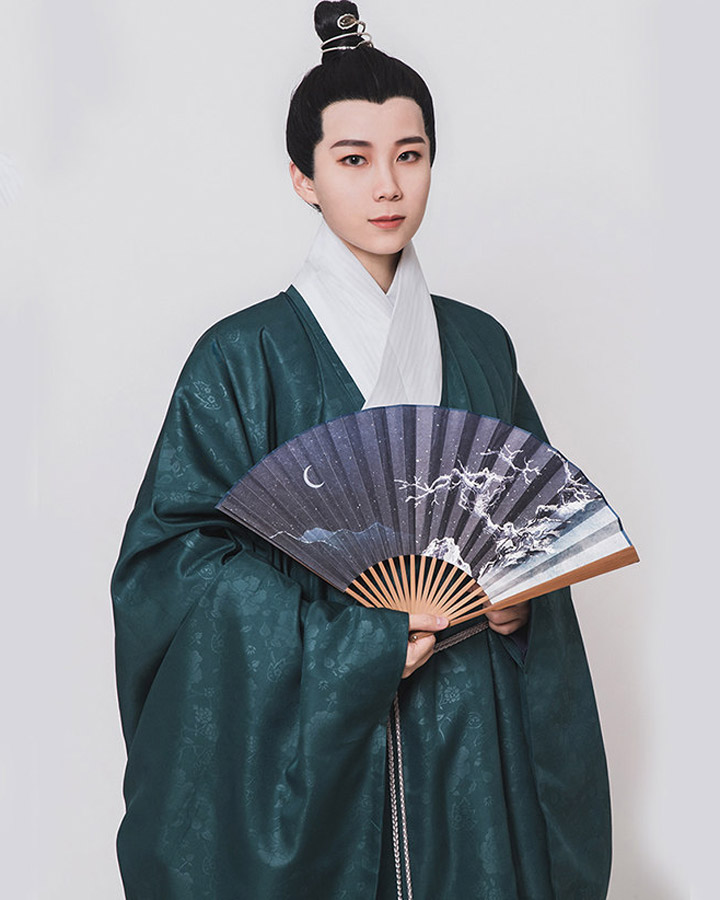
Three things were constantly recut as the robe moved through fashion: the build of the hidden flap, the length of the body and the width of the cuff. Late-Ming taste grew especially extravagant. Ye Mengzhu’s Yueshi Bian (阅世编) recalls the change in dress: in his youth, he wrote, the robes of his seniors hung to the shoes and the cuff was a foot at most, but later the body grew shorter and the sleeve wider, the hem barely past the knee, the skirt trailing outside the robe, the cuff to three feet, so that when a man folded his hands the cloth dropped to his boots and when he bowed it piled up on them, outside and inside alike. A cuff of no more than a foot had grown to three, reaching the boot at a single gesture.
That account matches the descriptions in the Ming novel Xingshi Yinyuan Zhuan, and Feng Menglong, commenting on the song “Zidi” in his collection Guazhi’er, sketches the fashion of young men: a white silk shirt against peach-red trousers, a Daopao with big sleeves, and low-backed pufferfish shoes. “Big sleeves” were, in the late Ming, a fashion signal people enjoyed talking about. The robe also crossed the sea. Carried to the Korean peninsula, it became everyday formal dress for kings, crown princes, officials and literati through the middle and late Joseon period. Archaeology keeps adding earlier threads: in October 1973 the Datong museum excavated the tomb of Yan Deyuan at the site of the Jin-dynasty Yuxu Temple west of the city, recovering 24 pieces of silk, among them two Daopao and one Hechang embroidered with cranes and clouds, the crane-and-cloud Hechang built on a four-heddle leno, a representative technique of Chinese leno weaving.
Placed side by side, the hidden flap, the protective collar, the centre seam and the tapes record a restrained way of dressing that gave the body room and the mind room with it. The structural changes, as the flap divided into types and the cuff grew from a foot to three, were a craft question and also a scale on which shifts in social taste could be read. Seen again today in a museum case or an old painting, the most important feature of the Daopao stays where it always was, on the inside and out of view.