The programming logic behind Sichuan’s newest heritage showcase is visible in its running order. Rather than arrange the province’s crafts as a list, the producers split the evening into six chapters and let each one carry a different material: a river chant, a woven thread, a length of bamboo, a stage tradition, a gathering of tunes, and a closing image of moonlight. The 2026 Sichuan Intangible Cultural Heritage Immersive Performance opened on the evening of September 24 at the Sichuan Grand Theatre in Chengdu, hosted by the provincial Department of Culture and Tourism and produced by the Sichuan Tianfu Performing Arts Group.
Two sites run in parallel, with the Grand Theatre as the main venue and the East Suburb Memory cultural park as an experience zone. Its theme is “Splendid Tianfu, Beautiful Heritage.”
Six Chapters on One Stage
Its opening program moves through “Prologue: A Voice Asking Where We Came From,” “One Thread Weaves a Thousand Years,” “One Bamboo Stands for Character,” “One Opera Opens New Ground,” “One Tune Gathers Ten Thousand Things,” and “Epilogue: A Moon Lights the Future.” Across them it presents the Chuanjiang boatmen’s chant, Shu brocade weaving, bamboo weaving, Sichuan opera, shadow puppetry, and Tibetan, Qiang and Yi song and dance. In one of the loudest moments, Chen Zi’an, a child face-changing enthusiast born after 2020, performed a face-changing passage in the Sichuan opera piece “Juehuo,” and the audience answered with sustained applause.
Technology does much of the staging work. Holographic projection is used throughout, and in dances such as “Flowing Light on Woven Brocade” and “Bamboo Shadows Seeking the Wind” it renders the threads of Shu brocade and the grain of bamboo weaving as moving, three-dimensional forms, so that the dancers pass through a space that is part screen and part stage.
Five inheritors were invited as guests of honor: He Bin, a national-level inheritor of Shu brocade; Meng Dezhi, a national-level inheritor of Shu embroidery; Yang Huazhen, a national-level inheritor of Tibetan weaving and cross-stitch embroidery; Axi Wuzhimo, a national-level inheritor of Yi embroidery; and Mao Yungang, a provincial-level inheritor of the Kangding liuliu folk tune. Professional companies and university ensembles joined them, among them the Sichuan Modern Song and Dance Theatre, the Chengdu Normal University School of Music and the Sichuan University School of Art, in crossover numbers that included the original song “A Work Chant Flung Across the River” and the dances “Spring Light Is Fine” and “Hundred Birds Paying Homage to the Phoenix.”
A Market at East Suburb Memory
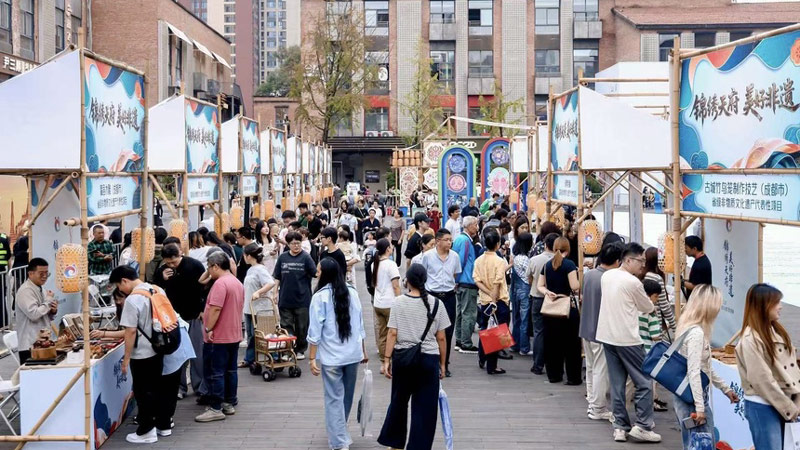
A looser format carries the same material at the second site. From September 24 to 26, the East Suburb Memory stage area runs a heritage market and hands-on zone each day from 14:00 to 22:00, with Shu embroidery, Chengdu dough figurines and Sandapao rice cakes among the food and craft stalls. A costume experience area and photo spots let visitors take part rather than watch, and the market sells what it shows. Each day between 16:00 and 16:30 it also stages flash performances, among them the Yutan colored dragon, Emei martial arts, and a costume runway show titled “Heritage in Silken Robes.”
Its run ended on September 26. The structure, a main-stage performance paired with a market where the same crafts can be handled and bought, is the provincial department’s attempt to move Shu brocade weaving, Shu embroidery and bamboo weaving out of display cases and into a place where audiences can watch, try, and take something home.