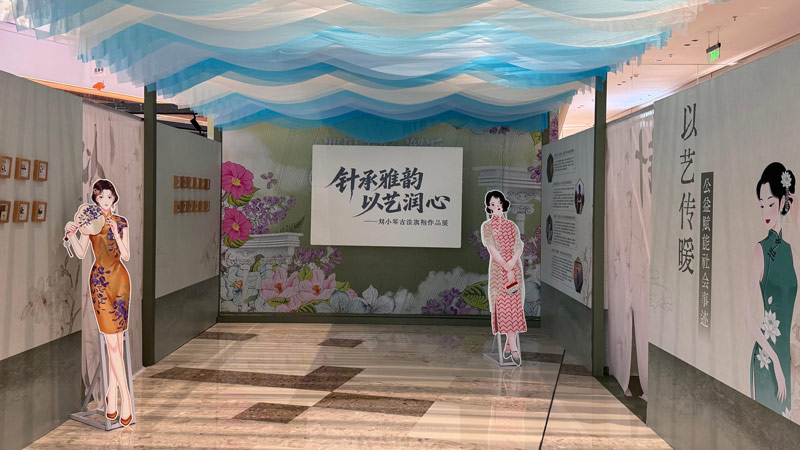
A traditional-method qipao has almost no seams. It is cut flat from a single piece of cloth and shaped afterwards, which is why the pieces on the racks at a Chengdu mall this autumn read as calm and unforced rather than fitted. The exhibition that holds them began on September 18 at Xuhui Cmall in Wenjiang District and runs to October 16, in the ground-floor space by gate 2.
It is the fourth installment of the third season of the Ordinary People Gallery, a series organized by the district’s culture, sports and tourism bureau with the district federation of literary and art circles and run by the district cultural center. Since it began in June 2024, the gallery has put craftspeople, students and local entrepreneurs on the same stage, and it has moved its displays out of professional venues and into shopping and living spaces. The subject this time is the work of Liu Xiaoqin (刘小琴), an inheritor of qipao craft recognized at the municipal level in Chengdu.
Whole-Piece Cut, Shaping by Hand
Finished traditional-method qipao, Pankou and brooches fill the display, with photographs and captions explaining four core techniques behind them: knotting, embroidery, openwork and carving. On either side of the display stand sit small Pankou brooches and cultural-creative accessories, and a set of panels walks through how each stage of the making works.
Liu set out the shaping method in her own words. “Traditional qipao are cut flat from a whole piece and shaped into form, which suits a reserved and contained bearing,” she said. “There are very few dividing lines; the shaping depends entirely on a press-and-stretch technique. Heat is used to change the fabric’s grain, the front shoulder seam is opened so it curves forward naturally, and the waist is drawn into a curve, so that the finished garment feels light and comfortable to wear.” She added that the exhibition is meant to let visitors understand how the craft is done and to bring them closer to traditional dress culture.
Behind the exhibition lie more than 20 years at the craft. In 2022 she founded the Caisha Qipao Studio in Xinglin Community of Yongning Subdistrict, using idle space, and it has drawn enthusiasts who come to try the techniques themselves. Alongside it she runs hands-on training courses, an approach she describes as a “fingertip economy” that brings flexible work to residents. Since then its courses have trained more than 1,000 people, helped over 300 into flexible employment, and given dozens of people with disabilities a skill to work with.
Training That Travels Beyond the Gallery
The gallery’s own shift matters as much as what hangs in it. Moving displays into malls is meant to turn art from something the public watches into something the public joins. Over the Mid-Autumn and National Day holidays the exhibition stays open to the public, and Wenjiang has built a wider program around the season with four themes, sport, village, heritage and exhibition-going, spread across six sections. Guanghua Park and Wenmiao Yinxiang host moon-viewing, Hanfu shows and cultural programs, while Heshenghui and Xuhui Cmall stage rolling-lantern dances, fish-dragon lanterns and shadow puppetry.