Brides and grooms arrived by bus. On the morning of September 28, sixty couples and ten couples who had been married fifty years or more stepped off vehicles dressed as wedding cars and walked onto a stage at Wuzhou Lake Square in Linyi, Shandong, for a ceremony held under the title “One Nation Celebrating Together, Love Filling Yimeng.”
Bowing to heaven and earth came first, then the hejin cup, a rite in which bride and groom drink from a single vessel, then the joining of hands. Cui Fengyou, director of the Linyi People’s Congress standing committee, witnessed the marriages. Officials handed each pair a commemorative marriage certificate printed with silhouettes of the city’s landmarks, made only for Linyi. Ten golden-marriage couples then passed down a calligraphy scroll carrying four lines of family instruction: respect the old and care for the young, be diligent and thrifty, treat neighbors with leniency, serve the country with sincerity.
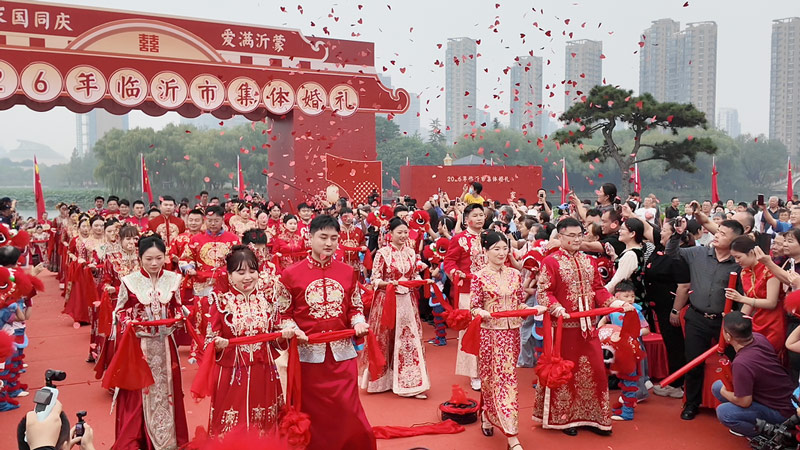
“This collective wedding let us set aside the expense of a lavish banquet and put down the burden of comparing bride prices, and we gained the blessing of an entire city,” said Li Chaozheng, who read the Good Family Tradition Initiative with his wife Yang Yan on behalf of all the couples.
Linyi has run the event three years running since 2024 and says it has guided 1,500 couples into marriage through it. This year the China Rural Civilization Conference met in the city and carried Linyi’s approach to wedding-custom reform to a national audience.
Rites Shared by Three Cities
Two other cities staged their own versions within the same holiday window. On September 26, Yinchuan in Ningxia held its first collective wedding for workers, bringing 20 young employees from different trades to the Lanxigu International Conference Center. The event belongs to the Yinchuan Federation of Trade Unions’ service program for young workers, aimed at easing the cost of marrying. A customized bus wedding car arrived bearing large red characters for joy, and the hall was dressed as a Chinese wedding scene: red silk drapes, dragon-and-phoenix candles, a brazier, a saddle and a basket of five grains. A mother combed the bride’s hair three times in the combing rite; a suona band played “Hundred Birds Paying Homage to the Phoenix” as the sedan-chair welcome, the red-veil handover and the scattering of five grains followed; and at the hall the couples made three bows, signed a union pact and drank the shared cup together. Golden-marriage worker couples took the stage to describe decades of companionship, and the 20 new couples pledged to resist high bride prices.
On September 29, Luntai County in Xinjiang married nine couples in Chinese dress under the title “One Nation Celebrating Together, Fate Sealed in Autumn.” To a measured score they walked in, stepped over a saddle, and completed the hand-in-hand rite before bowing three times, to heaven and earth in thanks for the land, to their parents in thanks for raising them, and to each other in a vow to grow old together. Attendants brought a tray and a brush for the eyebrow-painting rite, then gold scissors and a brocade pouch for the hair-binding rite, in which a lock from each was cut and sealed in the pouch as a pledge. The couples took family precepts plaques and, in a “ten years, one tree” segment, planted saplings together. Tudihan Yimir, deputy director of the county People’s Congress standing committee, served as witness. The date was set to mark the 77th anniversary of the People’s Republic.
Custom Reform Under the Rites
The three ceremonies keep the same core: three bows, the shared cup, the binding of hair, the joining of hands. Their dress runs the same range as well, phoenix crowns and Xiapei, gold-woven Mamianqun, Xiuhe dresses and modified Xinzhongshi gowns. Where they diverge is in what the organizers want the rite to carry. Linyi binds the ceremony to the Yimeng spirit and to family tradition, using the scrolls from older couples to make the idea concrete. Yinchuan writes the refusal of high bride prices into the couples’ pledge. Luntai adds tree planting and family precepts to the sequence. Across one holiday, the revival of ritual and the practical work of changing wedding custom are made to share a single stage.