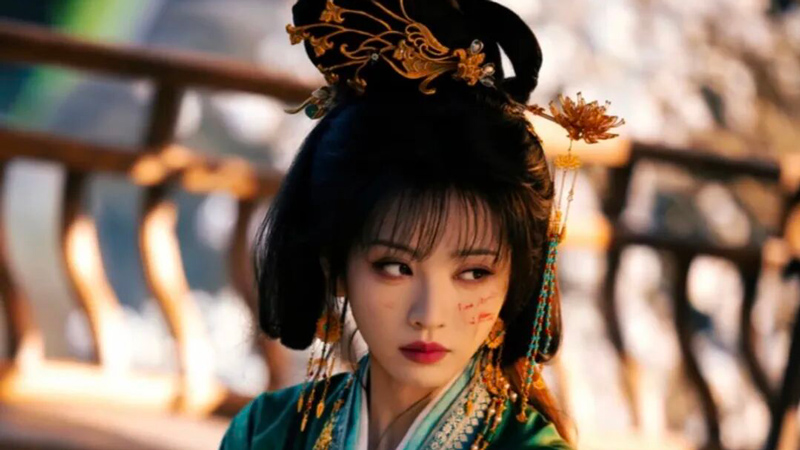
A leaked costume photo can make a whole drama feel off before a single scene airs. Actress Tian Xiwei (田曦薇) has become the center of that kind of debate in Transfer Gold Hairpin (嫁金钗). Viewers say her makeup and fabric look fine, yet the full image feels strange. They cannot name the problem. The reason is not simple bad taste. The show claims a grounded Han dynasty visual language, but several choices come from later periods or modern styling. When parts from different systems are mixed, the eye notices the clash before the mind explains it. That vague discomfort is historical pattern recognition. It is the costume equivalent of hearing a wrong note in a familiar song.
Wrong Dynasty Pin
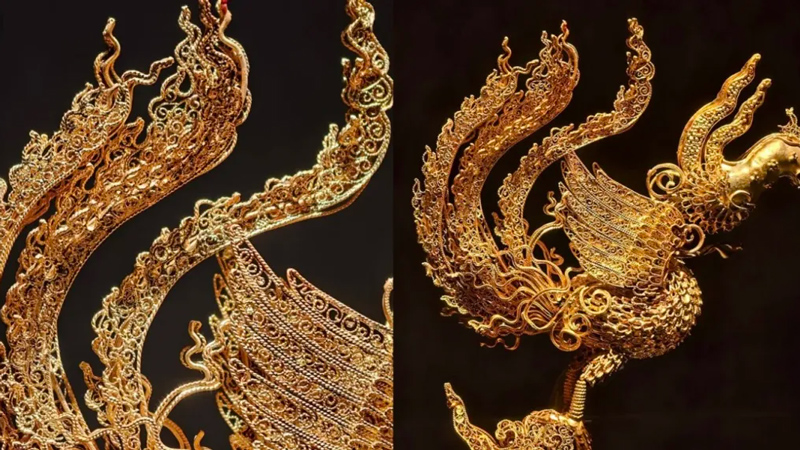
The clearest signal is the gold phoenix hairpin in the center of her bun. It is rich and bright, but it belongs to another era. Han noblewomen did not wear a central gold phoenix. They wore Buyao (步摇), a swaying ornament with hanging beads. An old text says it moved when the wearer walked. Western Han pottery figures show these beads fixed at both sides of the hair. The design was loose, mobile, and light, matched with a low bun. It was made for movement, not for sitting still. A large central phoenix looks more like a Ming dynasty lady’s headdress. Tang dynasty phoenix pins usually joined a formal phoenix crown, facing forward. Putting a Ming-style phoenix in a Han setting is like wearing a Victorian collar with a toga. The drama title even promises a golden hairpin, so audience expectations are high. One wrong pin can break the whole world.
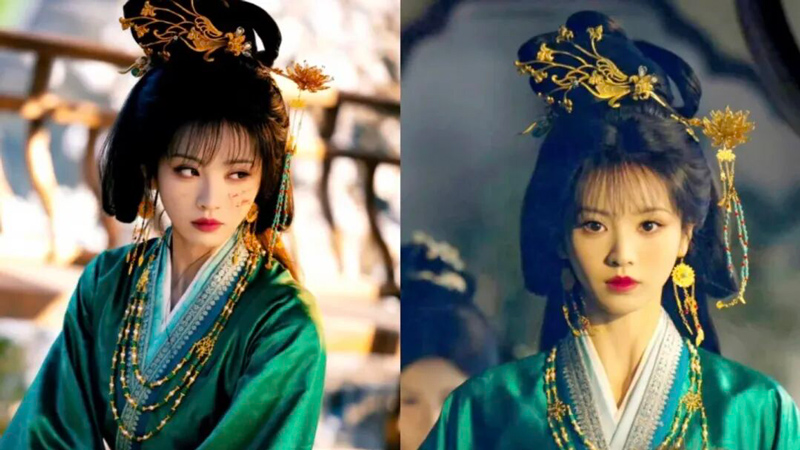
Another issue is balance. Traditional Chinese formal dress usually follows a central axis. Step-sway ornaments come in pairs. Sideburn ornaments come in pairs. Left and right answer each other. This symmetry is not conservative. It creates dignity, order, and ritual calm. The leaked look pushes most visual weight to one side, leaving the other almost empty. It can be beautiful, but it loses the stable balance that formal dress needs. Modern stylists often use asymmetry to create design energy. That works on a red carpet. On a ritual-heavy costume, it fights the old logic. People sense the imbalance, but they may only say “weird.” The body knows before the vocabulary arrives.
None of this means every element must be copied from a museum. Costume design needs imagination. The problem starts when a borrowed piece is treated as decoration rather than grammar. A hairpin is not just metal and shape. It carries rules about rank, occasion, gender, age, and movement. If a designer ignores those rules, the result may still photograph well. It will not feel true. The audience may not know the name of the ornament, but they can feel that the sentence is wrong. That is why the look keeps trending: it is pretty enough to attract attention and off enough to invite debate.
Details and Debate
Earrings add another small crack. From the Zhou dynasty into the early Tang, Central Plains women left few ear ornaments in tombs. Some neighboring groups wore them more often. Stone Age jade slit rings and Qin and Han ear pendants existed, but scholars debate their use. One theory links them to ritual workers; another links them to enslaved people as marks. Many were tied with silk thread rather than inserted through a pierced hole. A modern-looking dangling earring therefore pulls the eye away from the Han frame. It is not a huge mistake alone. In a strict visual system, small modern details can tip the whole face into the present.
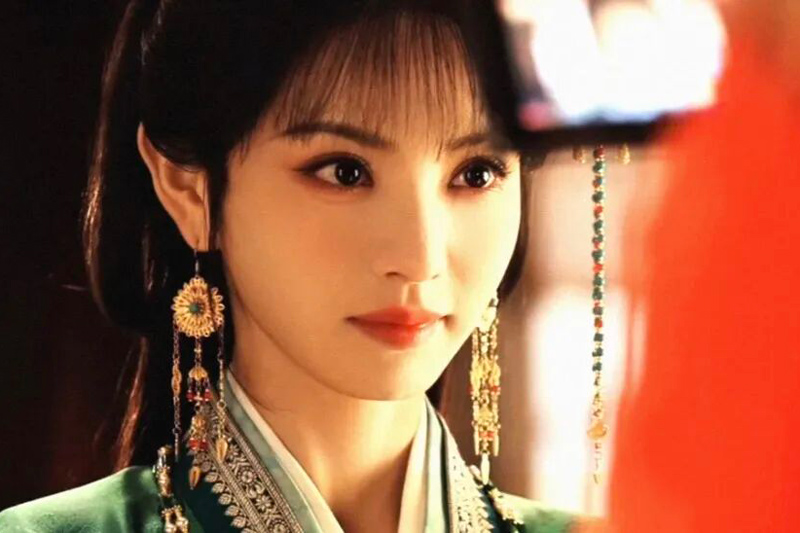
Hair edges matter too. The bangs in the leaked images read as a modern beauty choice. The pulled loops on both sides resemble a young girl’s double-loop hairstyle, not the formal hair of a married noblewoman. Used on a teenage servant, that shape might fit. Used on a central romantic figure in formal dress, it creates mixed messages. The eye reads youth, casual cuteness, and modern softness where it expects adult rank and ritual weight. Again, the problem is not that one detail is ugly. The problem is that several details speak different languages at once. Costume design is a system. When one part is modern, another is Ming, and another is Han, the character stops belonging to any time.
The loud argument is actually healthy. Ten years ago, few viewers would ask whether a Han character could wear a Ming phoenix pin. Now audiences bring historical knowledge to costume review. Film and television are still the main window through which many people meet traditional dress. One careful drama can teach more than a hundred online classes. One careless drama can spread a wrong image across the internet. Designers should borrow elements, but they must first learn how those elements were worn and why. Otherwise, the borrow becomes a broken map.
What do you think? Should costume dramas chase pure historical accuracy, or should they be free to mix eras for beauty? The answer is probably not all-or-nothing. Viewers do not demand a museum catalog. They demand internal logic. If a show invents a world, it must teach its own rules and keep them. If it claims Han style, then Han style should guide the hairpin, the balance, the ears, and the edges. The “weird” feeling in these photos is not a mystery. It is a signal that the pieces are arguing. Good design makes them sing.