When Chen Yao (陈瑶) appears in Chen Yao’s new drama, her striped costume has made some viewers pause. The lines look familiar, almost like the trim on a modern cardigan or casual jacket. In a historical setting, that familiarity can feel jarring. Did the costume team borrow from a shopping mall? The answer is no. The stripes are not a modern shortcut. They belong to a much older design vocabulary, one already active in China before the Qin dynasty. A look at recent archaeological finds from Jingzhou (荆州), Hubei (湖北), shows that striped borders were part of elite dress long before runway fashion claimed them. What feels contemporary may simply be a design idea that never disappeared.
Chu Tomb Evidence
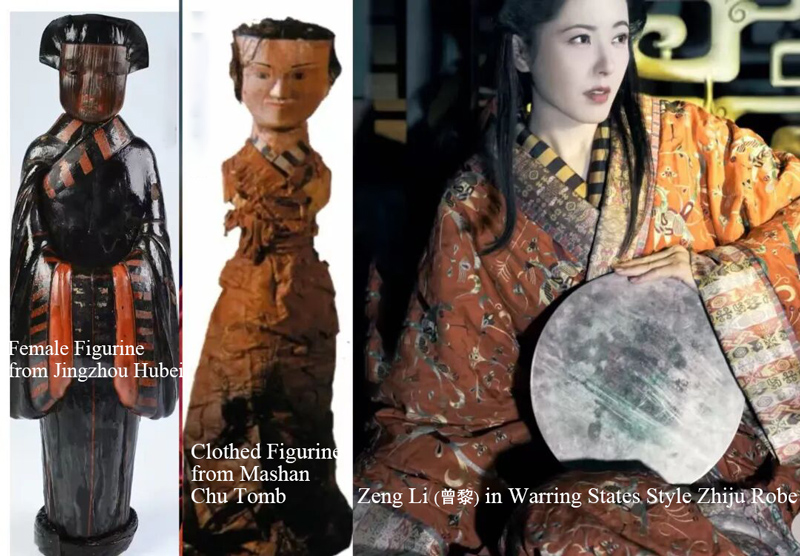
Mashan Chu Tomb No. 1 (马山一号楚墓) is often called a treasury of pre-Qin silk. The tomb produced more than thirty well-preserved robes and silk garments from the Warring States period. For scholars, this collection is not a minor find. It is the most complete surviving group of Chu clothing and a central reference for any serious reconstruction of that era’s fashion. While studying the pieces, researchers noticed something that surprises modern eyes: noble silk robes and thin gauze layers already used striped borders. The stripes were not random. They appeared on collars, lapels, and wide cuffs, often woven in several colors and different widths. Long before today’s fashion editors praised “statement stripes,” Chu weavers had made them a quiet signature.
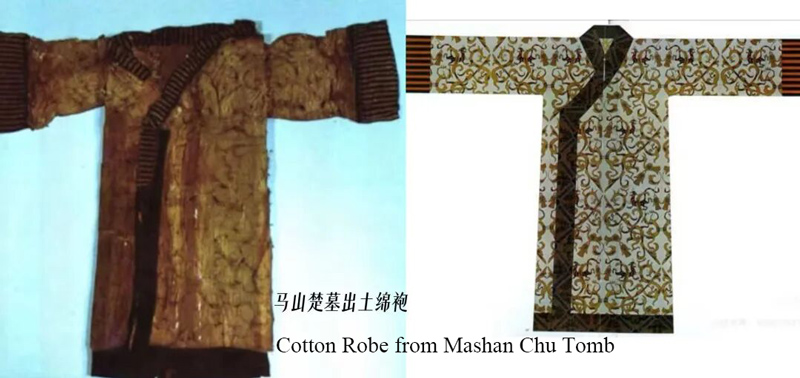
The design logic was sharp. A large robe might carry dense patterns across its main body, while the edges received a controlled geometric band. This created a clear hierarchy: rich display in the center, order at the border. In other words, people in the Chu state understood a styling rule that still works today. A complicated surface needs a calm frame. The striped trim did not compete with the main embroidery; it guided the eye and gave the garment structure. Calling such a choice “modern” misses the point. It is better described as durable. The same visual solution has been rediscovered by generation after generation because it solves a basic problem: how to make a loose, layered garment look balanced.
Many viewers assume that ancient Chinese dress was always covered with dragons, phoenixes, clouds, and heavy embroidery. That image is only half true. Pre-Qin artisans liked contrast. They could fill a robe with phoenix motifs, coiled hornless dragon, and scrolling plants, then leave the collar and cuffs to regular stripes. The result was not simple. It was controlled. The main pattern announced rank and ceremony; the striped border kept the silhouette from becoming visually heavy. This is why the costume in Chen Yao’s new drama can look both old and new at once. The audience is not seeing an error. The audience is seeing an old answer to a question fashion still asks.
Smart Design
Stripes on the edges also had practical value. Repeated wear, folding, and friction damage cloth first at the collar, lapel, and cuff. A woven strip could reinforce those vulnerable areas, helping the silk hold its shape. At the same time, vertical stripes changed how the body was read. They narrowed the visual width of a loose robe and offset the weight of large patterns. The wearer looked taller and more composed. Modern designers use stripes for similar reasons: to correct proportion, add rhythm, and give a garment a cleaner line. The resemblance is not a coincidence. It is a shared solution, found independently across time because bodies and fabric behave in predictable ways.
Why, then, do so many people feel a jolt of “modern” when they see the costume? The answer lies in geometry. Horizontal and vertical stripes, triangles, and diamonds are among the oldest and most adaptable patterns in clothing. A Chu weaver, a Tang tailor, a Song seamstress, and a contemporary fashion house may work with different tools, but they return to the same basic marks. The stripe is not owned by any century. It is a tool. What feels trendy today was already mature in the Warring States period. The costume does not travel forward in time. It simply uses a language that never went out of use.
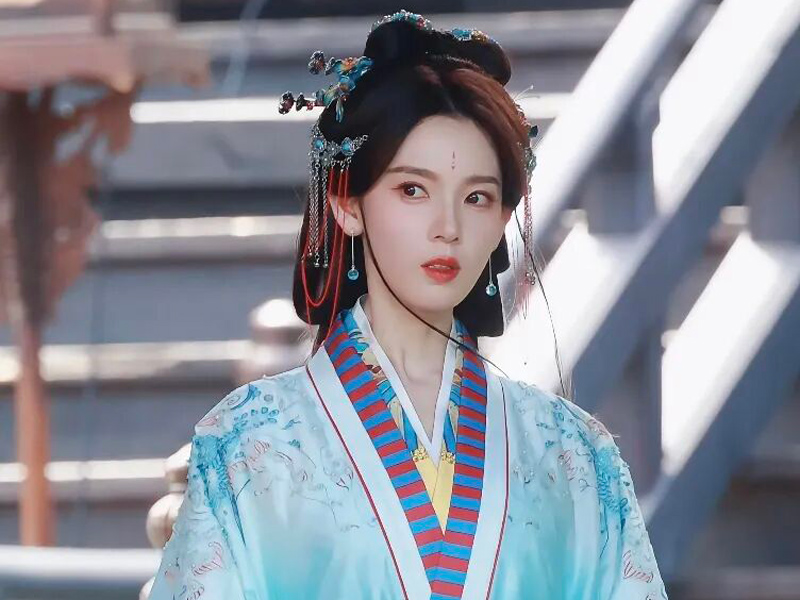
This is also why the familiar feeling should not be dismissed as a mistake. Familiarity can be a sign of survival. A design that lasts for more than two thousand years must do something useful, whether that means strengthening a hem, shaping a silhouette, or pleasing the eye. The stripes in Chen Yao’s new drama connect a modern viewer to a much older visual habit. They do not break the historical world. They reveal how continuous it is. The next time a striped edge appears on an ancient robe, the question might change. Instead of asking why it looks modern, ask why modern clothing still looks so ancient.
Ancient and modern taste are not sealed boxes. They borrow, repeat, and refine. A simple band of stripes can carry craft, function, and memory without shouting. In the costume debate, the real surprise is not that a historical drama used stripes. The real surprise is that viewers recognized them so quickly. That recognition is evidence. It shows that a 2,400-year-old choice still speaks to people today. The costume is not playing a joke. It is holding up a mirror, and the reflection is more familiar than expected.