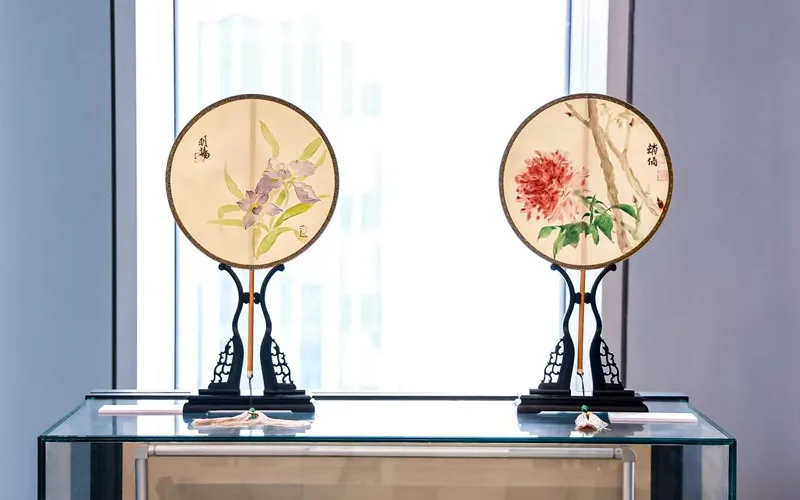
Framing a show this way is itself a curatorial decision. A fan painting is a picture made for a shaped support roughly the size of a hand, so composition has to work without the room a hanging scroll allows, and the brushwork has nowhere to hide. The museum’s own note describes the fan as a support that can hold distant mountains in a few inches or carry a national sentiment in the same space, and treats the form as a durable branch of Chinese painting rather than as an accessory assembly.
Four Rooms, Four Readings of the Fan
The display is organised into four units, each taking one line through the material: Red Backbone, Beauty Shared, Gathered Blossoms, and Green Waters and Blue Mountains. Underpinning the split are three stated dimensions, the transmission of the fan-painting lineage, its modern expression, and what the museum calls its contemporary empowerment. Qu Jian’s painted Chinese roses, among other works, were singled out by the curators as highlights.
Seen this way, the structure is a deliberate answer to the usual criticism of group exhibitions, which is that a themed show becomes a corridor of unrelated pictures. Here the four rooms are meant to be read as four arguments, with the historical line held in one, cross-cultural exchange in another, the range of the form in a third and the landscape tradition in the fourth. The catalogue language is careful to say the aim is to connect a millennium of fan painting with new contexts and new means of expression rather than to present a survey for its own sake.
Why Kunqu Opened the Show
The opening was given over to Kunqu, with Shao Tianshuai and Wang Linlin performing the interrupted-dream scene from The Peony Pavilion, before any speech was made. It set the register for a show that treats the fan as an object shared by painting, craft, poetry and performance; the same prop that carries a picture also carries a gesture on stage, and the museum chose the gesture first.
Xu Ning, director of the Art Development Centre of the Ministry of Culture and Tourism, then put the exhibition in a policy frame, describing Chinese fan painting as old and deep and the fan as an important carrier of traditional culture. He said the show sorts through the form’s development and concentrates what it holds in historical value, cultural content and contemporary spirit, and called it both a continuation of the tradition and a concrete attempt to bring it together with present-day taste. The centre and the museum used the opening to launch a joint National Arts Co-Creation programme, under which the two institutions will work together on exhibition planning, artistic exchange, public art education, creative product development and cultural events. The exhibition is hosted by the centre and the museum, co-curated by Huamei Energy-Saving Technology Group, and supported by BYD Group, the Shaanxi Academy of Chinese Painting and Hongxing.
What the Museum Plans Next
Li Jian, director of the Xinhua News Agency Art Museum, tied the show to a previous outing: in May the museum and the Art Development Centre had mounted a China-Arab art exhibition in Cairo under the title “Art in Harmony: Continuing a Thousand-Year Silk Road Heritage,” one of the events of a Global South media think-tank forum, using flower fan paintings from both traditions as the medium. He said he wants more projects that carry cultural depth and reach a general audience, and that the aim is to take the art out of the gallery and toward the wider public.
Qiao Yinan, the exhibition’s curator and deputy director of the centre, made the argument in one line, saying a fan is small but contains a great deal, and that the point of this batch of works is to bring the form into contact with a new era and new ways of saying things. The show also makes a quiet case for the fan’s double life: round fans and folding fans appear constantly in Hanfu styling as accessories, and exhibitions of this kind restore them to the status of an independent art form while leaving the accessory role intact.