Dongxiang Autonomous County in Linxia, Gansu, now has more than 2,000 women stitching embroidery for sale and 500 of them earning from home on flexible terms, after a training programme that began in 2019 turned a household craft into an order-based trade. The county reports a quality pass rate of 98 percent, up from 70 percent, and nine registered inheritors, two at prefecture level and seven at county level.
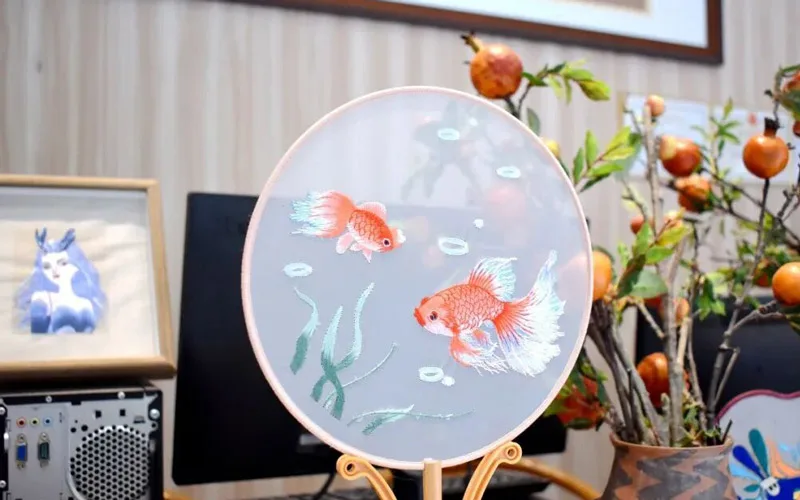
Local women call the work stitching flowers. It passed down the female line, mother to daughter and mother-in-law to daughter-in-law, without a pattern book: a girl learned by sitting beside her mother through the slack farming months, reading stitches and recognising motifs before she was trusted with a needle.
Three Stitches, One Palette
Fine-needle work layers coloured silk thread in open, even spacing. Chopping stitch drives a heavy needle straight through the cloth, so the pattern reads the same on both faces and stands up in relief. Flat stitch changes density from one passage to the next, which is how shading is done without blending thread.
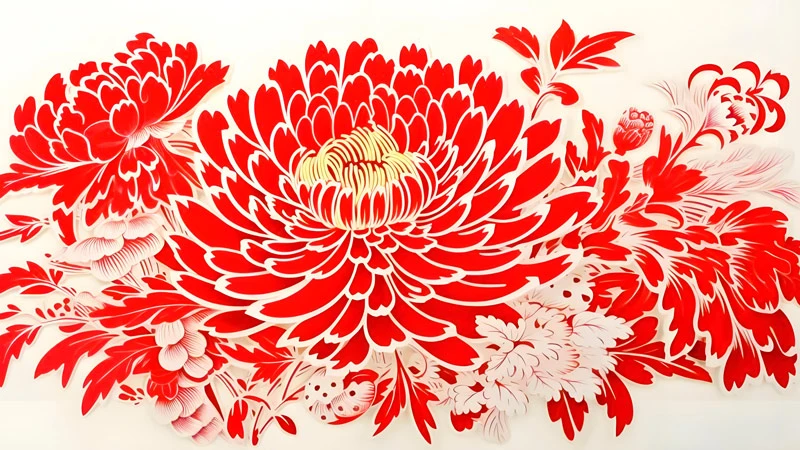
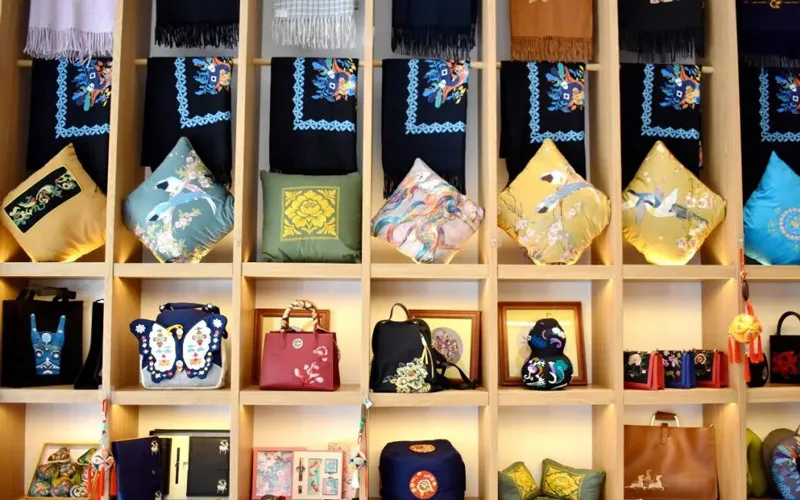
Colour is not subtle here. Red and green carry most of the field, with yellow, blue and pink cut in as accents, and the motifs come from a shared auspicious vocabulary: peony, plum, chrysanthemum, magpies on a plum branch, mandarin ducks on water. They sit on pillowcases and insoles, on collars and children’s wear. The wider Chinese repertoire is mapped in this site’s history of embroidery patterns, and the four best-known regional traditions are compared separately.
Payroll Built at the Training Table
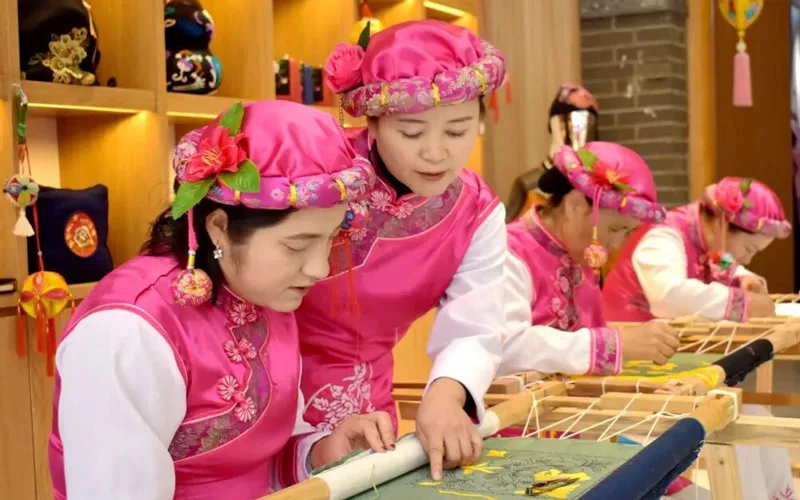
Nothing about the stitching changed in 2019; what changed was who paid for it. Women who had sewn for family and neighbours entered county training classes and met modern product standards for the first time. Zheng Maimai (郑麦麦) won her graduation contest and took the 300 yuan prize, then started on orders at 15 yuan for a single embroidered pouch, which was enough to convince the women around her that the needle could produce cash.
Zheng’s own line went trainee, then contest winner, then instructor. She now travels between townships teaching and earns more than 4,000 yuan a month. What she describes as the bigger change is in bearing: women who once would not speak in front of strangers now demonstrate stitches from a stage and travel to Beijing and Shanghai with their work.
The county then built the structure around that shift, through a model pairing designers, inheritors and needlewomen and run by leading enterprises, heritage workshops and women’s cooperatives that standardise training, materials, quality control and sales. The county culture centre carried out a resource survey and technique audit and opened a heritage database, and the tourism, women’s federation, human resources and rural revitalisation departments shared a special fund. The women’s federation alone has run 85 training sessions reaching more than 4,800 attendances, and 160 of the strongest trainees now work as industry backbone.
Who Decides What Gets Stitched
Product came next. The county built a labour brand around its needlewomen, with Ma Xiaoxiao travelling as its face, and pushed a local trading company to work with 16 design teams and brands on motifs drawn from geometric patterns and natural totems. Slippers, pendants, fashion accessories and tourism gifts followed, more than 110 lines in all, which moved the output past the souvenir shelf.
Exposure helped. Since 2021 the embroidery has appeared at the Beijing and Shanghai international fashion weeks and at Chuxiong’s fashion week in Yunnan, with needlewomen wearing what they had sewn themselves. Online, some of them sell and demonstrate live; offline, 13 Gansu-product centres outside the province carry the work, which now reaches 10 provinces and regions and two countries, with the Middle East and Southeast Asia under discussion.
The reusable part of the model is the order of operations. Standardise the craft at the training table, convert the standard into paid orders, then let designers and brands decide what gets made next. Chopping stitch and flat stitch are the same stitches they were a generation ago; the decision about what to sew, and for whom, has moved to a different table.