What the Third Hanfu Design Competition Decided
The third Shaanxi Hanfu Design Competition is a national contest for original designs in traditional Chinese clothing, and its 2026 edition closed on 5 November at the Tongchuan Theatre in Shaanxi with 6,122 entries from 11 countries and regions. Submissions came from 186 universities, companies and independent studios, the widest field in the event’s three editions, and the jury distributed three first prizes, six second prizes and nine third prizes.
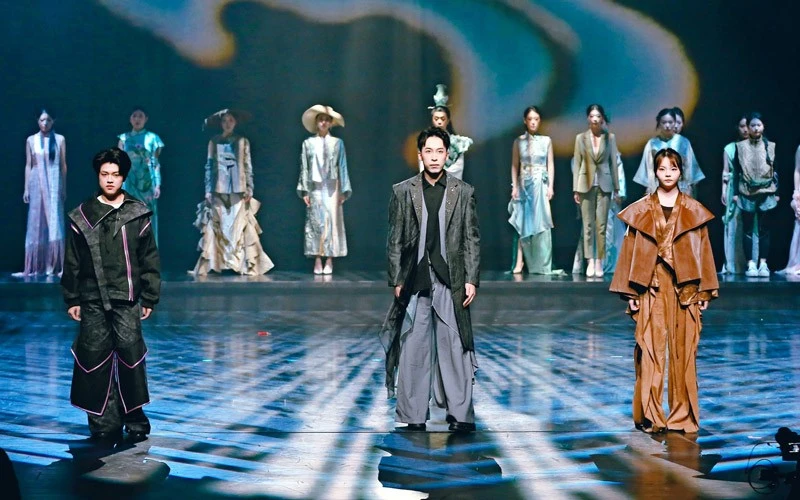
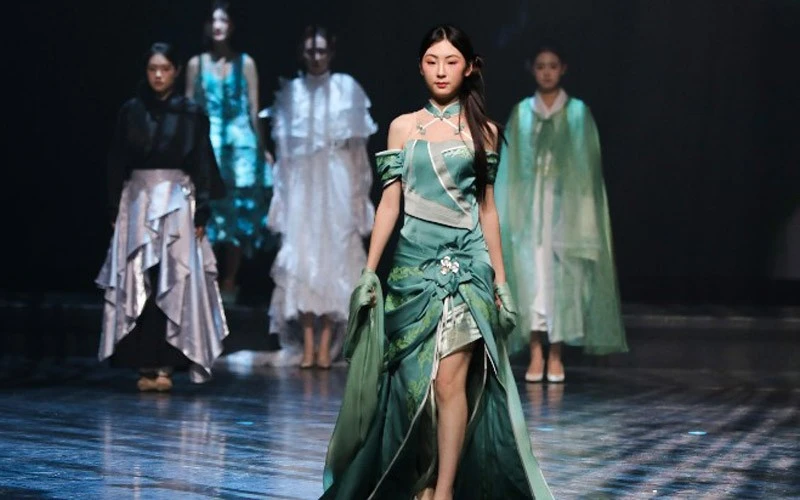
Three students took the top awards: Li Xiaopeng of Tsinghua University for “A Silk Road Heroine in Porcelain Tones”, Tong Shunfeng of Xi’an Polytechnic University for “Ink Glaze and Porcelain Shadow”, and Yang Yanyue of Southwest University for “Porcelain Reflecting the East”. All three titles work the same two materials the host cities supplied, porcelain glaze and silk, which suggests the jury rewarded fidelity to a shared brief rather than solitary invention.
Sponsorship ran across several bodies. Shaanxi’s provincial departments of culture and tourism, education, and industry guided the contest, while the governments of Tongchuan and Ankang co-hosted it with Xi’an Polytechnic University. Around 750 guests attended the ceremony, which doubled as the closing gala of the Yaozhou porcelain revitalisation season.
| Item | Detail |
|---|---|
| Ceremony | Evening of 5 November 2026, Tongchuan Theatre, Shaanxi |
| Guiding bodies | Provincial departments of culture and tourism, education, industry |
| Joint organisers | Tongchuan city, Ankang city, Xi’an Polytechnic University |
| Opened | Late June 2026; call for entries ran to late July |
| Tracks | Traditional Hanfu, porcelain-led fusion, conceptual |
| Entries | 6,122 works from 11 countries and regions, 186 institutions |
| Prizes | 3 first, 6 second, 9 third |
| Standing asset | 50,000-plus pattern 3D database at the university |
Three Tracks, Three Different Questions
Track design did most of the filtering. “Tradition Carried Forward” tested formal accuracy and documentary evidence. “Porcelain into New Form” asked designers to move Yaozhou glaze colours and carved-flower incision into fabric and silhouette. “Boundless Art” dropped structural constraint and judged conceptual completion alone. One cohort therefore answered three different marking schemes in the same cycle.
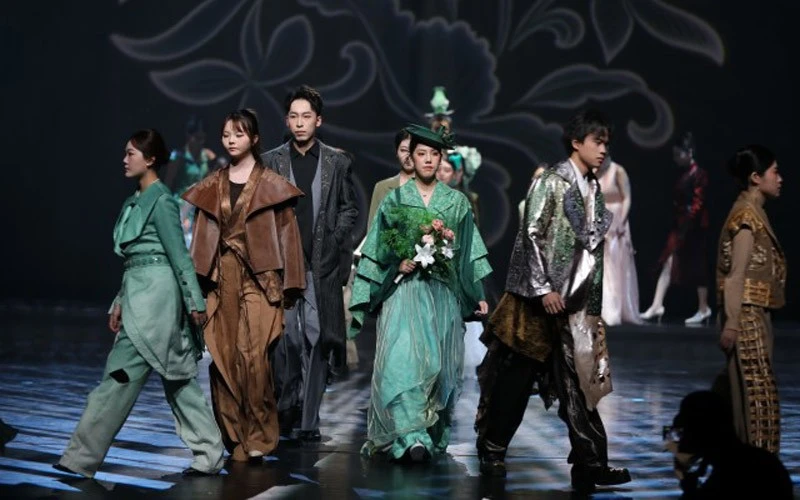
Judging ran in stages rather than in a single sitting. Entries passed preliminary selection, then a fieldwork camp that took shortlisted designers to kiln sites, the Yaozhou Kiln Museum, Chenlu town and Ankang’s sericulture districts, then final judging. Seeing raw material before finishing a design is unusual in Chinese design competitions, and it left a visible mark on what reached the final.
- Call for entries: late June to late July, open worldwide
- Preliminary selection: early September
- Fieldwork camp: Tongchuan and Ankang, late August into September
- Sampling and garment production: September to October
- Award ceremony: 5 November, Tongchuan Theatre
- Festival showcase: 8 November, Silk Road International Arts Festival
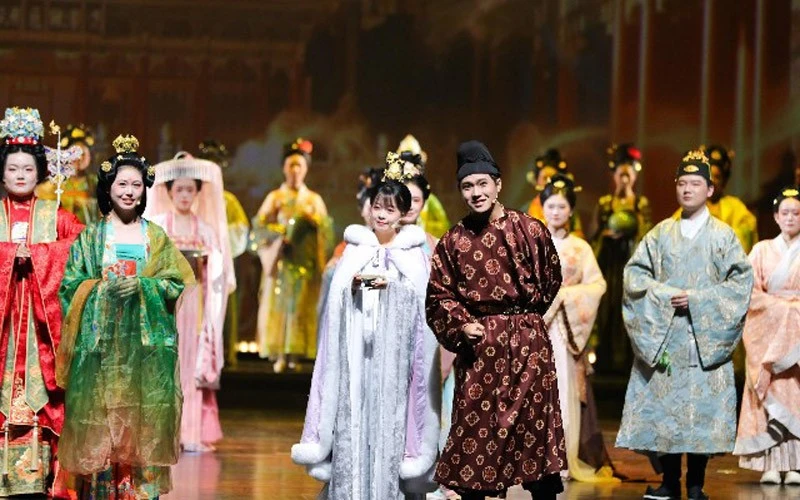
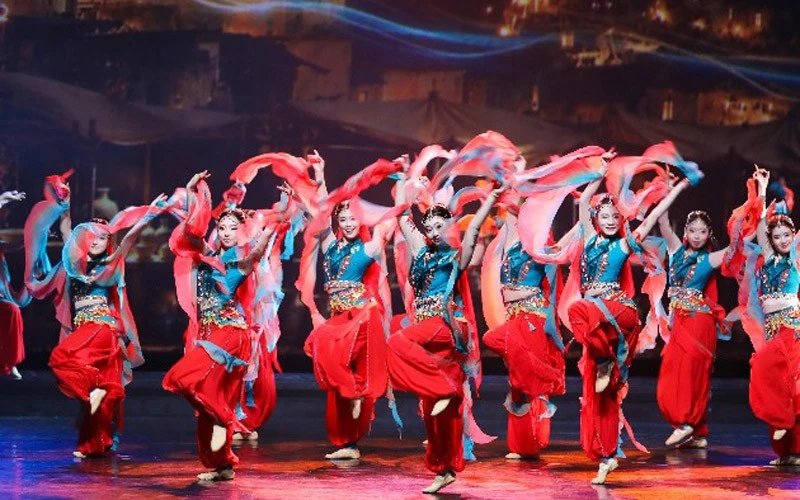
The ceremony itself was staged as a history lesson. A student-produced musical drama ran a prologue and four acts, moving through the early Tang, high Tang, Northern Song and the modern era, and the winning garments came out only after that sequence had played. Placing awards behind a dynastic narrative gave each entry a context a runway alone cannot supply.
Organisers describe the arrangement as one school and two cities. A university supplies academic capacity and a campus, two municipal governments supply raw material, venues and local storylines, and the contest supplies a deadline. Whether the model outlives its third edition depends on evidence the fourth one will have to produce.
The 50,000-Pattern Vault Factories Can Call On
Behind the stage sits the asset the university keeps promoting. Xi’an Polytechnic University is the only textiles and apparel specialist in western China, runs the first Hanfu research institute based on a university campus, and through a platform it calls one centre and two institutes has built a three-dimensional database holding more than 50,000 patterns of traditional Chinese clothing.
Structured data is the difference between a picture archive and a working tool. A flat motif file says nothing about proportion or placement. A three-dimensional record carries panel relationships, so one asset can be pulled for a sleeve, a skirt panel or a collar band and still read correctly at each position.
For a county-level workshop the binding constraint is rarely a shortage of attractive motifs. It is knowing which panel a motif belongs on, which technique can execute it at volume, and what that combination does to the retail price. A vault that answers those three questions stops being a reference library and becomes a production input. That claim is testable, which is more than most contest rhetoric can offer.
Because the vault is indexed by garment form, a workshop already producing four of the types of Hanfu it sells can pull every reference that fits those cuts in a single pass, instead of commissioning new artwork each season. The same logic explains why the Hanfu movement moved so quickly from hobbyist sewing to factory orders: once a form is documented, cost falls and iteration speeds up.
Porcelain, Silk and the Factory Order
Tongchuan and Ankang each contribute one link. Tongchuan brings Yaozhou celadon, whose glaze depth and slanting-knife carved flower translate directly into print, jacquard and embroidery. Ankang brings mulberry silk and weaving capacity. A single garment can carry a colour vocabulary from one city and a fibre from the other.
Putting the contest at the tail of the porcelain season is a path test rather than a scheduling convenience. Heritage crafts usually stop at small souvenirs, where the constraints stay mild. Dress is harsher: cut, fabric, technique and cost apply at once, and a glaze colour that photographs beautifully may be impossible to hold in a garment that has to survive a wash.
What the industry lacks is not sewers and not livestream hosts. It lacks people who can judge how an excavated garment should be reconstructed and, in the same conversation, whether that reconstruction can be made on existing equipment at a sellable cost. Short courses cannot produce that judgement. The contest moves the exposure into the years when designers are still students.
On the award stage the two city governments and the university signed a cooperation agreement covering heritage, talent and industry. A signature is cheap by itself; what matters is whether the fourth edition’s briefs get written by people who have now spent three years inside a production district.
Winners travelled to Xi’an on 8 November for the 12th Silk Road International Arts Festival, where their work shared a programme with a dance-poem built on silk and porcelain. Peer recognition and public visibility usually arrive years apart. Compressing them into one month shortens the window in which a young designer can turn a prize into orders.
One number will settle the argument, and it is not on the award list. Of the 50,000 patterns in the vault, how many will a factory actually call for in the next twelve months? The contest has built the channel. Whether the production line picks up the other end shows up in next year’s order books.
Common Questions
What is the Shaanxi Hanfu Design Competition?
It is an annual contest organised by the Tongchuan and Ankang city governments with Xi’an Polytechnic University, judged across traditional, fusion and conceptual tracks, and used by the province to connect heritage crafts with apparel manufacturing.
How many entries did the 2026 edition receive?
6,122 entries arrived from 11 countries and regions, submitted by 186 universities, companies and independent designers. Eighteen prizes were awarded, three of them first prizes.
What is the 50,000-pattern database?
It is a three-dimensional archive of traditional Chinese clothing patterns built by Xi’an Polytechnic University, recording structure and panel relationships alongside motif, so files can be reused for production rather than only viewed.
Does winning a prize lead to production?
Not automatically. A prize establishes design credibility. Production depends on whether a factory can execute the piece at a cost the market accepts, which is why the university promotes the pattern vault as the practical link between the two.