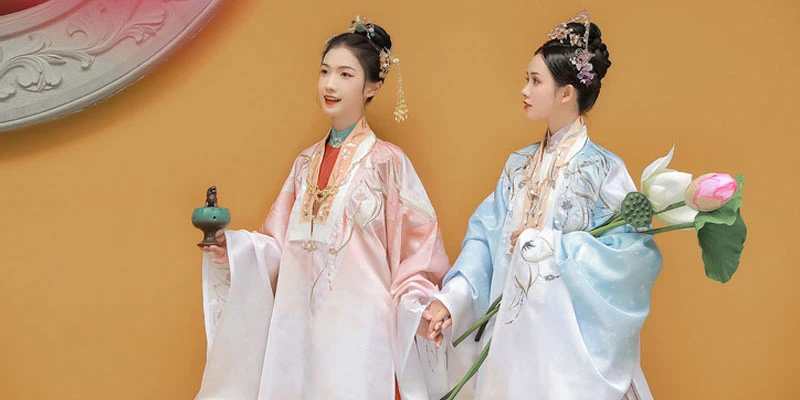
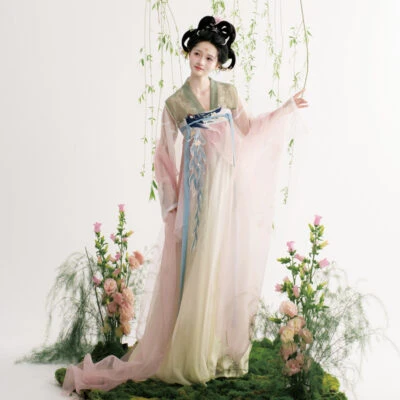
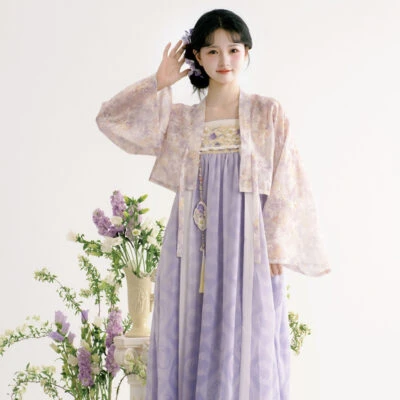
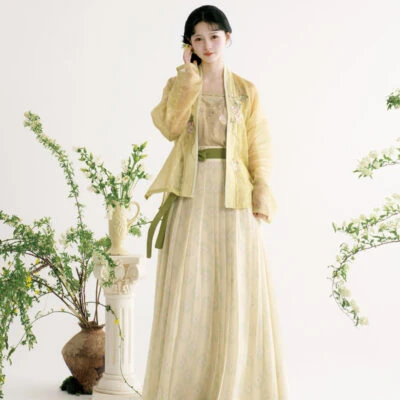
Most guides to Hanfu hand the reader a glossary and stop there. The glossary is the easy part. What a reader actually needs is a check order: which feature to look at first, which features are secondary, and which single detail can date a garment once the family is settled. The four-part sequence below works on a photograph as well as on a garment, and it takes about two minutes.
Four Features That Identify a Hanfu Form
Hanfu identification rests on four observable parts: the collar, the closure, the sleeve and the hem. The collar-and-closure pairing is the only first-order test. Whether a top crosses at the chest or opens straight down the middle decides which of two families it belongs to; sleeve shape, garment length and hem construction only sort the garment further inside that family.
Crossed closures come in four collar types: Jiaoling, Quling, Yuanling and Shuling. Parallel closures come in five: zhiling, heling, yuanling, fangling and shuling. The overlap is not an error. The same collar profile paired with a different closure makes a different garment, which is why a round-collar robe with an off-centre closure and a round-collar jacket that opens straight down the front are listed as two separate forms rather than one.
| Collar | Structure | Usual closure | Where it is misread |
|---|---|---|---|
| Jiaoling | Collar joined to the lapel, crossing at the chest in a y shape | Crossed | Read the lapel direction to separate youren from zuoren |
| Quling | Band encircling the neck, close to a tall round collar | Crossed | Mostly an inner layer, mistaken for a round collar |
| Zhiling | Two lapels parallel and symmetrical | Parallel or off-centre | Lapels meeting with no gap at the top make a heling |
| Yuanling | Round neckline, stiffened inside | Off-centre or parallel | Confused with the standing collar more than any other pair |
| Fangling | Square neckline, a Ming-period addition | Parallel | Common on Ming jackets and coats |
| Shuling | Straight collar raised at the front to wrap the neck | Off-centre or parallel | Square corners, closed with toggle buttons |
| Tanling | Low neckline cut in a heart shape | Off-centre, slanted | A Han-period robe collar, not a Tang innovation |
The lapel test is the one check that almost never fails. In a youren garment the wearer’s left front panel wraps across to the right armpit and ties there, hiding the right panel underneath. Reverse the overlap and you have zuoren, which appears in Chinese dress history on some non-Han garments and on burial dress, not on living Han formal wear. Photographs, murals and excavated garments all show this clearly, which makes it the cheapest first question to ask.
Collar and Closure Decide the Family
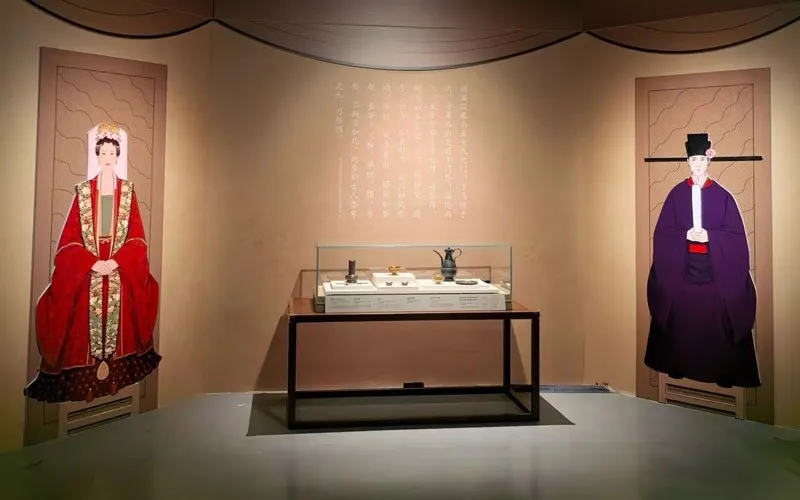
Jiaoling youren is the base form of the whole system. The collar runs continuous with the lapel, crosses at the chest, and closes at the right side. Everything from a Shenyi to a Ming tieli can carry it, and the difference between those garments lies elsewhere, in cut and length rather than at the neck.
A parallel closure is a different construction, not a variation. The two lapels run straight and do not cross; a heling is the version where the lapels meet at the top with no opening between them. Song painters used the parallel front constantly on the Beizi and the Banbi, both of which hang open over an inner layer.
Round and standing collars cause the most confusion, because both read as a ring around the neck in a photograph. A round collar has a flat ring, stiffened with interlining, fastened with a button loop, and it entered Chinese dress from Central Asia before becoming standard everyday dress in the Sui and Tang. A standing collar is a straight collar with its front edge raised to wrap the throat; it appears in the middle of the Ming period, spreads by the late Ming, stands about one cun high, and closes with one or two toggle buttons. Fold the top down and it becomes a lapel collar, which is why the two get mixed up in museum captions.
The closure count is a useful tiebreaker. A standing collar with an off-centre closure usually carries three or four groups of ties under the arm. A standing collar with a central opening closes with three, five or seven toggles. A tall collar with a central row of buttons is a standing-collar jacket; a flat ring with a single loop at the throat is a round collar.

Sleeve Width and Length Set the Occasion
Sleeves carry the formal and everyday distinction. The mainstream Hanfu sleeve is round in the body and gathered at the cuff. Broad, long sleeves belong to ceremonial dress; narrow and short sleeves belong to work clothes, military dress and winter wear. Han and Tang ceremonial dress runs wide, Song and Ming everyday dress runs narrow, which gives a rough date before any other feature is read.
Length is the third layer. Measured from waist to foot, garment length separates a ru, a short top, from a shu, a short coat, and from a Shenyi, a full-length robe. Within the Shenyi the cut divides again: a Quju carries an extended front panel that spirals around the body and ties at the back, while a Zhiju runs straight from the collar to the hem. Wrapping or not wrapping is the visible difference between the two.
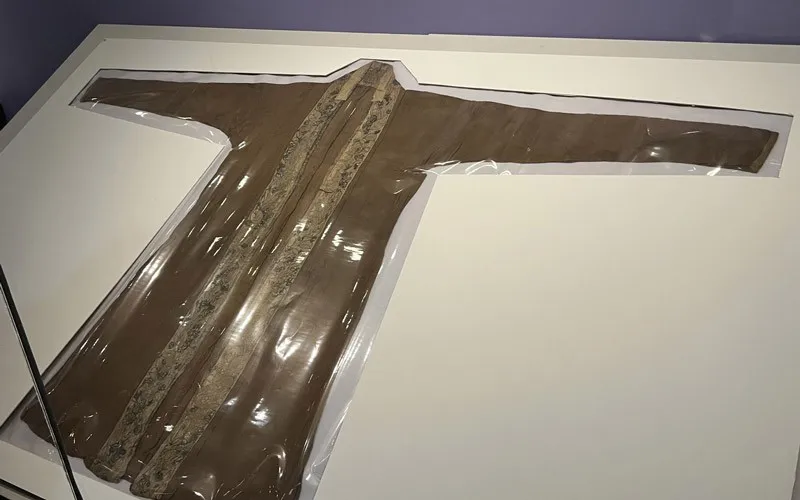
Excavated garments show how far the measurements can run. The Southern Song official Zhao Bodan, buried in 1216 in Huangyan, Zhejiang, wore a round-collar plain-gauze robe as his outermost layer: 115 cm long, 230 cm across the sleeves, 95 cm wide in the sleeve, with a 46 cm sleeve root, a 72 cm chest and a 96 cm hem. That is a public-duty robe, not a working garment, and the numbers are the reason a photograph of it reads as formal at a glance. A second robe from the same tomb, a Jiaoling gauze robe with a lotus pattern, measures 135 cm long with a 271 cm sleeve span and a 47 cm sleeve width, and carries what the excavation report describes as the earliest button-loop fastening found in Chinese archaeology.
The Hem Line Dates the Garment
The horizontal band spliced into the lower body is called Henglan (横襕), and it is the sharpest dating signal on a robe. A lanshan is a long garment cut through from shoulder to hem with one band added at the bottom; a Lanpao is the same construction in a heavier cloth. The words for single-layer and lined garments follow the older distinction: a shan is unlined and worn daily, a pao is lined or padded for cold weather.
The China National Silk Museum holds a Northern Dynasties robe that makes the band easy to see: round collar, right lapel, narrow sleeve, broad body, and a strip of cloth spliced in at the hem whose woven pattern runs in a different direction from the body. That break in the pattern is the band. The splice had a practical cause as well, since the width of the old looms made a horizontal join cheaper in cloth than a wider woven panel, and the same constraint explains why so many early robes are pieced at the hem rather than cut whole.
Position dates the garment. Sui-period Lanpao already ran in two collar types at once: a mural in the tomb of Xu Minxing, dated 584, shows a Jiaoling Lanpao, while donor figures in cave 389 at Dunhuang mostly wear the round-collar form. Song regulation fixed the student version in white fine cloth with a round collar, broad sleeves, a hem band and waist pleats, reserved for examination graduates and state-school students. By the Ming the band had moved up to the knee and was decorated, which is why Ming sources call it a knee band, xilan, rather than a hem band. In 1391 the first Ming emperor restricted the lanshan to state-school students, specified jade-coloured cloth, a broad sleeve with a black border and a black sash, and the garment stayed a scholar’s uniform until the dynasty ended.
Five Checks Before You Call It Hanfu
Run the sequence in order, then run it backwards as a check. If any of the five questions below cannot be answered from the photograph or the garment itself, the identification is not settled yet, and the next step is an object or a museum record rather than another glossary.
- Which lapel is on top? Left over right is youren. Right over left is zuoren, which does not belong on living Han formal dress outside specific historical contexts.
- Is the neckline a flat ring or a raised band? Flat ring, stiffened, button loop at the throat: round collar. Raised band, square corners, toggle buttons: standing collar.
- Do the lapels cross or run parallel? Crossing means a crossed closure. Parallel means a parallel closure, and lapels meeting with no gap at the top make it a heling.
- Is the band at the hem sewn on, or woven in? A spliced strip whose pattern direction differs from the body is a hem band. At the bottom edge it points to Tang or Song; moved up to the knee it points to Ming.
- Do sleeve and length contradict each other? A floor-length robe with a very short narrow sleeve, or a waist-length top with floor-sweeping sleeves, is usually a modern mix rather than a historical form.
Compressed to one line, the procedure runs: collar and closure fix the family, sleeve and length fix the occasion, the hem band fixes the date. When the three disagree, the garment is either a revival piece built from several periods or a stage costume, and the disagreement itself is the answer.
This is also why identification cannot stop at names. The names were assigned later by scholars and collectors; the garment only obeys its own cutting and sewing. A robe that measures 95 cm across the sleeve and a robe that measures 47 cm are both called by period names, and only the measurements tell you which one was worn to court and which one was worn at home.