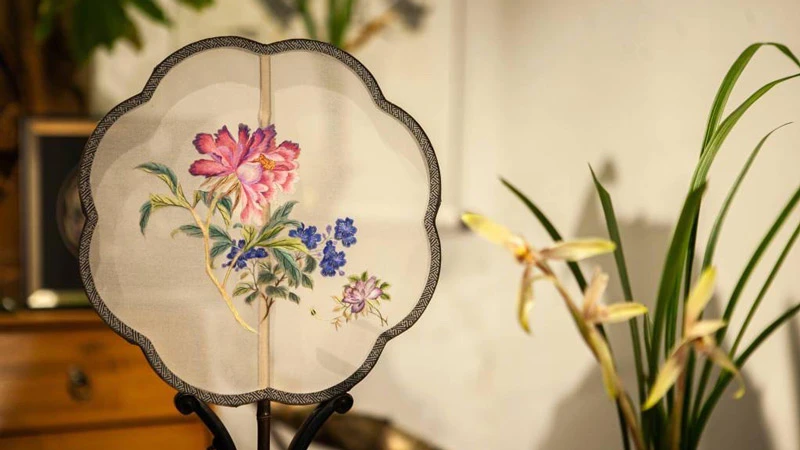
Sachets and embroidered paddleboards made in Shibing county, Qiandongnan, Guizhou, went on sale this summer as licensed merchandise for the 2026 World Cup, the largest order yet for a workshop that has spent two decades selling Miao embroidery to buyers abroad.
Hands Inside the Wall, Machines Outside
On 15 October the hand-embroidery room at the Wushui Yuntai workshop in Shibing’s Taozhiwan industrial park was full, needles rising and falling while butterflies, birds and fish came up out of the cloth. One wall away, six digital production lines turned flat stitch and knot stitch into instructions a machine could read, and a decorative panel took shape in minutes rather than days. Long Luying (龙禄颖), a provincial-level inheritor of Miao embroidery, runs the operation.
Ten or more stitch types, among them flat stitch, split-thread, knot stitch and horsetail embroidery, have been converted into machine language. Daily output rose by 20 to 60 times and unit cost fell to roughly a tenth of what it was. Handwork was not retired to make room for that: repeating patterns go to the machines, and the fine, dense passages still go to the embroiderers. Long put the split in one line, hand embroidery for the soul and machine work for the wings, and added that the machines amplify the craft rather than replace it.
Pay reflects the same division. An ordinary embroiderer earns 3,000 to 6,000 yuan a month; the most skilled take home 80,000 to 100,000 yuan a year. More than 1,500 registered embroiderers now carry digital skill tags, which lets a platform match incoming orders to what each of them does best.
Canton Fair Booths and a World Cup Licence
Getting Miao work onto foreign shelves took two decades of showing up. Long left her village for the Canton Fair and kept returning, edition after edition, with samples laid out and a stack of embroidered pieces within reach; when a buyer stopped, she handed over a piece and pointed at the stitches while explaining the Miao story behind the pattern. Orders accumulated, goods reached shops in New York and London, and overseas sales settled at about 4 million yuan a year. Total output value has reached more than 27 million yuan, supporting over 2,000 embroiderers with work at home.
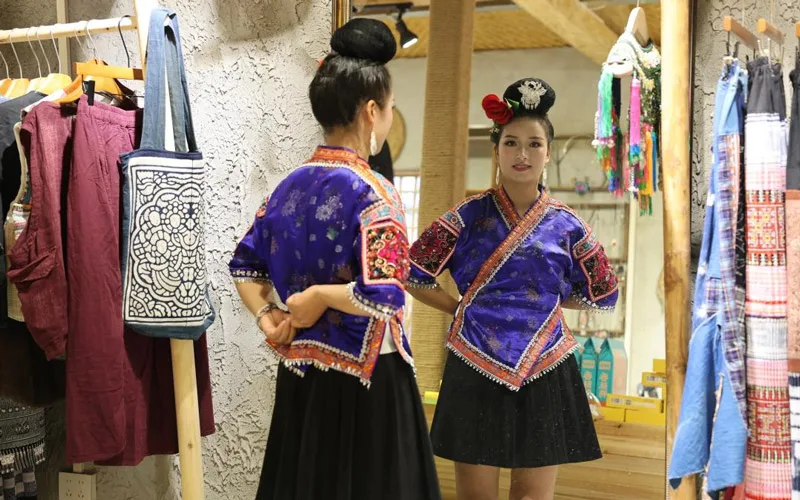
Milan came in early spring 2025, when she took a run of Miao garments onto the Fashion Week schedule with the patterns untouched and the cut and palette adjusted for an international eye. She was back at the workshop by 8 March, checking quality and scheduling orders. In 2026 the workshop qualified for FIFA’s official licence under a programme pairing heritage crafts with the tournament, and embroidered paddleboards, sachets and charms went on sale worldwide as licensed goods. Stitching for that order was pushed down to the villages, and close to 400 women earned labour income from it.
What buyers respond to, in her reading, is Chinese culture and workmanship that does not look like anything else on the shelf. A Belgian creator brought her own pattern and asked for it in butterfly stitch. At a fair in Britain, where many visitors took the pieces for souvenirs without knowing how long one takes, Long sat down at the front of the booth and started sewing; a ring of visitors stood and watched her work.
Why Standardisation Came Before Scale
The first barrier to exporting was not abroad but at home. An early order called for embroidered patches on 200 tote bags, and she recruited 50 or 60 women at short notice to take material home and stitch. The delivery was a shock: some lines ran smooth and some coarse, and a number of birds had come back with two heads and six wings. More than half the batch failed inspection and had to be remade.
Training moved into the villages after that, with women taught where they live and stitching done at home, stitch by stitch and colour by colour. The method now runs order by order: a brand sends a pattern with a named stitch and a required finish, and the training is built around that single specification so that workshops in different villages produce one standard. Patterns were copied repeatedly in the early years, which pushed her to register trademarks and file patents; 50 of the company’s creative embroidered products now hold national patents, and a custom design that once took a week to turn around is finished in three days. The business itself dates from 2000, when she left a state-owned employer in Shenzhen, and from 2006, when the company was registered with eight embroiderers on the books. Since then more than 5,800 people have been trained, four training bases and nine village production points have opened, and 669 registered poor households were lifted through embroidery work. In October 2023 she attended the 13th National Women’s Congress and introduced Miao embroidery to guests there. Her son Long Yu has taken over the sales side, travelling the country with the products and filling custom orders for Village Super League mascots.
Stitch by Stitch: Five Miao Techniques
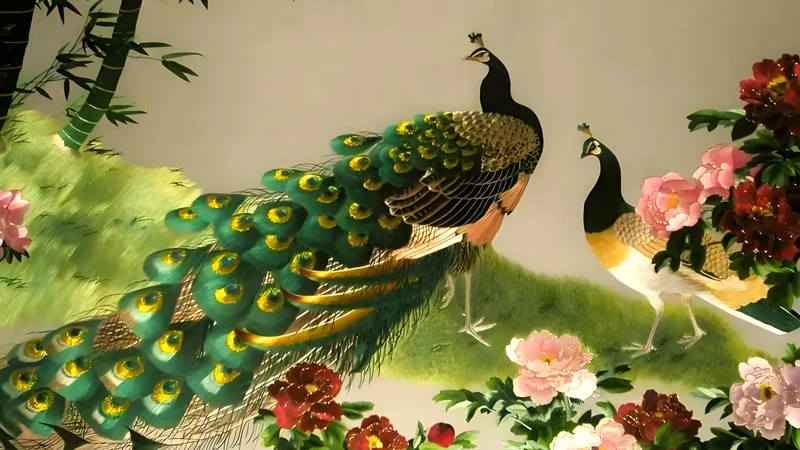
The stitch families that carry this trade behave very differently under the needle. Flat stitch wants an even, glossy surface. Split-thread embroidery divides one silk filament into strands before stitching, which is how it produces fine gradation. Knot stitch builds texture out of small grains. Horsetail embroidery wraps horsetail in silk as a core, giving the motif relief. Butterfly stitch works the symmetry and layering of wing patterns, and is the one foreign clients ask for by name.
Each of them is slow and dependent on the hand that holds the needle, which is why the craft resisted scale for so long and why the current split matters. Cultural export is not only a question of volume: Jiang Lizi, a Guizhou Miao designer who has promoted the culture abroad, priced the difference on an ordinary object. A plain transparent phone case sells for about 50 yuan; add a pattern, a charm or a raised ornament and the price reaches 300 to 400 yuan without difficulty. Miao motifs on a case that a young buyer abroad would carry anyway put the patterns into daily use, which is the outcome the workshop has been chasing since its first Canton Fair.