A blue-and-white cloth exhibition opened at the Han Meilin Art Museum in Hangzhou on 24 October and runs to 31 December, moving through three rooms that take resist-printed cotton from carved block to art symbol to finished garment, the last of them filled with thirteen outfits by fashion students.
| Dates | 24 October to 31 December 2026 |
|---|---|
| Venue | Academic design hall, Han Meilin Art Museum, West Lake Scenic Area, Hangzhou |
| What it is | Three-part show on dyed and woven art, running from blue calico to student clothing |
| Works | Domestic cloth, carved print blocks and tools; Han Meilin’s textile art; thirteen outfits by China Academy of Art students |
| Also running | “Buke Siyi” art market, opened on the first day |
| Academic frame | Parallel show of the fourth Fashion Eco-chain conference, “Philosophy of Boundaries” |
A Print Block, a Resist Paste, an Indigo Vat
Carving comes first, and the room is laid out to show why. Blue calico arrives as bolts of household cloth, as carved pearwood blocks, and as the scraper, the vat and the drying frames that go with them. Four steps produce the look: cut the pattern into the block, scrape the resist paste through it, dip the cloth in indigo, then hang it in air, where the colour shifts from yellow-green to a settled blue.
Order matters more than any single step. The block fixes the skeleton of the pattern, the paste decides which ground stays white, the vat settles the depth of blue, and oxidation finishes the colour after the cloth has left the dye. The Nantong Blue Calico Museum, a supporting partner, lent objects and tools to this room, which is why the display reads as a working shop rather than a flat sequence of textiles.
When Motifs Slip Free of the Figure
Room two belongs to Han Meilin (韩美林). Under the headings “form into pattern” and “blue-white and the book from heaven”, the walls show him pulling animals, plants, paper-cut shapes and archaic forms into rhythmic line, then folding his Tianshu symbols into indigo printing. Linework replaces description, and the surface starts to carry tempo instead of subject matter.
Cutting follows that change. Once a motif stops resembling a thing and starts repeating a stroke, the block no longer has to describe; it only has to hold a rhythm, which is the part of resist printing that has always worked best. The museum treats the room as the hinge of the show, a traditional medium gaining an abstract vocabulary without leaving its own technique behind.
Thirteen Outfits Built on a Resist Logic
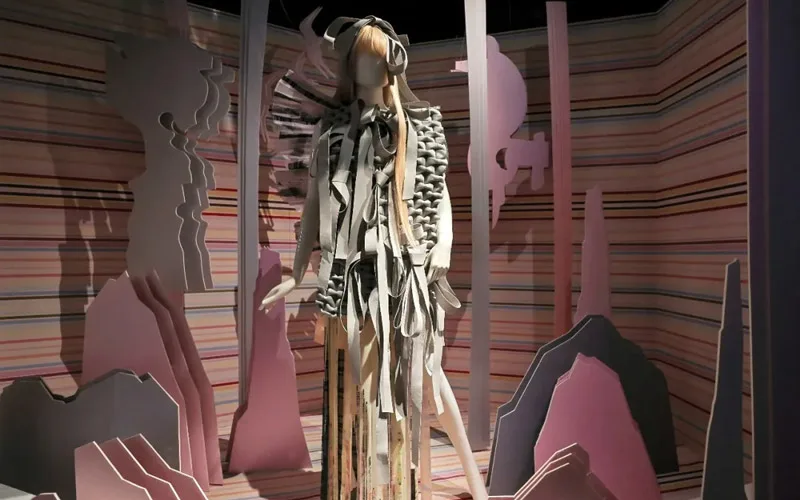
Room three holds thirteen outfits made by students of the China Academy of Art’s School of Fashion Design, each built from a Han Meilin symbol or painting. Cao Jingjia’s “Rock Silk” layers semi-sheer prints to imitate ink wash and finishes with puff sleeves, a bodice, a skirt and leg warmers. Lin Xinya’s “Drifting Shadows” starts from washed denim and cuts laser-burned leather into openwork. Jiang Xinchen’s “Plume Woven Colour” washes ink strokes into cloth, adds wax resist, then prints Tianshu lines and stitches them by hand. Fu Ranyang’s “Standing in Hangzhou” turns public sculpture and local building outlines into patterns for streetwear in wool felt, pleated panels and washed denim.
Nine more take their own routes: Zou Huixuan’s “Deer Call” works the animal through black-on-black layering; Liu Xinjie’s “Carved Ink” scales ink-wash detail into cut lines; Wang Chenxi’s “Locking Horns” sets padded shoulders and asymmetric bias cuts against wet-moulded leather; Cheng Xi’s “Curved Construction” rebuilds sculptural planes as garment panels; Li Yixuan’s “Roaming Image” reduces fish to exaggerated shapes and geometry; Chen Minjie’s “Childhood Reverie” assembles dolls, bows and pearls; Zhang Yifei’s “Galloping Threads” leans on fringe with TPU and knit; Lin Liyin’s “Form Beyond Image” translates folk totems and Tianshu signs into triangles and arcs; Yuan Qianhui’s “Melting Colour” carries folk painting into fabric, silhouette and trim.
On the opening day the museum director Wu Tao and the school’s vice dean Ling Yali spoke, and the two institutions put up a plaque for a museum-school partnership covering exhibition work, course practice, student internships, academic exchange and public education. Two of the student designers, Lin Xinya and Yuan Qianhui, walked visitors through their own decisions.
The argument of the show sits in this room. Resist printing caps how many colours a cloth can hold, which forces a designer to bargain between pattern and empty ground; digital printing removes that cap. Several of the thirteen answer by stacking methods, layering prints, laser cutting, or putting wax resist under digital output. Blue calico survives here as a constraint worth keeping rather than a motif to be copied.