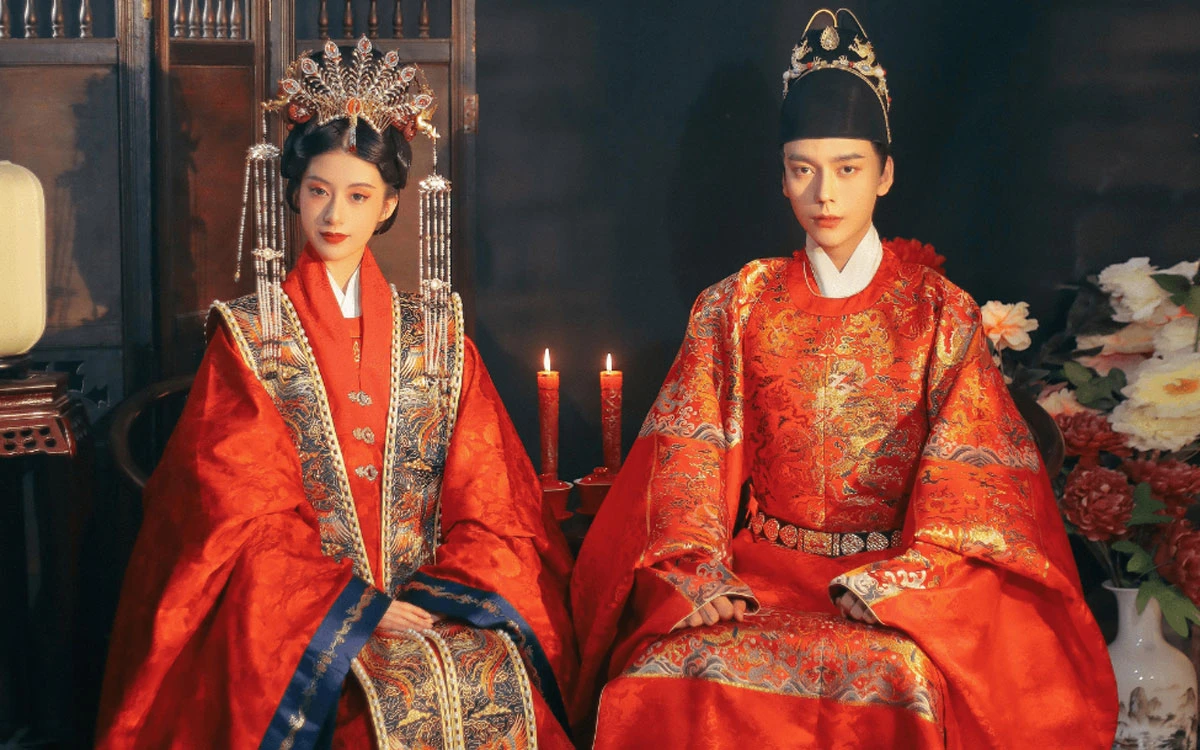
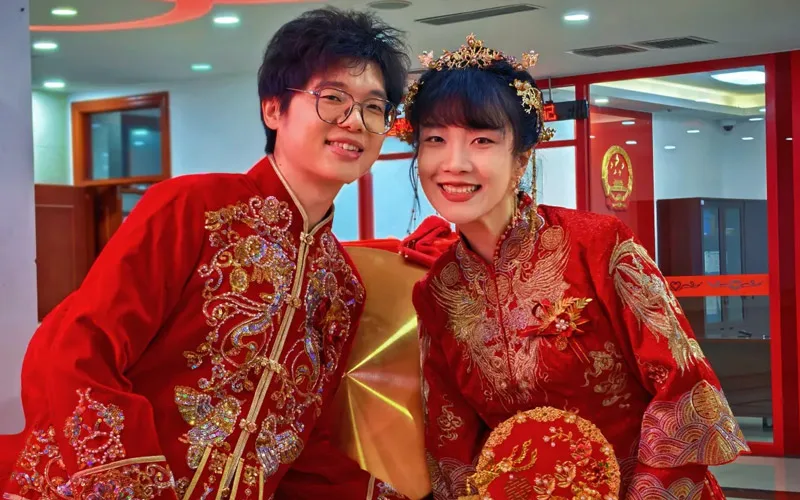
Twenty-six couples married at the Dongcheng District marriage registration centre in Beijing on the morning of 17 October, in deep red Xiuhe gowns and phoenix crowns, at the tenth edition of the city’s public welfare collective wedding and the first held in Dongcheng.
| Date | Morning of 17 October 2026, ceremony from 10:08 |
|---|---|
| Venue | Dongcheng District Marriage Registration Centre, beside the Beijing Central Axis |
| What it is | Tenth Beijing public welfare collective wedding, the first staged in Dongcheng |
| Scale | Twenty-six couples |
| Attire | Deep red Xiuhe gowns with gold thread; phoenix crowns and tasselled round fans for the brides |
| Rites | Red-carpet entry, witnessing, officiating, certificate, oath, token exchange, three bows |
| Entry | Public welfare format, guided by the Beijing Civil Affairs Bureau with association and district partners |
In the Makeup Room Before the Ceremony
Rain fell through the morning and the courtyard filled anyway: red lanterns overhead, roses along the corridor, hand-held signs stacked on the tables. Down one level, the makeup room carried the noise. Brides sat in deep red gowns worked with gold thread across the chest and cuffs, phoenix crowns on their heads and tasselled round fans in their laps, while grooms leaned in to straighten a crown or pull a collar flat.
Hao Zheng and Zheng Mingyu reached the centre at six in the morning and spent the next four hours in that room. The two met, by their own account, at first sight, and married after three years together. “Every detail, the styling, the ceremony, was handled with care, and the gowns are especially fine, which made the whole thing feel ceremonial,” Zheng Mingyu said. Her parents, she recalled, had also married at a collective ceremony, so the morning carried a handover between two generations of the same family.
Three Bows and a Collective Vow
At 10:08 the couples entered from both sides of the hall, met on the red carpet and walked to the stage hand in hand. The roster cut across trades: soldiers, schoolteachers, doctors, research engineers and grassroots civil servants, most of them in their twenties and thirties.
Witnessing, officiating and certificate presentation ran in sequence, followed by the exchange of tokens and three bows, to the era, to the home region and to parents. The collective oath came next: “Rich or poor, fair weather or foul, we share the crossing. As the years turn, we keep to one another. We build a household, we carry its duties, we hold to the manners of the time.” A group of children sang “The Best Future” as the ceremony closed and handed sweets to the guests.
Wang Chenyu came from Qingdao in Shandong and Yu Xiaoxin from Dandong in Liaoning; both registered their marriage in Beijing under the national cross-region registration policy. “A collective wedding is a lively, unusual experience we will not forget,” Yu Xiaoxin said, and added that it also answers the call to spend less on the day and keep the energy for the marriage itself. Organisers described the format as a test model for wedding reform in the capital, pairing the culture of the Central Axis with ceremony and charity work.
How the Xiuhe Gown Became a Default Wedding Look
What the couples wore deserves a second look. The Xiuhe gown is a jacket-and-skirt garment: standing collar, right lapel, Pankou closures, gold embroidery across the body and cuffs, and a skirt cut wide enough to walk and pose in. It is not a restoration of any one dynasty’s ceremonial dress. It grew out of the wedding-photography market and spread through film and television, with red carrying the plain language of celebration and gold carrying prosperity.
Phoenix crowns and round fans fill in the ritual layer. The crown served as a bride’s headdress in traditional weddings, its forms shifting by period; today’s versions are light replicas built around beadwork and hanging tassels. The fan was for covering the face and for passing between the couple, and a tasselled one doubles as the visual centre of a photograph. The ceremony was shortened the same way: three bows, thanks to parents, an exchange of tokens and a shared oath keep the respect and the gratitude of a wedding while dropping the banquet and the scale. Held beside the Beijing Central Axis, the morning set old urban order and present-day custom on a single line.