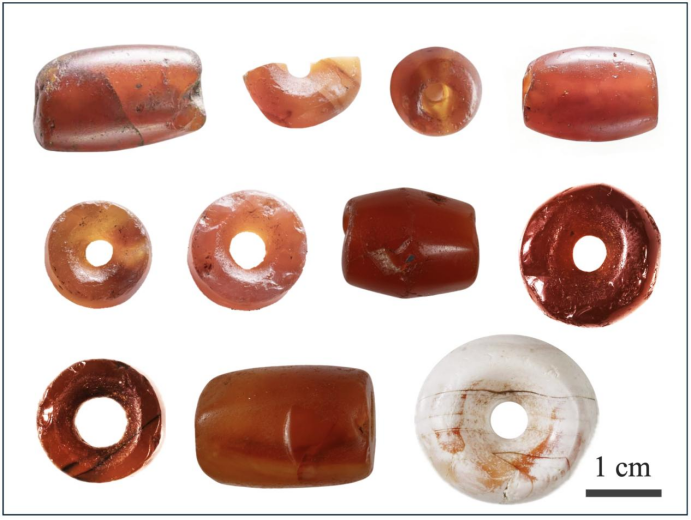
A groundbreaking archaeological discovery at the Sanxingdui site in Sichuan Province has provided new insights into ancient Chinese trade networks. The Sichuan Provincial Institute of Cultural Relics and Archaeology announced on June 2, 2026, that red carnelian beads unearthed at Sanxingdui serve as physical evidence of cross-regional exchanges during China’s Bronze Age, revealing sophisticated trade connections that existed thousands of years ago.
The Sanxingdui archaeological site, located in Guanghan, Sichuan Province, has continuously produced remarkable finds since its initial discovery. These latest findings add another chapter to our understanding of one of China’s most mysterious ancient civilizations.
Significance of the Red Carnelian Discovery
The red carnelian beads represent more than just ornamental artifacts—they are material proof of extensive trade networks that connected ancient China with distant regions. Carnelian, a semi-precious stone prized for its distinctive reddish-orange color, was not native to the Sanxingdui region, indicating these beads traveled considerable distances before reaching their final resting place.
Archaeologists believe these beads arrived through ancient trade routes that connected the Sichuan Basin with regions to the west, potentially including areas of Central Asia and beyond. This discovery challenges previous assumptions about the isolation of ancient Shu civilization and demonstrates that Bronze Age China was far more interconnected than previously thought.
Uncovering Ancient Trade Networks
The trade networks revealed by these artifacts likely operated along routes that would later become part of the famous Silk Road. The presence of carnelian at Sanxingdui suggests that proto-Silk Road trade connections existed hundreds of years earlier than previously documented, fundamentally changing our understanding of ancient Chinese trade.
These findings complement other discoveries at Sanxingdui, including bronze masks, gold objects, and jade artifacts, all of which point to a sophisticated civilization with extensive external connections. The diversity of materials and artifacts found at the site indicates that ancient Shu people engaged in complex cultural and commercial exchanges.
Modern Archaeological Techniques
The identification and analysis of these carnelian beads employed modern archaeological methods, including spectroscopic analysis and comparative studies with carnelian sources across Asia. These techniques allowed researchers to determine the likely origin of the beads and trace ancient trade routes with unprecedented precision.
Sichuan archaeologists continue to excavate the Sanxingdui site, with new pits discovered in recent years yielding thousands of artifacts. Each discovery adds to our understanding of this enigmatic civilization, which flourished approximately 3,000 to 5,000 years ago.
The Sanxingdui discoveries hold immense significance for understanding Chinese cultural heritage. The site provides evidence of a unique civilization that developed independently in the Sichuan Basin while maintaining connections with other regions. This dual nature—distinctive yet connected—characterizes much of ancient Chinese civilization.
For visitors interested in experiencing these discoveries firsthand, the Sanxingdui Museum in Guanghan displays artifacts from the ongoing excavations. The museum has become a major cultural tourism destination, attracting visitors eager to witness the mysterious bronze masks and other artifacts that define Sanxingdui archaeology.
Future Research Directions
Archaeologists plan to continue excavations and research at Sanxingdui, with particular focus on understanding the full extent of ancient trade networks. The red carnelian beads represent just one piece of a larger puzzle about how ancient Chinese civilizations connected with the wider world.
As research continues, scholars anticipate more discoveries that will further illuminate the sophisticated cultural and commercial exchanges that characterized Bronze Age China. The Sanxingdui site continues to be one of China’s most important archaeological locations, promising revelations for years to come.