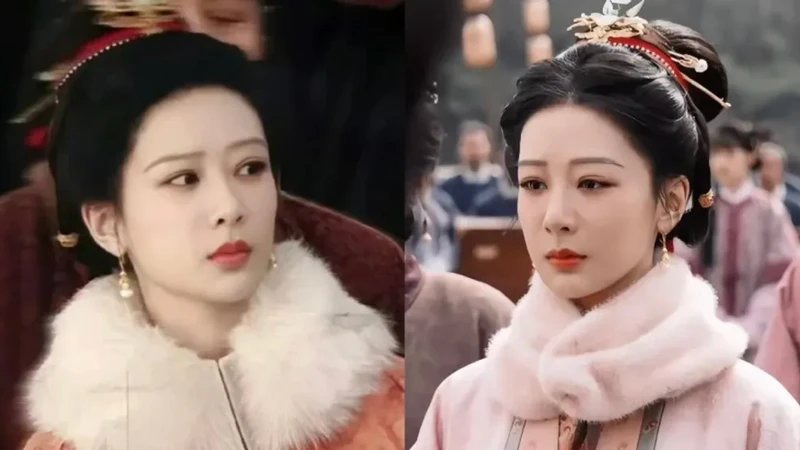
In the historical drama The Mo (家业), the earrings worn by actor Yang Zi (杨紫) in her role as Li Zhen (李祯) are more than just elegant accessories. They are a direct portal to the fashion sensibilities and consummate craftsmanship of the Ming Dynasty, roughly 600 years ago. The specific style, a Hulu (葫芦)-shaped pendant, was a staple in the jewelry boxes of Ming noblewomen. This attention to detail in costume design does more than create a visually authentic scene; it prompts a fascinating question. How did a simple fruit’s form become a centuries-long symbol of status and blessing, so meticulously crafted that it still impresses modern audiences?
Design and Detail
The Hulu earring seen on screen is a refined example of its kind. Typically part of a full ceremonial headdress set, its design is both symbolic and intricate. The version Yang Zi wears appears to be made of white jade or pearl, forming the body of the gourd. A delicate gold leaf caps the top, with two beads suspended beneath to create the distinctive “waist” and lower bulb of the fruit. The most arresting detail is the tiny ring of minuscule gold granules that cinches this waist, a testament to the jeweler’s skill.

These earrings evolved from Yuan Dynasty styles. Two main types were prevalent. One was the “Large Pagoda Hulu Ring,” where four or five beads were strung on gold wire, topped with a pagoda spire or floral motif. The other was the “Natural Hulu” shape, a more direct imitation of the fruit. The choice of materials was lavish, ranging from gold and silver to crystal, pearl, and various precious stones, often combined in a single piece.
The gold-inlaid-jade design was particularly prized. Lustrous gold, representing wealth and nobility, was paired with finely carved jade, a stone symbolizing purity and moral integrity. This combination was not merely opulent; it embodied a harmonious ideal. The hollowed-out jade Hulu pendants found in museum collections today showcase this perfect marriage of material and meaning, where beauty served a deeper purpose.
Craftsmanship and Status
The complexity of these pieces speaks volumes about Ming craftsmanship. Beyond simple casting, artisans employed techniques like Leisi (累丝, filigree). This demanding process involved drawing gold or silver into fine threads, weaving them into intricate braids or patterns, and then soldering them onto the jewelry. The resulting texture was delicate, luminous, and unmistakably hand-wrought.

Such earrings were far from commonplace. They were markers of high social standing and official ritual. Records like the Da Ming Hui Dian (大明会典) list “one pair of four-pearl Hulu earrings” among the formal betrothal gifts from the emperor to his empress. Their presence in imperial protocols underscores their significance.
While the Ming period saw their peak popularity, the gourd motif has a long history in Chinese adornment. The relative abundance of Ming and Qing-era examples in archaeological finds simply gives us a clearer window into their sophisticated design language during that era. Wearing them was a deliberate display of taste, wealth, and connection to auspicious cultural symbols.
Symbol of an Era
Why was the humble gourd so profoundly emblematic? In traditional jewelry design, forms from nature were a primary visual language for conveying blessings. The Hulu, with its numerous seeds and connecting vine, became a powerful metaphor for prosperity and continuity. The phrase “Guadie Mianyan (瓜瓞绵延),” describing endless vines and abundant fruit, was a direct wish for a flourishing family with many descendants.
Ming artisans captured this wish in miniature. They transformed the gourd’s symbolic promise of happiness and perpetual renewal into a wearable art form. The poet Lu You once wrote of a small gourd, “Though tiny, it holds heaven and earth, accompanying my wanderings for miles.” This sentiment reflects the immense cultural weight carried by the little pendant swinging from an ear.

The Ming Dynasty itself was an era of great artistic achievement and subtle mystery. Its jewelry craftsmanship represents one of its pinnacles. The Hulu earring is a quintessential artifact of this time—a fusion of exceptional skill, social meaning, and poetic symbolism. It was never just decoration.
When viewers see Li Zhen wearing them in The Mo, they are seeing more than a pretty accessory. They are glimpsing a Ming woman’s identity, her family’s hopes, and the silent language of beauty and belief that resonated through a golden age of craftsmanship. This is the true power of thoughtful historical costume design.