
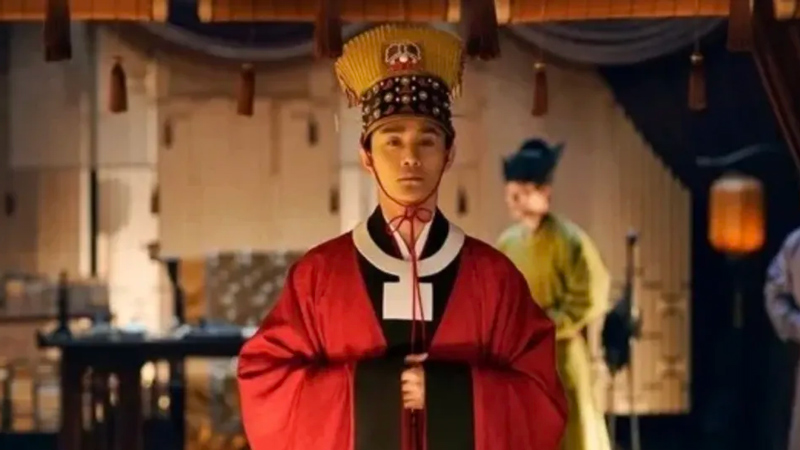
In the historical drama Serenade of Peaceful Joy (清平乐), a peculiar white neckpiece adorns the robes of officials, instantly capturing the modern viewer's eye. To contemporary audiences, it might resemble an odd fashion accessory or even a pet's collar. But this item, far from mere decoration, was a powerful instrument of state authority. Its correct name is the Fangxin Quling (方心曲领), and its story is one of rigid hierarchy, cosmic symbolism, and physical discipline within the imperial system.
A Mark of Rank
Not every official in the Song Dynasty could wear the Fangxin Quling. Its privilege was reserved by law for those of the seventh rank and above, specifically those entitled to wear a certain type of ceremonial undergarment. This regulation, documented in texts like the Book of Sui (隋书·礼仪志七), made it a clear, visual demarcation between high-ranking central bureaucrats and lower-level local magistrates. It was a badge of inclusion within the empire's most powerful administrative circle.
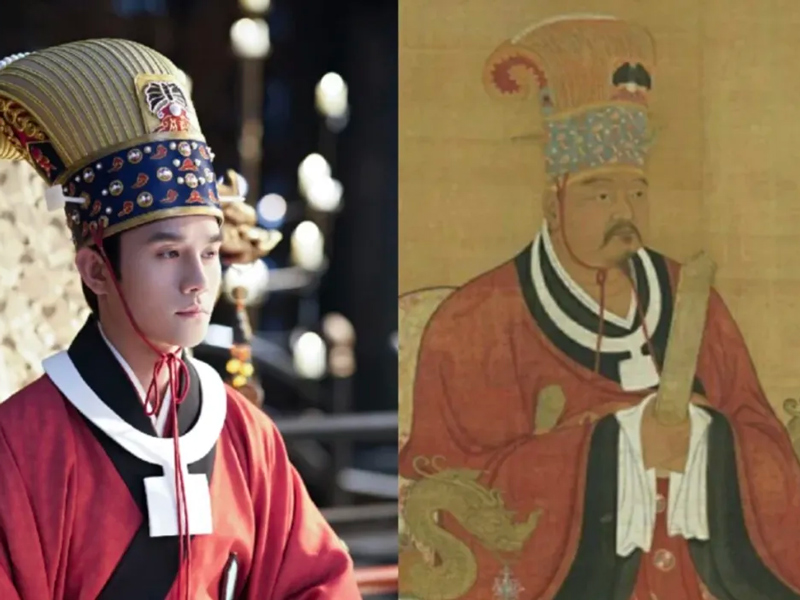
This was not a Song invention. The collar's institutional origins can be traced back to the Sui and Tang dynasties, evolving from more complex ceremonial attire. The Song court fully standardized and codified its use, embedding it firmly within the formal court robe system. It became a standard component of court dress for nearly 600 years, only finally falling out of use during the Ming Dynasty's Wanli (万历) period. Its longevity speaks to its deep-rooted significance in the ritual governance of imperial China.
Symbols in Silk
The design of the Fangxin Quling was a direct expression of ancient Chinese cosmology. Its form embodied the principle of "round heaven, square earth." The circular curve that rested around the neck symbolized the heavens, representing the divine mandate and cosmic order. The flat, square pendant that hung down the chest symbolized the earth, corresponding to the emperor's temporal power and the worldly social hierarchy.
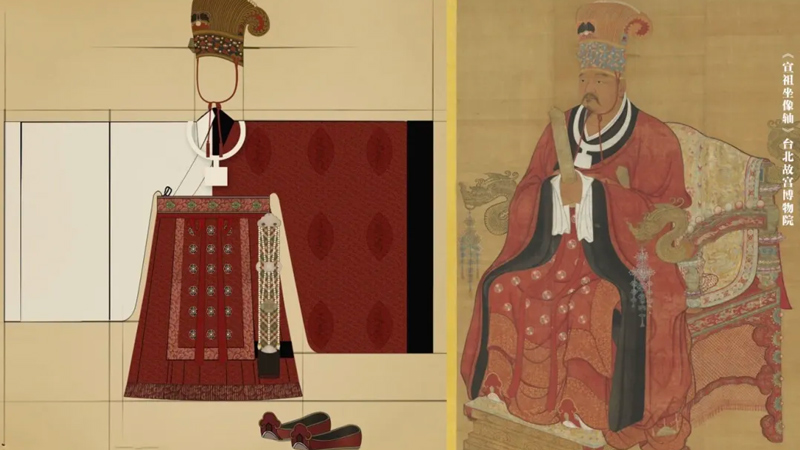
When an official donned this item, he was literally shouldering the connection between heaven and earth. His physical form was framed within this "square and round" structure. It served as a constant, wearable reminder that his role was to serve as a conduit: receiving the mandate from heaven above and executing the emperor's will on earth below. His body became a living vessel for this fundamental political philosophy.
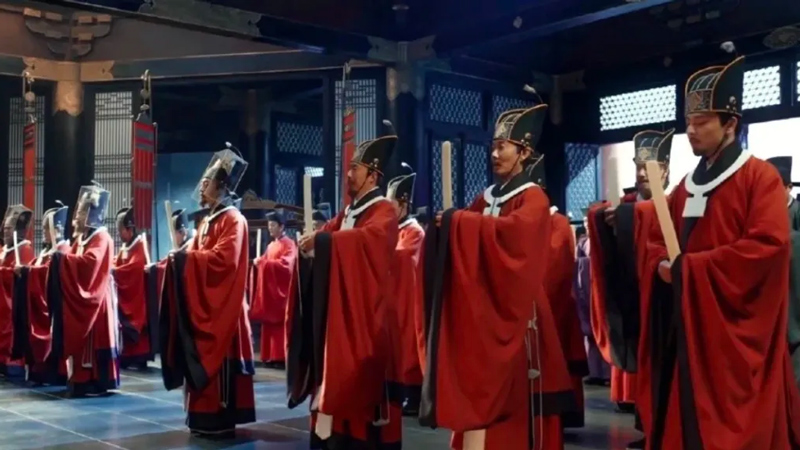
This symbolism was mirrored in the full court regalia. During grand levées, both the emperor and his officials wore similar robes with the Fangxin Quling. Distinctions in rank were made through other elements: the number of tiers on a crown, the type of ornamental panels, or the details of the jade pendants. The common framework reinforced unity, while subtle differences maintained strict hierarchy.
The Discipline of Dress
Beyond symbolism, the Fangxin Quling was a practical tool for bodily control. Crafted from stiff, heavy cloth, its primary function was to "press the collar." Its weight and rigidity ensured all underlying layers of the complex robe lay perfectly flat and smooth. Any unruly crease was considered a breach of ceremonial decorum and an affront to the solemnity of the court.
Its method of wearing contributed to this control. It was an open loop fastened with two ties. After meticulously assembling the many layers of court dress, an official would place it around his neck, adjusting and tying it to a precise tension—secure enough to hold, but not overtly restrictive. This careful balance was key to its function as a behavioral guide.
The device created a direct physical feedback loop. If the wearer moved too abruptly, bowed too deeply, or gestured too wildly, the ties would pull on the square pendant, immediately creating pressure and discomfort against the throat. This sensation served as an instant, corporeal correction, training the official to move with measured, restrained, and "squarely correct" motions. The collar enforced etiquette not just through rules, but through palpable physical sensation.
Ultimately, the Fangxin Quling was much more than an article of clothing. It was a material representation of bureaucratic rank, a wearable diagram of imperial cosmology, and a sophisticated device for physical comportment. In the solemn atmosphere of the Song court, it silently but powerfully articulated a central truth: that in serving the throne, an official's mind, duty, and even his body were not entirely his own.
