
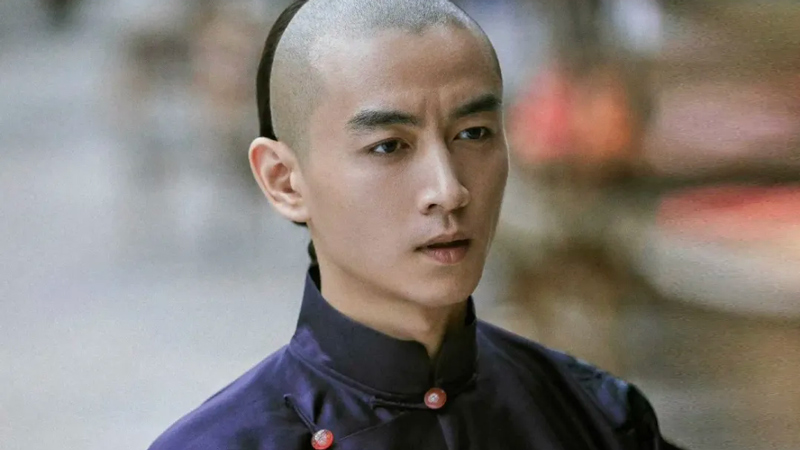
Open any television show or film set during the Qing dynasty, and you’ll see a familiar sight: men with shaved foreheads and long, thick braids of hair down their backs. This style, often called a "queue," has become the universal visual shorthand for the era. From the scheming courtiers in Empresses in the Palace (甄嬛传) to the romanticized princes of Scarlet Heart (步步惊心), the hairstyle is a constant. But this ubiquitous image is a historical fiction, a modern compromise for audience appeal that whitewashes a brutal and symbolic reality.
The iconic "half-shaved" look is actually a late-Qing invention, a far cry from the humiliating and severe hairstyles mandated when the dynasty first seized power.
The "Money Rat Tail"
The true hairstyle of the early Qing was starkly different. Following the Manchu invasion and the establishment of the Qing court, the infamous "Queue Order" was decreed: "Keep your hair and lose your head, or keep your head and lose your hair." The mandated style was the Jinqian Shuwei (金钱鼠尾, "Money Rat Tail"). This involved shaving almost the entire head, leaving only a small patch of hair on the crown, roughly the size of a copper coin. This tiny patch was then braided into a thin, weak plait that had to be slender enough to pass through the center hole of the coin itself, hence the name. It was a look of deliberate denigration and control.
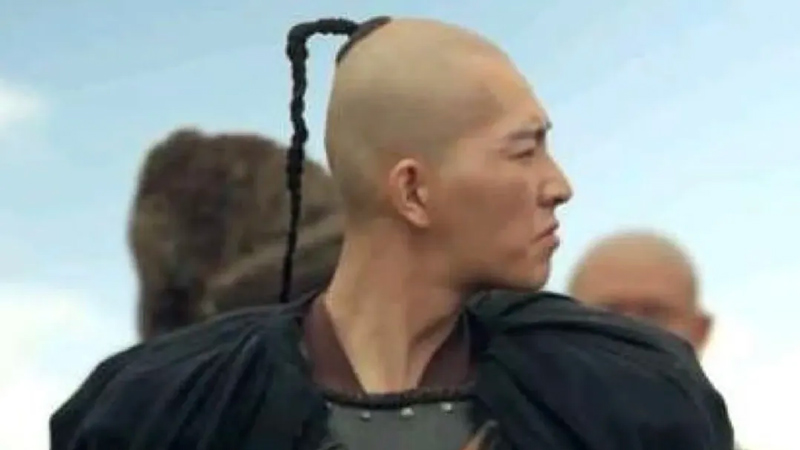
This was the official standard throughout the reigns of emperors like Shunzhi (顺治) and Kangxi (康熙). Historical records, including the Veritable Records of the Qing (清世祖实录), show enforcement was violent and absolute. A commoner named Ding Quan (丁泉) was executed simply because the patch of hair he left was deemed too large, despite local officials pleading for mercy. His family faced punishment for their "inadequate supervision." The hairstyle was a daily, physical manifestation of submission.
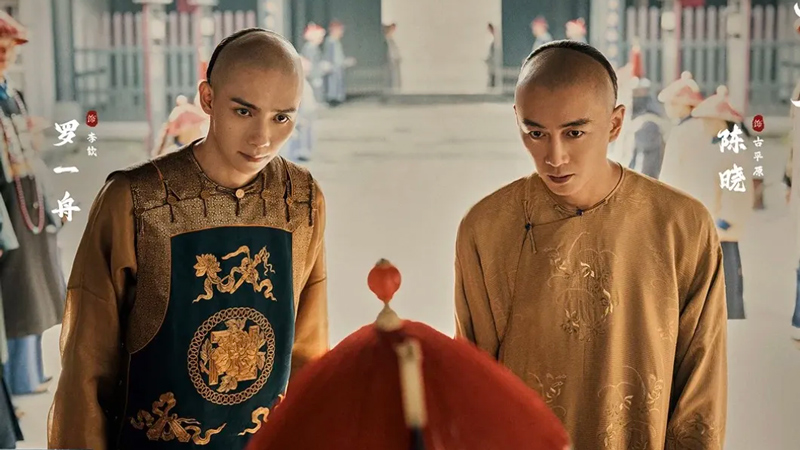
Yet, if we look at dramas set in this precise period, the hairstyle is almost always wrong. Series like Scarlet Heart and Empresses in the Palace, whose stories unfold in the Kangxi and Yongzheng courts, feature characters with the much fuller, later-period queues. The razor-sharp, severe "Money Rat Tail" is deemed too unappealing, too strange for modern audiences accustomed to handsome leads. A recent drama, Legend of the Magnate (大生意人), made a rare attempt at accuracy. The character Xu San (徐三), a military officer, sports the thin, pathetic braid, a visual cue to his status and the era's harsh norms.
Evolution of the Queue
Over centuries, the queue evolved, slowly becoming more substantial. By the mid-Qing dynasty, the shaved area had receded. The allowed patch of hair grew larger, and the resulting braid became thicker and longer, resembling a "pig's tail" more than a rat's. This was not a relaxation of rules but a gradual cultural shift within the conquering Manchu establishment itself. The style remained a non-negotiable identifier of Qing authority over its Han Chinese subjects.
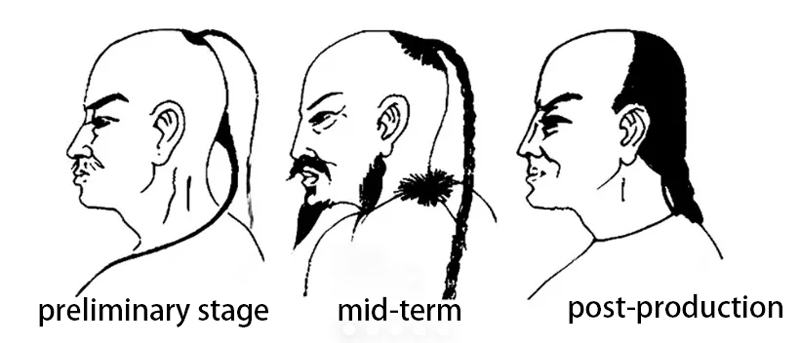
The final evolution is what we recognize today: the "ox tail" or so-called "yin-yang head." By the late 19th century, roughly half the head was shaved from the temples back, with the remaining hair from the crown and back braided into a single, thick, rope-like plait. This is the look seen in dramas about the late Qing, such as those involving the Empress Dowager Cixi. It is this version, dramatically more substantial than its origins, that has been anachronistically applied to dramas set two hundred years earlier.
This evolution reveals a ironic twist. In the early Qing, the smaller the patch of hair, the purer one's Manchu blood and the higher one's status were considered. A sparse "Money Rat Tail" was a mark of elite conformity. By the 1800s, the larger braid was simply the fashion of the time. Modern productions have flipped this symbolism entirely, using the fuller, more visually palatable late-style queue to make characters look more dignified or attractive, a complete reversal of its original meaning.
A Symbol of Humiliation
To understand the deep-seated resentment some hold toward "pigtail dramas," one must grasp what the queue meant for Han Chinese. Confucian philosophy held that "one's body, skin, and hair are received from one's parents," and to preserve them intact was a fundamental filial duty. The forced shearing of the forehead and braiding of the rest was a profound spiritual and cultural violation, a deliberate tactic to break Han identity and ensure loyalty.
Resistance was fierce and bloody. Many chose death over the haircut. Others, like the Ming loyalist scholar Zhang Dai (张岱), fled to remote mountains. He preferred a life of poverty, surviving on wild herbs in the Shen mountains (深山) of Zhejiang, to living under the Qing and submitting to the razor. The queue was never just a hairstyle; it was the most visible stamp of conquest, a walking emblem of defeat worn by every man for nearly three centuries.
This is the heavy history lighthearted palace intrigue dramas gloss over. When modern audiences see a "pigtail," they might think of romance or political conspiracy in a glittering Forbidden City. For a long time, however, it represented a nation's trauma. The consistent aesthetic choice to use the anachronistic, less severe hairstyle is more than a historical inaccuracy; it is a sanitization of a painful past, transforming a symbol of humiliation into a mere period costume accessory. The real "Money Rat Tail" forces us to see the Qing era not through rose-tinted glasses, but as it was: a complex, often brutal, chapter where power was enforced on the very bodies of the people.
