
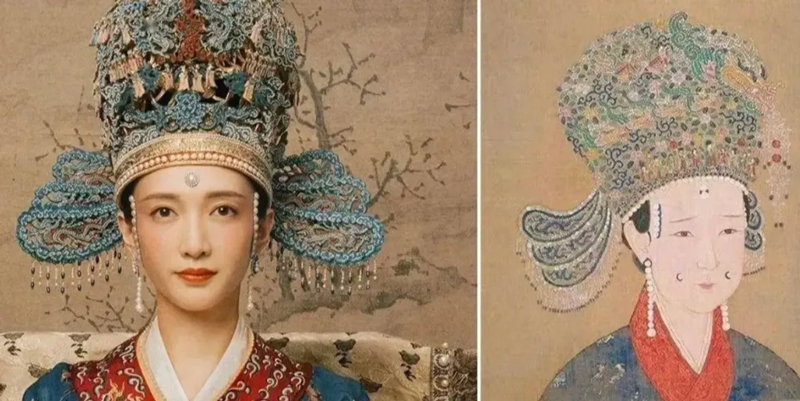
Visitors to the Forbidden City often pause before display cases, puzzled by the pearls adorning ancient artifacts. These pearls are rarely perfectly round; many are oval, lumpy, or asymmetrical. This immediately conflicts with modern expectations, where flawless, spherical pearls symbolize luxury. The immediate assumption might be that historical artisans used inferior materials, but the truth is far more compelling.
These irregular pearls are not evidence of poor quality but are artifacts of a different world—a time when pearls were gifts of nature, not products of controlled cultivation. Their shapes tell a story of rarity, historical technology, and aesthetic values that prized natural form over engineered perfection. This exploration seeks to answer the central question and redefine what we consider "valuable" in historical context.
Wild Pearl Formation
Every irregular pearl in the imperial collection began its life in the wild. Unlike today's farmed gems, historical pearls formed entirely by chance within mollusks like oysters and mussels. When a minute irritant, such as a sand grain, entered the shellfish, the creature's mantle tissue responded by secreting layers of nacre around it. This process, called biomineralization, had no guiding template or fixed nucleus. The nacre deposited unevenly over years, resulting in organic, baroque shapes. This "wild formation" meant that perfectly spherical pearls were extraordinary rarities, akin to finding a naturally flawless diamond.Therefore, the irregular pearls seen on royal hairpins, necklaces, and robes were not settled for but actively sought after, their unique contours serving as a certificate of authentic, natural origin.
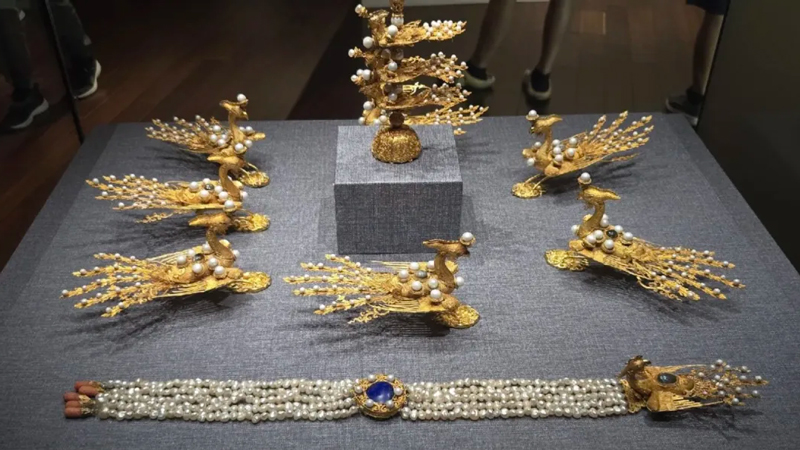
The most prized pearls in ancient China came from specific aquatic regions. Coastal areas like Hepu (合浦) in the South were renowned for producing Nan Zhu (南珠), or Southern Pearls. An old adage, "Xi zhu bu ru Dong zhu, Dong zhu bu ru Nan zhu (西珠不如东珠,东珠不如南珠)," emphasized their superiority over Western and Eastern pearls. These pearls, harvested from the South China Sea, became symbols of supreme status and were strictly controlled by the state.
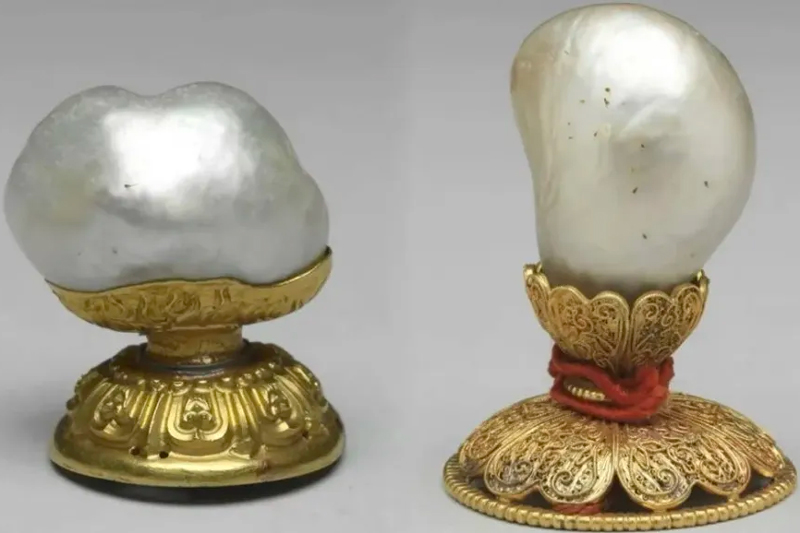
Commoners were forbidden from private harvesting or trade, making possession a royal prerogative. Pearls from freshwater bodies like Dongting Lake (洞庭) and Taihu (太湖) were also collected but generally held less prestige than saltwater gems. The logistical challenge of retrieving these wild pearls, coupled with their inherent scarcity, meant that uniformity was an impossible standard.
Time has also altered the appearance of these ancient pearls. A common Chinese saying, "ren lao zhu huang (人老珠黄)," compares aging people to yellowing pearls. Pearls are composed of delicate layers of calcium carbonate and conchiolin, an organic protein. Over centuries, exposure to light, air, and fluctuating humidity causes this organic matrix to break down. This natural degradation leads to a loss of original luster, resulting in a softer, more muted sheen often described as a "matte texture."
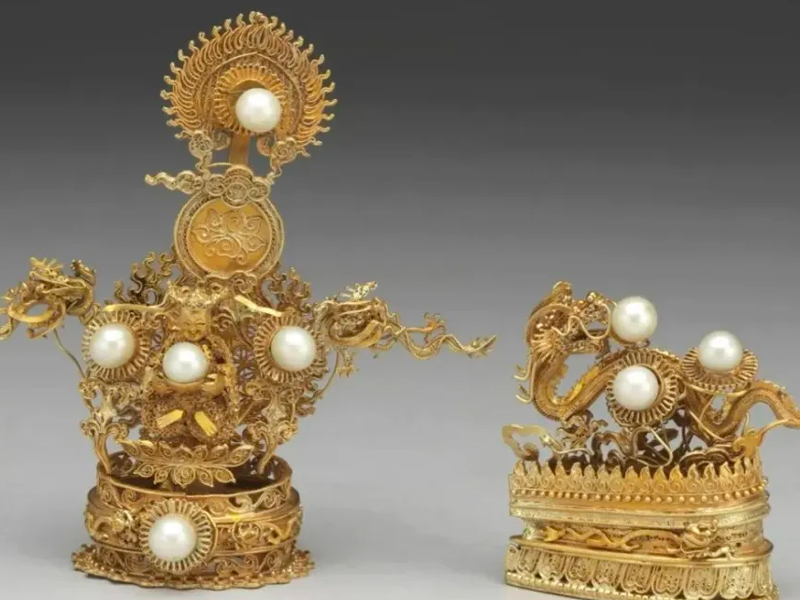
Conservation ethics in museums dictate that this patina of age must be preserved. While modern techniques can polish a pearl to brilliance, restorers of cultural relics intentionally avoid such practices. They aim to maintain every historical layer, meaning the pearls we see today showcase their authentic, centuries-old character, not a renewed shine.
Cultured Pearls and History
The perfect roundness of modern pearls is a triumph of human intervention through cultured pearl farming. The widespread technique involves surgically implanting a round bead nucleus into a mollusk, which then secretes nacre uniformly around this perfect sphere. This method, perfected in the early 20th century, guarantees high yields of consistently shaped pearls. However, the core concept is far older. Historical records indicate that rudimentary pearl cultivation existed in China during the Song Dynasty.
The text Wenchang Miscellaneous Records (文昌杂录) contains references to implanting nuclei into shellfish. Furthermore, a man named Ye Jinyang (叶金扬) from Huzhou (湖州) in the Southern Song period is credited with advancing "attached pearl" technology, where objects were fixed to shells to create blister pearls. This early innovation, known as "yang zhu" (养珠), demonstrates that the pursuit of influencing pearl growth has deep roots.
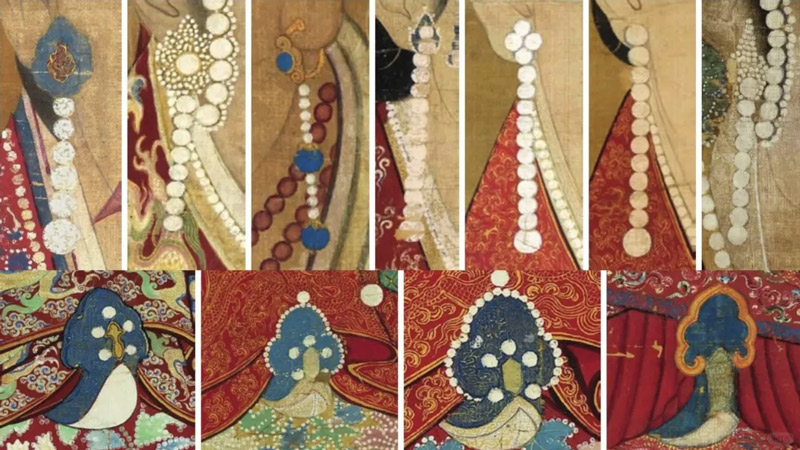
Given this historical knowledge, why did the imperial court continue to favor irregular wild pearls for its most significant artifacts? The answer lies in a profound cultural aesthetic that diverged from industrialized ideals. Ancient Chinese art and philosophy often celebrated the beauty of the natural and unadorned, encapsulated in ideas like "tian ran qu diao zhuo" (天然去雕琢).
Perfect symmetry was sometimes viewed with suspicion, as it could imply artificiality or excessive manipulation—a concept mirrored in the phrase "guo you bu ji" (过犹不及). In this value system, a wild pearl's unique, irregular shape was a mark of its genuine, untamed origin. Consequently, wild pearls commanded higher social and economic value than early cultured ones, solidifying their status as the only fitting decoration for royal and ritual objects.
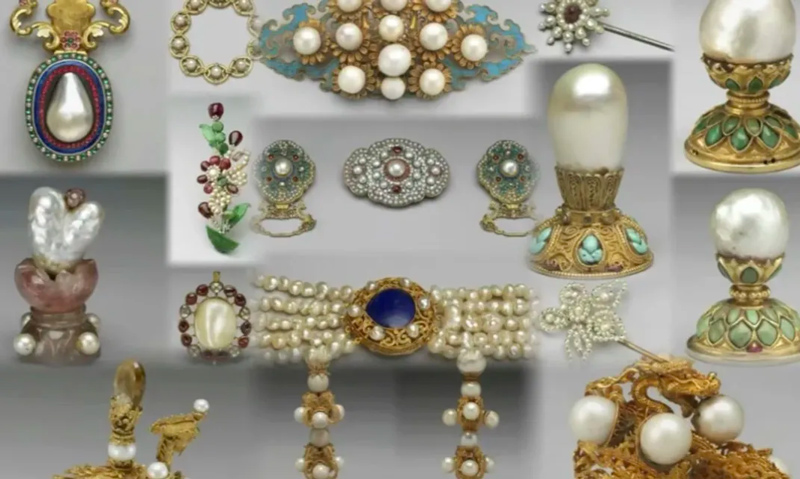
This preference extended to the repair and restoration of heirlooms. When ancient artisans needed to replace a missing pearl on a ceremonial belt or crown, they sourced another wild pearl, even if its shape did not perfectly match its neighbors. This practice ensured visual and material continuity with the artifact's original era. Today, when we look at these pieces, we are seeing a cumulative historical choice—a preference for natural authenticity that persisted across dynasties.
The pearls' irregularity is, therefore, a direct reflection of past values. They challenge contemporary viewers to shift perspective: these are not "poor" pearls but deliberate selections that embody a different standard of beauty, one where nature's artistry was deemed superior to human-engineered uniformity.
